EasyManua.ls Logo

Cessna 210B - Aircraft Description; Engine Controls

Cessna 210B
42 pages
Print Icon
To Next Page IconTo Next Page
To Previous Page IconTo Previous Page
Loading...
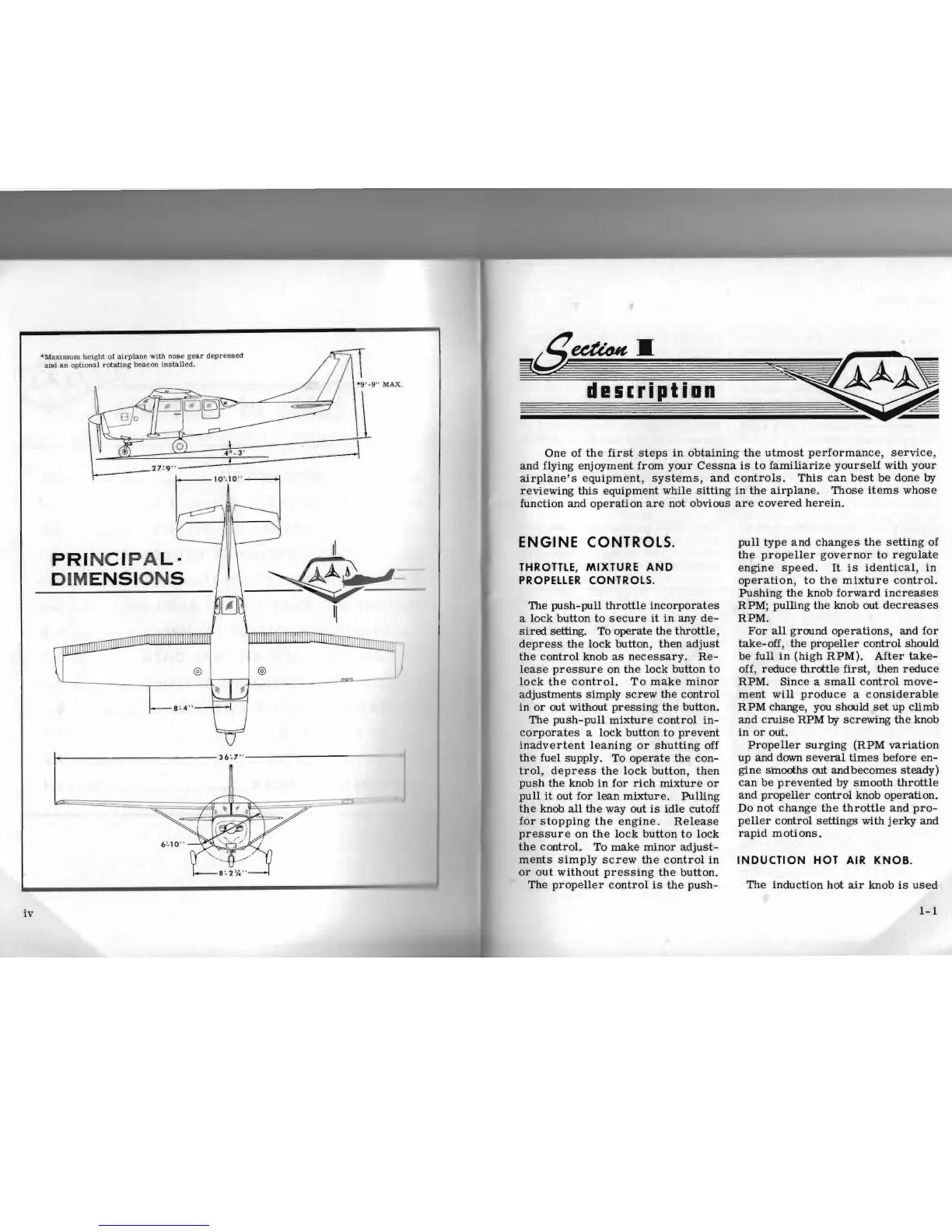
*Ma
...
ximum
h
eig
ht
or
ajrplane
with
n0
5(>
ge
ar
depr
essed
am.l
an
optional
rotating
beacon
install
ed.
1
77\1
PRI
NC
I
PA
L-
D
IM
ENSI
ON
S
'''y
*9'-9"
MAX.
II
~
L
1\
f--------------36'7"--------
--
~=
deSEri
One of
the
first
steps
in
obtaining
the
utmost
performance,
service,
and
flying
enjoyment
from
your
Cessna
is
to
familiarize
yourself
with
your
airplane's
equipment,
systems,
and
controls.
This
can
best
be
done
by
reviewing
this
equipment
while
sitting
in
the
airplane.
Those
items
whose
function and
operation
are
not obvious
are
covered
herein.
ENGINE CONTROLS.
THROTTU,
MIXTURE
AND
PROPELLER
CONTROLS.
The
push-pull
throttle
incorporates
a
lock
button
to
secure
it
in
any
de-
sired
setting. To operate
the
throttle,
depress
the
lock
button,
then
adjust
the
control
knob
as
necessary.
Re-
lease
pressure
on
the
lock
button
to
lock
the
control.
To
make
minor
adjustments
simply
screw
the
control
in
or
out without
pressing
the
button.
The
push-pull
mixture
control
in-
corporates
a
lock
button
to
prevent
inadvertent
leaning
or
shutting
off
the
fuel supply. To
operate
the
con-
trol
,
depress
the
lock
button,
then
push
the
knob
in
for
rich
mixture
or
pull
it
out
for
lean
mixture.
Pulling
the
knob
all
the
way out
is
idle
cutoff
for
stopping
the
engine.
Release
pressure
on
the
lock
button
to
lock
the
control.
To
make
minor
adjust-
ments
simply
screw
the
control
in
or
out
without
preSSing
the
button.
The
propeller
control
is
the
push-
pull
type
and
changes
the
setting
of
the
propeller
governor
to
regulate
engine
speed.
It
is
identical,
in
operation,
to
the
mixture
control.
Pushing
the
knob
forward
increases
RPM;
pulling
the
knob out
decreases
RPM.
For
all
ground
operations,
and
for
take-off
,
the
propeller
control
should
be
full
in
(high
RPM).
After
take-
off, reduce
throttle
first,
then
reduce
RPM.
Since
a
small
control
move-
ment
will
produce
a
considerable
RPM
change, you should
set
up
climb
and
cruise
RPM
by
screwing
the
knob
in
or
out.
Propeller
surging
(RPM
variation
up and down
several
times
before
en-
gine
smooths out and
becomes
steady)
can
be
prevented
by
smooth
throttle
and
propeller
control
knob
operation.
Do
not
change
the
throttle
and
pro-
peller
control
settings
with
jerky
and
rapid
motions.
INDUCTION
HOT
AIR
KNOB
.
The
induction
hot
air
knob
is
used
iv
1-1

Table of Contents

Related product manuals