EasyManua.ls Logo

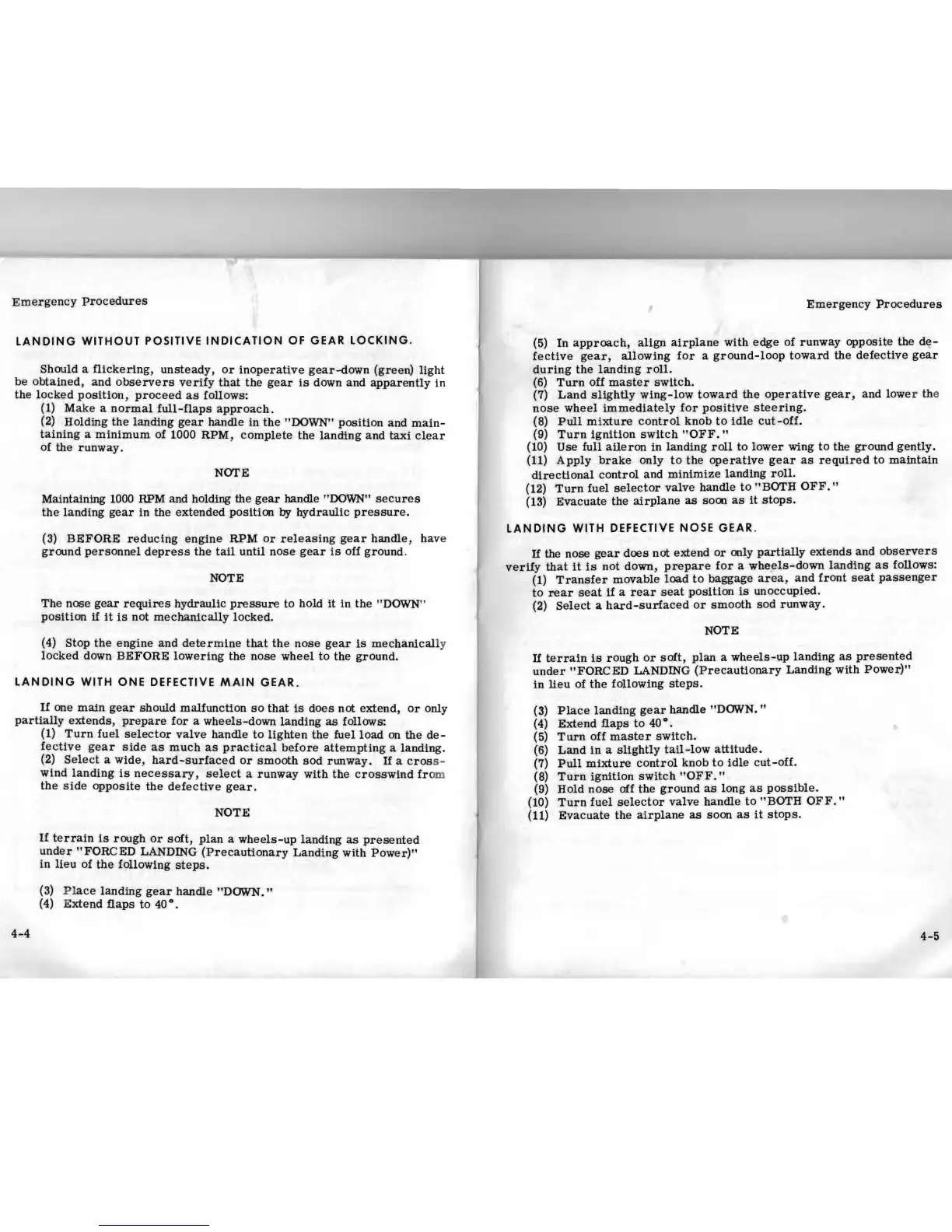
Cessna 210B - Landing Without Positive Indication of Gear Locking; Landing with One Defective Main Gear; Landing with Defective Nose Gear

Cessna 210B
42 pages
Print Icon
To Next Page IconTo Next Page
To Previous Page IconTo Previous Page
Loading...
1-'l.V
Emergency
Procedures
LANDING
WITHOUT
POSITIVE
INDICATION
OF
GEAR
LOCKING.
Should
a
flickering,
unsteady,
or
inoperative
gear-down
(green)
light
be
obtained,
and
observers
verify
that
the
gear
is
down
and
apparently
in
the
locked
position,
proceed
as
follows:
(1)
Make
a
normal
full-flaps
approach.
(2) Holding
the
landing
gear
handle
in
the
"DOWN" pOSition
and
main-
taining
a
minimum
of 1000
RPM,
complete
the
landing
and
taxi
clear
of the
runway.
NOTE
Maintaining 1000 RPM and holding the
gear
handle "DOWN"
secures
the
landing
gear
in
the
extended
position
by
hydraulic
pressure.
(3)
BEFORE
reducing
engine
RPM
or
releasing
gear
handle,
have
ground
personnel
depress
the
tail
until
nose
gear
is
off
ground
.
NOTE
The
nose
gear
requires
hydraulic
pressure
to
hold
it
in
the
"DOWN"
position
if
it
is
not
mechanically
locked.
(4) Stop
the
engine
and
determine
that
the
nose
gear
is
mechanical
ly
locked
down
BEFORE
lowering
the
nose
wheel
to
the
ground.
LANDING
WITH
ONE
DEFECTIVE
MAIN
GEAR.
If
one
main
gear
should
malfunction
so
that
is
does
not
extend,
or
only
partially
extends,
prepare
for
a
wheels-down
landing
as
follows:
(1)
Turn
fuel
selector
valve
handle
to
lighten
the
fuel
load
on the
de-
fective
gear
side
as
much
as
practical
before
attempting
a
landing.
(2)
Select
a Wide,
hard-surfaced
or
smooth
sod
runway.
If
a
cros
s-
wind
landing
is
necessary,
select
a
runway
with
the
crosswind
fr
om
the
side
opposite
the
defective
gear.
NOTE
If
terrain
is
rough
or
soft,
plan
a
wheels-up
landing
as
presented
under
"FORCED
LANDING
(Precautionary
Landing
with
Power)"
in
lieu
of
the
following
steps.
(3) P
lace
landing
gear
handle
"DOWN. "
(4)
Extend
flaps
to
40°.
L....
Emergency
Procedures
(5)
In
approach,
align
airplane
with
edge
of
runway
oppOSite the
de-
fective
gear,
allowing
for
a
ground-loop
toward
the
defective
gear
during
the
landing
roll.
(6)
Turn
off
master
switch.
(7)
Land
slightly
wing-low
toward
the
operative
gear,
and
lower
th
e
nose
wheel
immediately
for
positive
steering.
(8)
Pull
mixture
control
knob
to
idle
cut-off.
(9)
Turn
ignition
switch
"OFF.
"
(10) Use
full
aileron
in
landing
roll
to
lower
wing
to
the
ground
gently.
(11)
Apply
brake
only
to
the
operative
gear
as
required
to
maintain
directional
control
and
minimize
landing
roll.
(12)
Turn
fuel
selector
valve
handle
to
"BOTH
OFF."
(13)
Evacuate
the
airplane
as
soon
as
it
stops.
LAN
DING
WITH
DEFECTIVE
NOSE
GEAR.
If
the nose
gear
does
not
extend
or
only
partially
extends
and
observers
verify
that
it
is
not
down,
prepare
for
a
wheels-down
landing
as
follows:
(1)
Transfer
movable
load
to
baggage
area,
and
front
seat
passenger
to
rear
seat
if
a
rear
seat
position
is
unoccupied.
(2)
Select
a
hard-surfaced
or
smooth
sod
runway.
NOTE
If
terrain
is
rough
or
soft,
plan
a
wheels-up
landing
as
presented
under
"FORCED
LANDING
(Precautionary
Landing
with
Power)"
in
lieu
of
the
following
steps.
(3)
Place
landing
gear
handle
"DOWN. "
(4)
Extend
flaps
to
40°.
(5)
Turn
off
master
switch.
(6)
Land
in
a
slightly
tail-low
attitude.
(7)
Pull
mixture
control
knob
to
idle
cut-off.
(8)
Turn
ignition
switch
"OFF.
"
(9)
Hold
nose
off
the
ground
as
long
as
possible.
(10)
Turn
fuel
selector
valve
handle
to
"BOTH
OFF."
(11)
Evacuate
the
airplane
as
soon
as
it
stops.
4-4
4-5

Table of Contents

Related product manuals