EasyManua.ls Logo

Cessna 210B - Engine Systems and Instruments; Ignition-Starter Switch; Engine Instruments; Fuel System

Cessna 210B
42 pages
Print Icon
To Next Page IconTo Next Page
To Previous Page IconTo Previous Page
Loading...
Description
to
select
either
filtered
cold
air
from
the
induction
air
scoop
or
heated
air
from
the
right
exhaust
manifold.
In
the
unlikely
event
that
ice
should
form
in
the
induction
system,
as
evidenced
by an
unexplained
drop
in
manifold
pressure,
pull
the
induc-
tion
hot
air
knob full out. Do not
use
an
intermediate
position.
IGNITION-ST
ARTER
SWITCH.
The
combination
starter
and
igni-
tion
switch
is
key-operated.
When
the
key
is
turned
to
the
extreme
clockwise
"
START-PUSH"
position,
the
right
magneto
is
inoperative
and
a
series
of
high-voltage,
retarded
a
starting
vibrator
used
in
conjunc-
tion
with
the
left
magneto.
Pushing
in on
the
key,
while
holding
it
in
th
e
extreme
clockwise
position,
engage
s
the
starter.
When
the
key
is
releas
ed
from
the
"START-PUSH"
positio
n,
it
automatically
returns
to
"BO
TH
. "
Refer
to
page
3-9
for
discussion
0
the
use
of
the
ignition-starter
switch
during
hand-cranking.
ENGINE
INSTRUMEN
TS.
FUEL
flOW
INDICATOR.
The
fuel
flow
indicator
use
d willi
the
Continental
fuel
injecti
on
sy!
tem
is
a
fuel
pressure
gage
ca
ll
sparks
are
furnished
for
starting
by
brated
to
indicate
the
app
ro
x
in
lil
li
MINIMUM
OPERATING
A
FUEl
PRESSURE
\
NORMAL
~III~
i~~~~
FU
EL
FLOW
SET
TING
/
\\46~~
I
/o
15
P5I
10
\,
CRUISE 12
FUEl
POWER
14
~-
flOW
=-\\
\
GAL.
/
HR
.
FUL~000i61'
8~~0
\
POWER
I
,
.
~
a
.
.ooo~
-
t:
18
'-IL
;z
"-
S.
l.
........
.000
~
Q
15 .15 PSI
20'
~
~
FT
~;:
2~
\
,';/
,,0':::
,,_
I
~
\
....
~"\SE"
~
~
--=\
-
LEVEL
v~
~
.;:-
i-\~
TAKE-OFF
t<'o'"
AND
CLIMB
POWER
RANGE
FUEl
gallons
per
hour
of
fuel being
metered
to
the
engine.
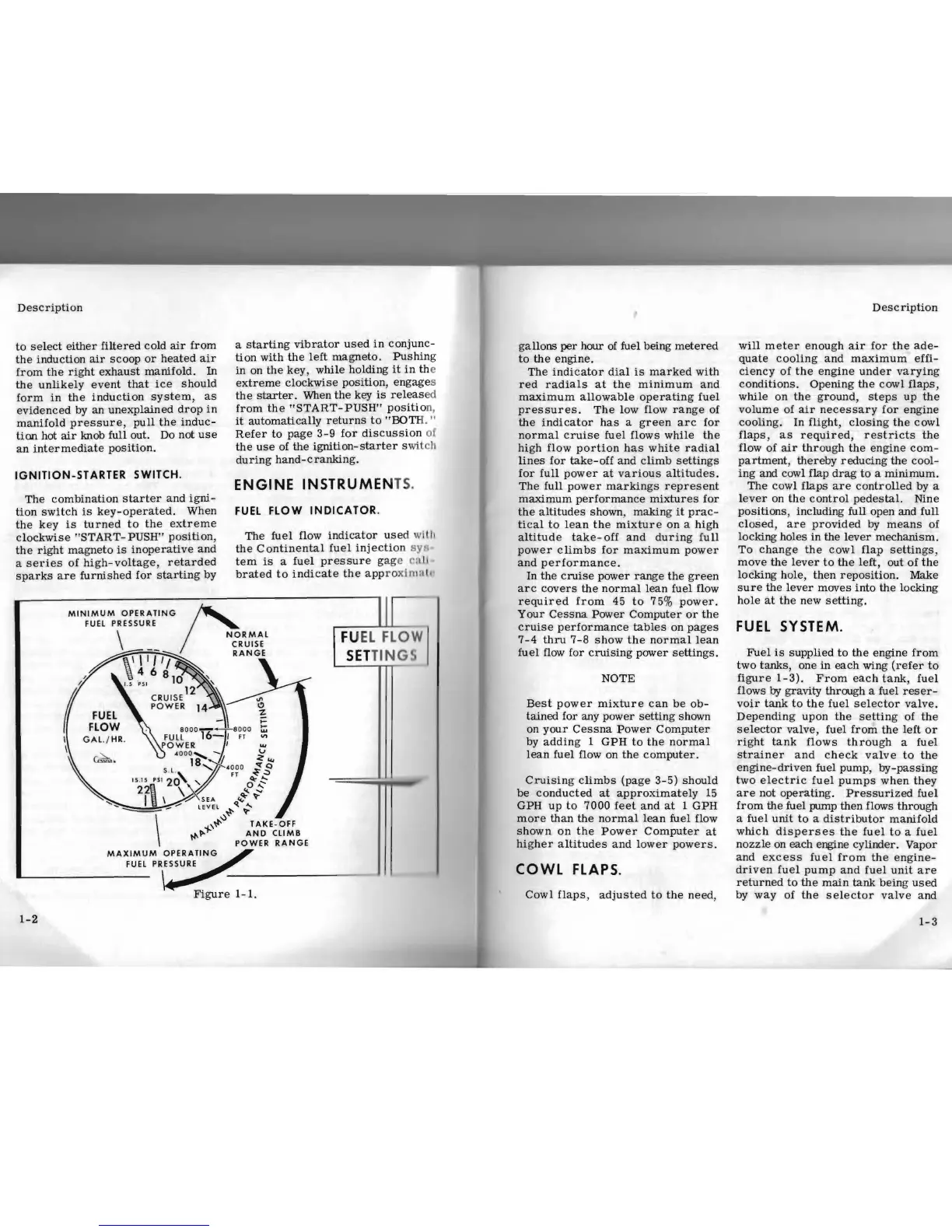
The
indicator
dial
is
marked
with
red
radials
at
the
minimum
and
maximum
allowable
operating
fuel
pressures.
The
low flow
range
of
the
indicator
has
a
green
arc
for
normal
cruise
fuel
flows
while
the
high
flow
portion
has
white
radial
lines
for
take-off
and
climb
settings
for
full
power
at
various
altitudes.
The
full
power
markings
represent
maximum
performance
mixtures
for
the
altitudes
shown,
making
it
prac-
tical
to
lean
the
mixture
on
a
high
altitude
take-
off
and
during
full
power
climbs
for
maximum
power
and
performance.
In the
cruise
power
range
the
green
arc
covers
the
normal
lean
fuel flow
required
from
45
to
75%
power.
Your
Cessna
Power
Computer
or
the
cruise
performance
tables
on
pages
7-4
thru
7-8
show
the
normal
lean
fuel
flow for
cruising
power
settings.
NOTE
Best
power
mixture
can
be
ob-
tained for any power
setting
shown
on you.r
Cessna
Power
Computer
by
adding
1
GPH
to
the
normal
lean
fuel flow on
the
computer.
Cruising
climbs
(page
3-5)
should
be
conducted
at
approximately
15
GPH
up
to
7000
feet
and
at
1
GPH
more
than
the
normal
lean
fuel flow
shown
on
the
Power
Computer
at
higher
altitudes
and
lower
powers.
COWL
FLAPS.
Cowl
flaps
,
adjusted
to
the
need
,
Description
will
meter
enough
air
for
the
ade-
quate
cooling
and
maximum
effi-
ciency
of
the
engine
under
varying
conditions.
Opening
the
cowl
flaps,
while
on
the
ground,
steps
up
the
volume
of
air
necessary
for
engine
cooling.
In
flight
,
closing
the
cowl
flaps
,
as
required,
restricts
the
flow of
air
through
the
engine
com-
partment,
thereby
redUCing the
cool-
ing
and
cowl flap
drag
to
a
minimum.
The
cowl
flaps
are
controlled
by a
lever
on
the
control
pedestal.
Nine
pOSitions, including full open and full
closed,
are
provided
by
means
of
lOCking holes in the
lever
mechanism.
To
change
the
cowl
flap
settings
,
move
the
lever
to
the
left,
out
of
the
locking hole,
then
reposition.
Make
sure
the
lever
moves
into
the
locking
hole
at
the
new
setting.
FUEL
SYSTEM.
Fuel
is
supplied
to
the
engine
from
two
tanks,
one in
each
wing
(refer
to
figure
1-
3).
From
each
tank,
fuel
flows by gravity through a fuel
reser-
voir
tank
to
the
fuel
selector
valve.
Depending
upon
the
setting
of
the
selector
valve,
fuel
from
the
left
or
right
tank
flows
through
a
fuel
strainer
and
check
valve
to
the
engine-driven
fuel pump,
by-passing
two
electric
fuel
pumps
when
they
are
not
operating.
Pressurized
fuel
from
the
fuel pump
then
flows through
a
fuel
unit
to
a
distributor
manifold
which
disperses
the
fuel
to
a
fuel
nozzle
on each engine cylinder. Vapor
and
excess
fuel
from
the
engine-
driven
fuel
pump
and
fuel
unit
are
returned
to
the
main
tank
being
used
by
way
of
the
selector
valve
and
1-2
1-3

Table of Contents

Related product manuals