EasyManua.ls Logo

Cessna 210B - Care of the Airplane

Cessna 210B
42 pages
Print Icon
To Next Page IconTo Next Page
To Previous Page IconTo Previous Page
Loading...
Operating
Limitations
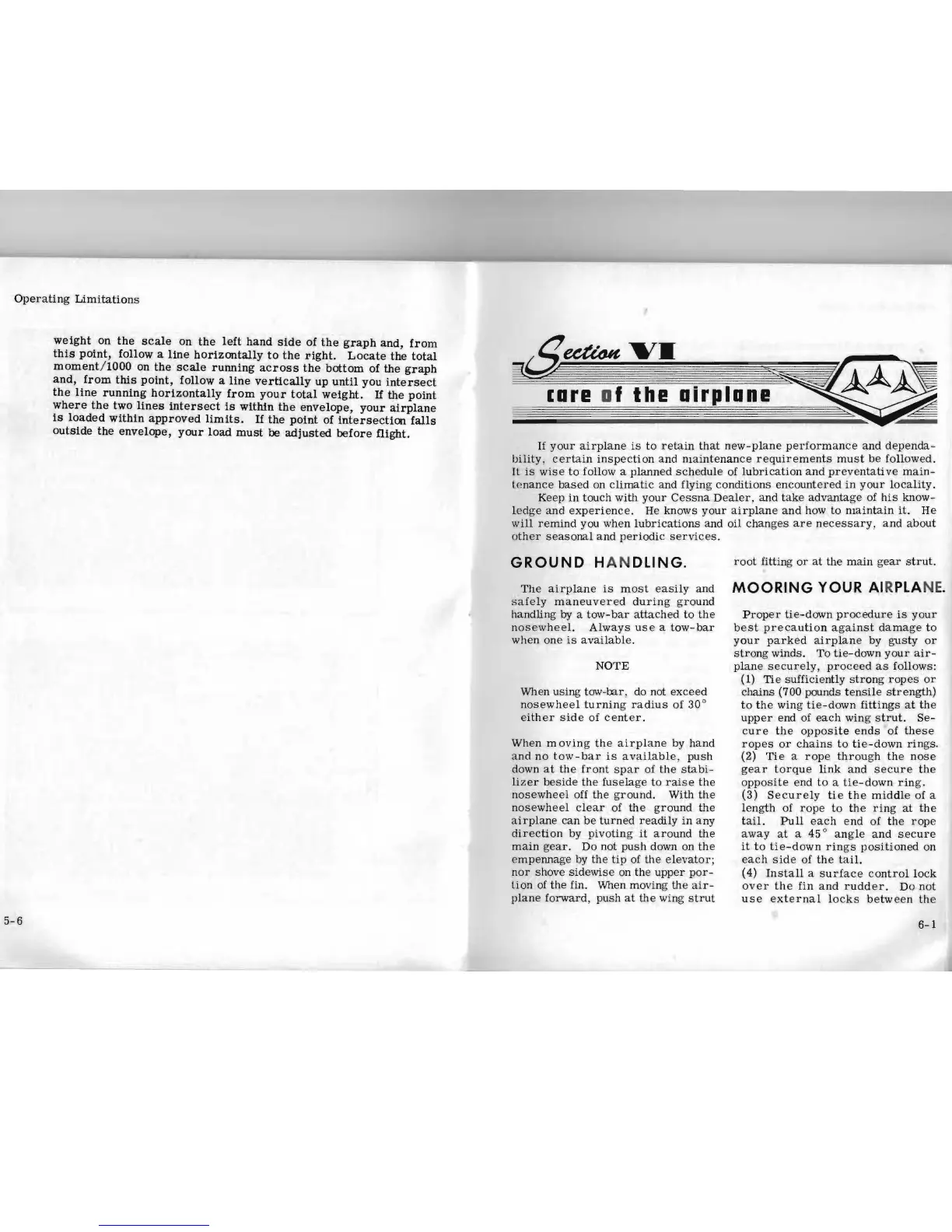
weight
on
the
scale
on
the
left
hand
side
of
the
graph
and,
from
this
paint,
follow
a
line
horizontally
to
the
right.
Locate
the
total
moment/lOOO
on
the
scale
running
across
the
bottom
of
the
graph
and,
from
this
paint,
follow
a
line
vertically
up
until
you
intersect
the
line
running
horizontally
from
your
total
weight.
If
the
point
where
the
two
lines
intersect
is
within
the
envelope,
your
airplane
is
loaded
within
approved
limits.
If
the
point
of
intersection
falls
outside
the
envelope,
your
load
must
be
adjusted
before
flight.
VI
Eare
af the
air
If
your
airplane
is
to
retain
that
new-plane
performance
and
dependa-
bility
,
certain
inspection
and
maintenance
requirements
must
be
followed.
It
is
wise
to
follow a
planned
schedule
of
lubrication
and
preventati
ve
main-
tenance
based
on
climatic
and
flying
conditions
encountered
in
your
locality
.
Keep
in
touch with
your
Cessna
Dealer,
and
take
advantage
of I
his
know-
ledge
and
experience.
He
knows
your
airplane
and
how
to
maintain
it.
He
will
remind
you when
lubrications
and
oil
changes
are
necessary,
and
about
other
seasonal
and
periodic
services.
GROUND
H
AN
DLING.
The
airplane
is
most
easHy
and
safely
maneuvered
during
ground
handling by a
tow-bar
attached
to
the
nosewheel.
Always
use
a
tow-bar
when
one
is
available
.
NOTE
When using
tow-tar
, do not
exceed
nosewheel
turning
radius
of
30
0
either
side
of
center.
When
moving
the
airplane
by
hand
and
no
tow-bar
is
available,
push
down
at
the
front
spar
of
the
stabi-
lizer
beside
the
fuselage
to
raise
the
nosewheel
off
the
ground.
With
the
nosewheel
clear
of
the
ground
the
airplane
can
be
turned
readily
in
any
direction
by
pivoting
it
around
the
main
gear.
Do not
push
down on
the
empelUlage by
the
tip
of
the
elevator;
nor
shove
sidewise
on
the
upper
por-
tion
of
the
fin. When moving
the
air-
plane
forward,
push
at
the
wing
strut
root
fitting
or
at
the
main
gear
strut.
MOORING
YOUR
AI
R
PLA
N
E.
Proper
tie-down
procedure
is
your
best
precaution
against
damage
to
your
parked
airplane
by
gusty
or
strong
winds. To
tie-down
your
air-
plane
securely,
proceed
as
follows:
(1)
Tie
suffiCiently
strong
ropes
or
chains
(700 pounds
tensile
strength)
to
the
wing
tie-down
fittings
at
the
upper
end of
each
wing
strut.
Se-
cure
the
opposite
ends
of
these
ropes
or
chains
to
tie-down
rings.
(2)
Tie
a
rope
through
the
nose
gear
torque
link
and
secure
the
opposite
end
to
a
tie-down
ring.
(3)
Securely
tie
the
middle
of a
length
of
rope
to
the
ring
at
the
tail.
Pull
each
end
of
the
rope
away
at
a
angle
and
secure
45
0
it
to
tie-down
rings
positioned
on
each
side
of
the
tail.
(4)
Install
a
surface
control
lock
over
the
fin
and
rudder.
Do
not
use
external
lOCks
between
the
5-6
6-1

Table of Contents

Related product manuals