EasyManua.ls Logo

Cessna 210B - Read before Working Loading Problem; Section V - Operating Limitations; Engine Instrument Markings; Engine Operation Limitations

Cessna 210B
42 pages
Print Icon
To Next Page IconTo Next Page
To Previous Page IconTo Previous Page
Loading...
Operating
Limitations
......
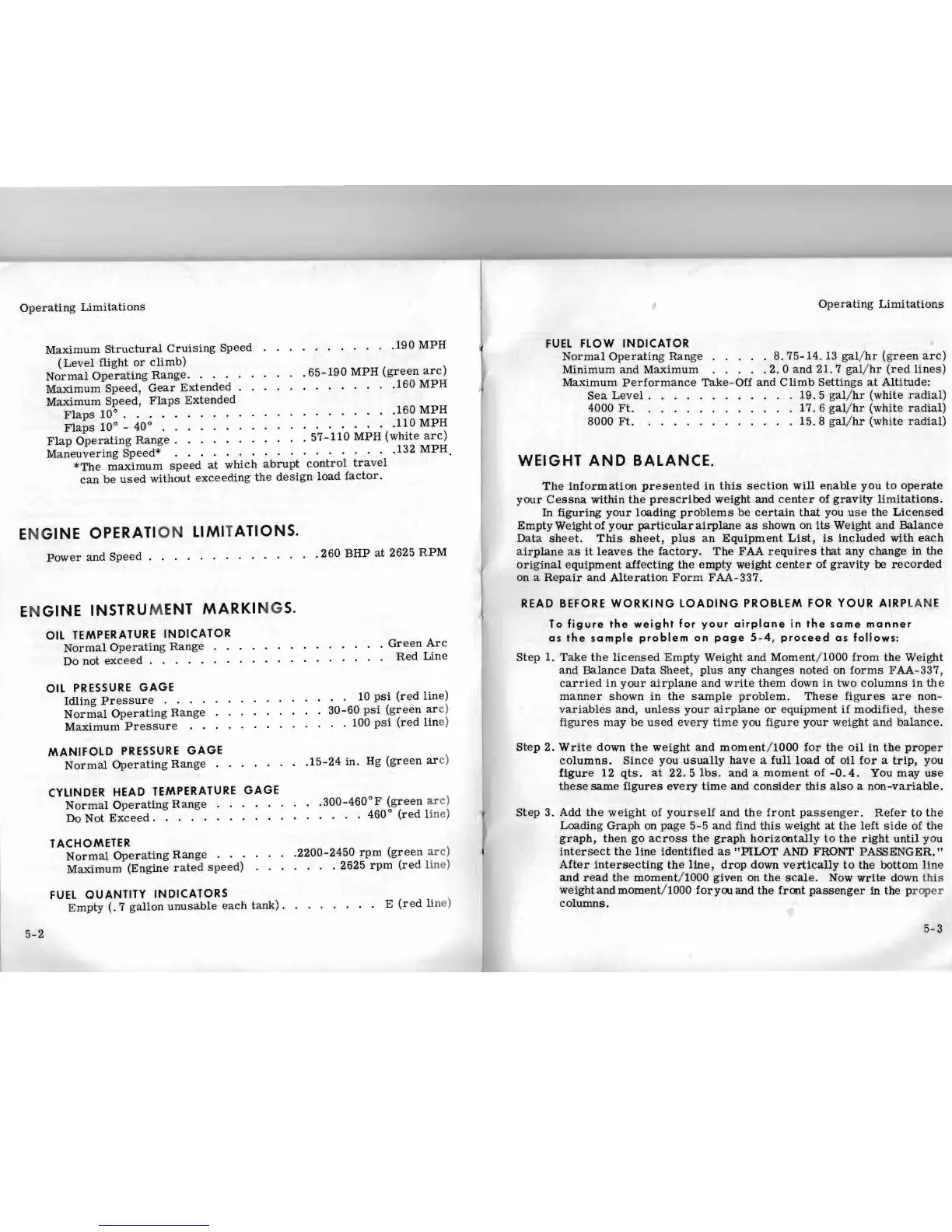
. . 190
MPH
Maximum
Structural
Cruising
Speed
(Le
v
el
flight
or
climb)
.65-190
MPH
(green
arc)
Normal
Op
e
rating
Range
.....
.160
MPH
Maximum
Speed,
Gear
Extended
.
Maximum
Speed,
Flaps
Extended
Flaps
10°.
. . . . .
.....
. . 160
MPH
Flaps
10° _ 40° . . .
..
.
....
110
MPH
Flap
Operating
Range.
.57-110
MPH
(white
arc)
Maneuvering
Speed* . . . . . . . .132
MPH
*
The
maximum
speed
at
which
abrupt
control
travel
can
be
used
without
exceeding
the
design
load
factor.
EN
GINE
OPERATI
ON
LIM
IT
ATIONS.
Power
and
Speed.
. .
...
.
.......
260
BHP
at
2625
RPM
EN
GINE
INSTRUM ENT
MARKI
NG
S.
OIL
TEMPERATURE INDICATOR
.
Green
Arc
Normal
Operating
Range
Red
Line
Do not
exceed
. . . . . . .
OIL
PRESSURE GAGE
· . 10
psi
(red
line)
Idling
Pressure
. .
30-60
psi
(green
ar
c)
Normal
Operating
Range
· . 100
psi
(red
lin
e)
Maximum
Pressure
MANIFOLD PRESSURE
GAG
'E
.15-24
in.
Hg
(green
ar
c)
Normal
Operating
Range
. .
CYLINDER
HEAD
TEMPERATURE GAGE
.300-460°F
(green
a
rc)
Normal
Operating
Range
. . . . 460°
(red
l
ine
)
Do Not
Exceed.
. . . . . . . . . .
TACHOMETER
.2200-2450
rpm
(gre
en
arc)
Normal
Operating
Range
Maximum
(Engine
rated
speed)
2625
rpm
(re
d
lin
e) ·
FUEl QUANTITY INDICATORS
Empty
(.7
gallon
unusable
each
tank)
.
· . . . E
(red
line)
Operating
Limitations
FUEl
HOW
INDICATOR
Normal
Operating
Ran
ge
.
....
8.75
-
14.13
gal/hI'
(g
reen
arc)
Minimum
and
Maximum
. . . .
.2.0
and
21. 7
ga
l/
hI'
(red
lines)
Maximum
Performance
Take
- Off
and
Climb
Settings
at
Altitude:
Sea
Level.
19.5
ga
l/
hI' (white
radial)
4000
Ft.
17. 6
ga
l/
hI' (white
radial)
8000
Ft.
. . . . . . . . . . . .
15.8
g
al
/ hI' (white
radial)
WEIGHT
AND
BALANCE.
The
information
presented
in
this
section
will
enable
you
to
operate
your
Cessna
within
the
prescribed
weight
and
center
of
gravity
limitations.
In
figuring
your
loading
problems
be
certain
that
you
use
the
Licensed
Empty
Weight
of
your
particular
airplane
as
shown on
its
Weight
and
Balance
Data
sheet.
This
sheet,
plus
an
Equipment
List,
is
included
with
each
airplane
as
it
leaves
the
factory.
The
FAA
requires
that
any
change
in
the
original
equipment
affecting
the
empty
weight
center
of
gravity
be
recorded
on a
Repair
and
Alteration
Form
FAA-337.
READ BEFORE
WORKING
LOADING
PROBLEM FOR YOUR AIRP LANE
To
figure
the
weight
for
your
airplane
in
the
same
manner
as
the
sample
problem
on
page
5-4
,
proceed
as
follows:
Step
1.
Take
the
licensed
Empty
Weight
and
Moment
/
lOOO
from
the
Weight
and
Balance
Data
Sheet
,
plus
any
changes
noted on
forms
FAA-337
,
carried
in
your
airplane
and
write
them
down
in
two
columns
in
the
manner
shown
in
the
sample
problem.
These
figures
are
non-
variables
and,
unless
your
airplane
or
equipment
if
modified
,
these
figures
may
be
used
every
time
you
figure
your
weight
and
balance.
Step
2.
Write
down
the
weight
and
moment
/
lOOO
for
the
oil
in
the
proper
columns.
Since
you
usually
have
a
full
load
of
oil
for
a
trip,
you
figure
12
qts.
at
22.5
lbs.
and
a
moment
of
-0.4.
You
may
use
these
same
figures
every
time
and
consider
this
also
a
non-variable.
Step
3. Add
the
weight
of
yourself
and
the
front
passenger.
Refer
to
the
Loading
Graph
on
page
5-5
and
find
this
weight
at
the
left
side
of
the
graph,
then
go
across
the
graph
horizontally
to
the
right
until
you
intersect
the
line
identified
as
"PILOT
AND FRONT
PASSENGER."
After
intersecting
the
line
,
drop
down
vertically
to
the
bottom
line
and
read
the
moment
/
lOOO
given
on
the
scale.
Now
write
down
th
is
weight
and
moment
/ 1000
foryOJ
and
the
front
passenger
in the p
rop
er
columns.
5-2
5-
3

Table of Contents

Related product manuals