25
4.2.3 INSPECTING THE CATALYTIC CONVERTER
The catalyst is the primary air duct between the incineration chamber
and the appliance ue terminal. Any accumulations of particles in the
catalytic converter will reduce the ow rate and the toilet eciency. It is
therefore important to ensure that the catalytic converter is open at all
times. Any changes in incineration time and/or incineration eciency
may be due to dense catalytic conversion. The best method to easily
clean the catalyst is to perform “steam cleaning” as described in section
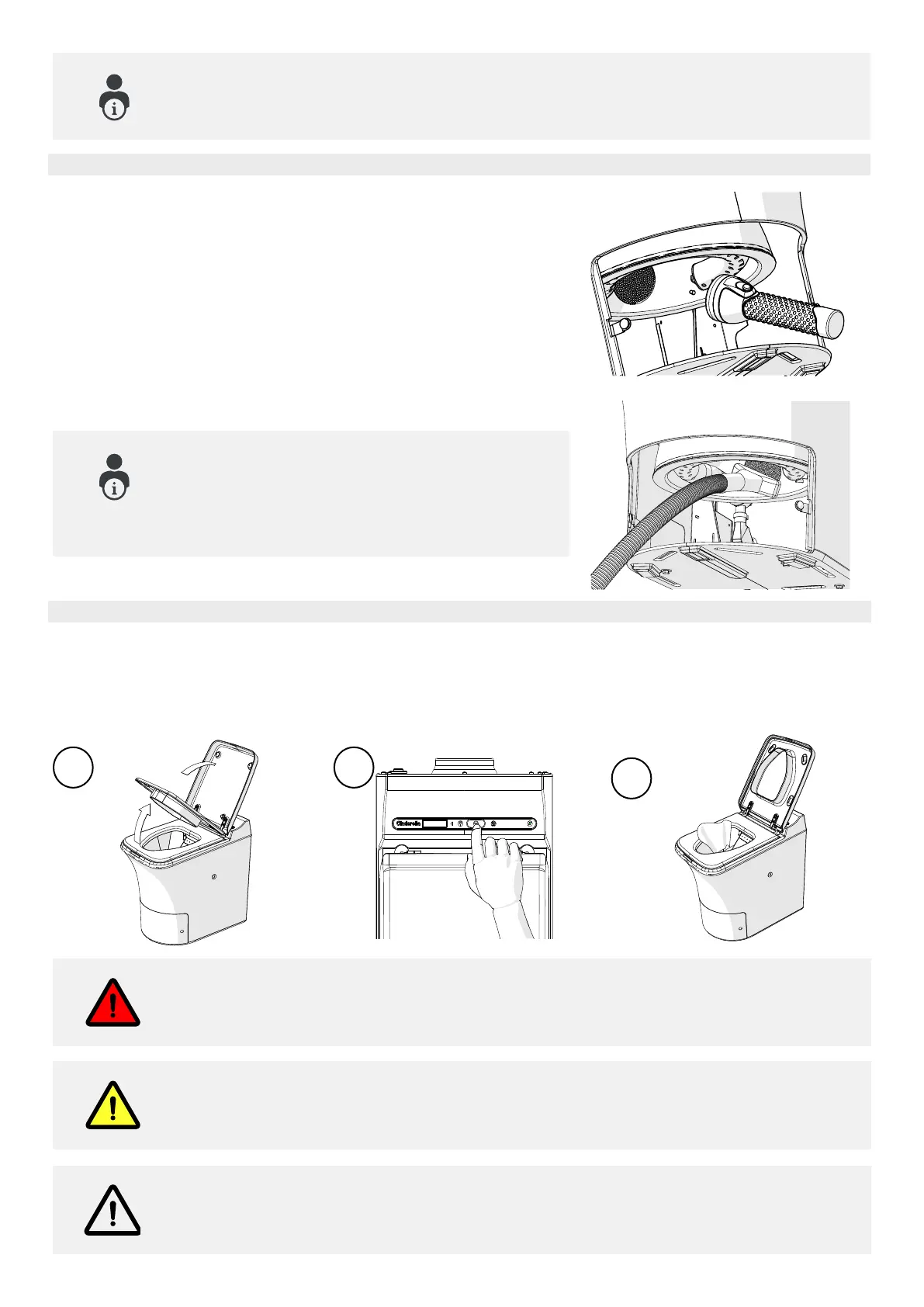
4.2.2. You can also inspect the front of the catalyst by removing the ash
container and illuminating the combustion chamber from the inside.
Any particles and accumulations can be removed using a vacuum
cleaner.
NOTE!
Do not use the toilet during the maintenance procedure, as this will impair the function of
the cleaning. The toilet can be used when the toilet returns to standby mode.
NOTE!
Clear signs of corrosion or deformity of the catalytic
converter will indicate that the catalytic converter
must be replaced. Contact your local service
provider to arrange for service.
4.2.4 CLEANING THE BOWL
Recommended frequency: as required for cleanliness and when emptying the ash container.
To clean the bowl:
1. Open the toilet lid.
2. Press and hold the Start button for three seconds to open the hatch to the washing position.
3. Use moist paper, water and a mild cleaning agent as required. Close the lid and start the incineration
1 2
3
WARNING!
Do not use ammable cleaning agents to clean the bowl. Make sure that the toilet is cooled
and in standby mode.
CAUTION!
Some metal edges may be sharp
NB!
Do not use chlorine-based cleaning agents to clean the bowl. Chlorine is extremely harmful
for the catalytic converter and if put into the toilet it may cause the catalyst to malfunction.


 To Next Page