0 – 11
5. NAME PLATE
5.3 Name plate
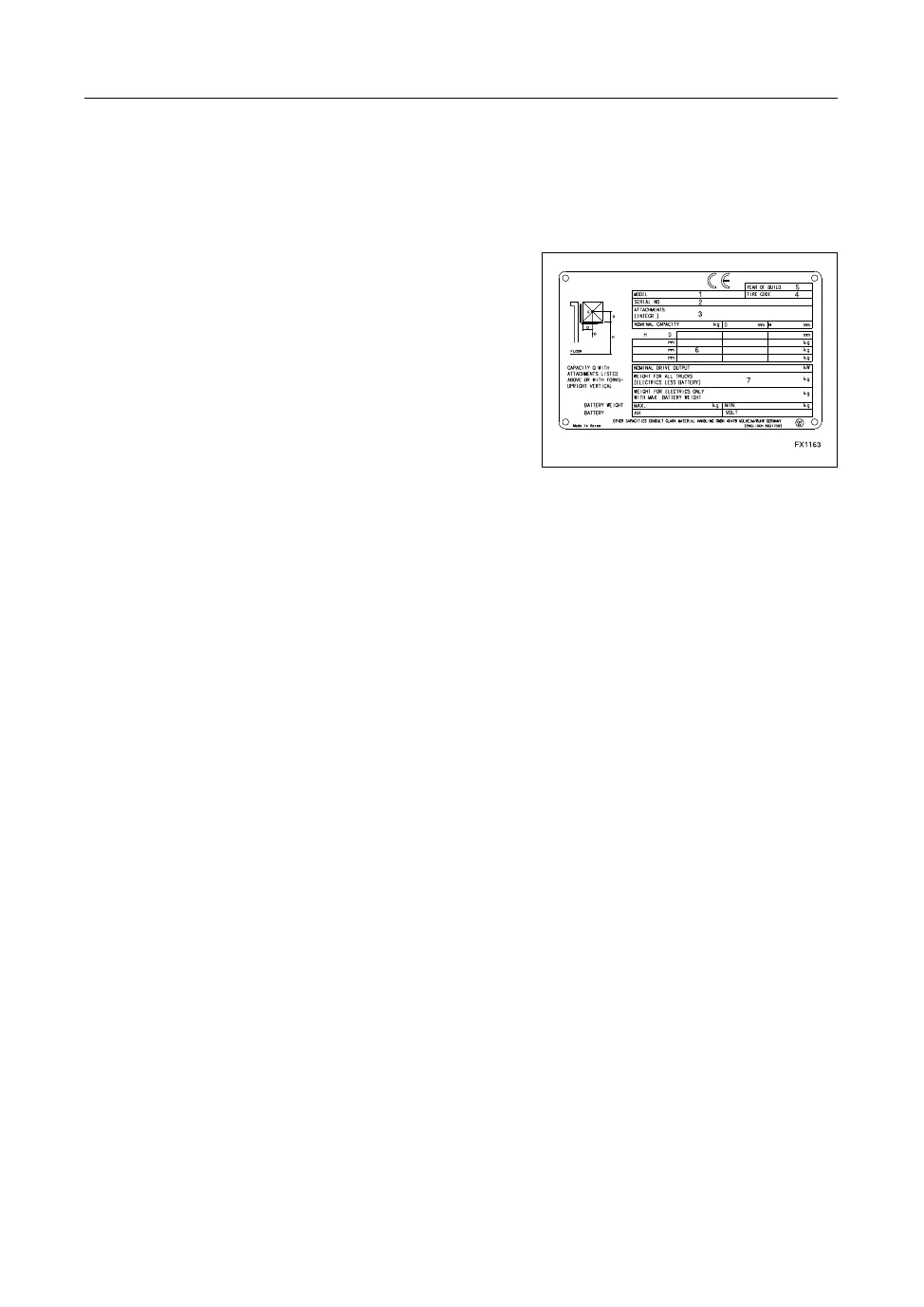
What you should know about your forklift-truck:
1. The location of the model name.
2. The location of the serial number.
3. The description of the additional
attachments (if any). Take note of the
additional capacity load plate.
4. Which tire type (dimension, ply-rating)
to be used.
The type of tire (pneumatic/elastic)
influences the static stability of the
forklift-truck.
For this reason only the tire types approved by the manufacturer may be used.
Column 4 shows the tire types which are approved by the manufacturer.
Tire code:
E = cushion
L = pneumatic
S = super elastic
Z = twin tires
R = radial
5. The year of build.
6. The capacity of the forklift-truck with forks.
In this space the capacity, the load centre and the lift height are stated. The
specified maximum values must not be exceeded.
Attention:
For additional attachments there must be mounted an additional load capacity
plate beside the type plate, which gives the permissible load capacity of your
forklift-truck for a CENTRAL LOAD in conjunction with additional attachments.
These load capacities must not be exceeded.
The subsequent mounting (not supplied by the manufacturer) of one or more
additional attachments requires immediate mounting of a new capacity plate for
the combination forklift-truck /additional attachments. The customer must obtain
this from the manufacturer or local dealer.
7. The forklift-truck weight less battery.
A damaged type plate or capacity plate must to be replaced.


 To Next Page