Tranquility
®
Digital (DXM2)—Troubleshooting Guide
Rev.: 10 March, 2015
16
Geothermal Heating and Cooling
An Alternative Way of Checking Compressors
A-D
Megohm Values of Copeland Compressors
For years servicemen have used megohmeters to evaluate
compressor motor windings. However, most megohmeter
manufacturers publish guidelines that apply to open motors.
For this reason, Emerson Climate Technologies has
investigated the use of megohmeters on hermetic and semi-
hermetic compressors.
When using megohmeters to evaluate the motor insulation
of compressors, it is important to understand that they
should not be used as one would a volt-ohm meter. A single
megohmeter reading gives little insight into the condition of a
motor’s insulation.
Megohmeters are best used as a part of a regular
maintenance program to monitor trends (over several
months). For example, one might record a megohm value
and compare it to a previous reading. If subsequent readings
show a trend of lower and lower values, then corrective
action (such as system clean up) should be taken.
Emerson does not incorporate the megohmeter into any of
its quality checks. All Copeland® compressors must pass
U.L. required tests using hi-potential current leakage testers
(“hi-pot”). Studies performed by Emerson have found that
compressors with megohmeter readings as low as 0.5
megohms still pass the hi-pot.
There are many factors that affect megohm readings
including contaminated refrigerant, oil level, refrigerant in
oil and current leakage through electrical fusites or terminal
plates.
Any external electrical components connected to the
compressor terminals also affect megohm readings. Wires,
contactors and relays all leak current and will decrease
compressor megohmeter readings if not disconnected.
As mentioned earlier a single megohm reading cannot be
used to condemn a compressor since many other factors are
involved. However, limits can be placed on megohm values
that dictate action be taken. Emerson has found that these
limits are related to the rated voltage of the compressor.
Megohm values equal to or greater than 1000 ohms per volt
are probably acceptable. For example, a 460 volt compressor
might show a megohm reading of 460,000 ohms or 0.46
megohm. Compressors with rated voltages of 208 to 230
volts would then be operable at megohm values of 0.208 to
0.230 megohms; for simplicity, Emerson has set the limit at
0.5 megohms before a compressor is condemned. Figure 1
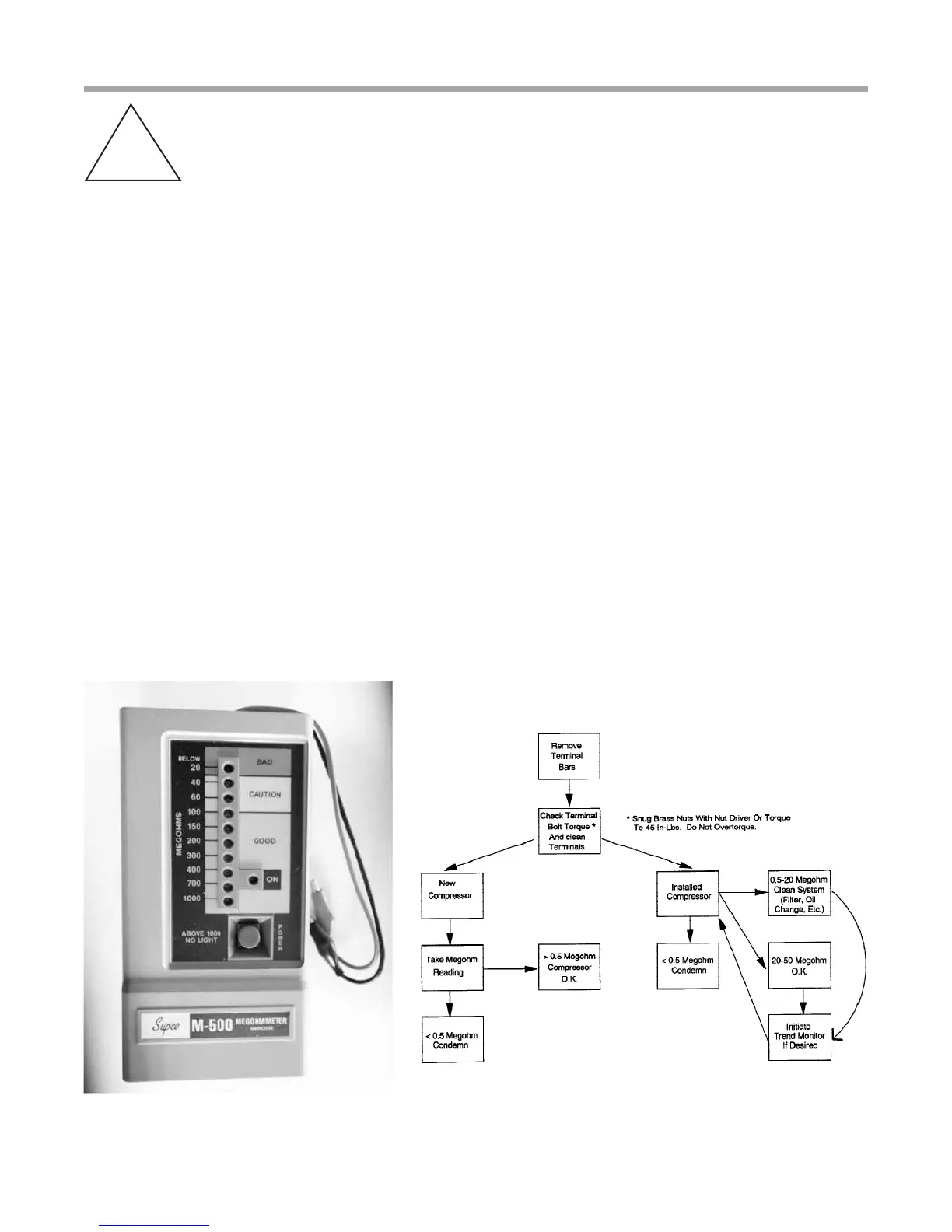
shows the required procedure for checking compressors with
a megohmeter.
New compressors that have never been installed will not
need any system clean-up procedures so long as the
megohm reading is above 0.5. A baseline reading must be
established for comparison purposes and since this is its rst
reading this will be its baseline value.
Megohmmeter
2
© 2010 Emerson Climate Technologies
Printed in the U.S.A.
AE4-1294
Application Engineering
BULLETIN
Figure 1
Megohmeter Test Procedure



 To Next Page