Compact controller ER 2022S and ER 2022SA
8. Configuration
8.9 Interface “intE”
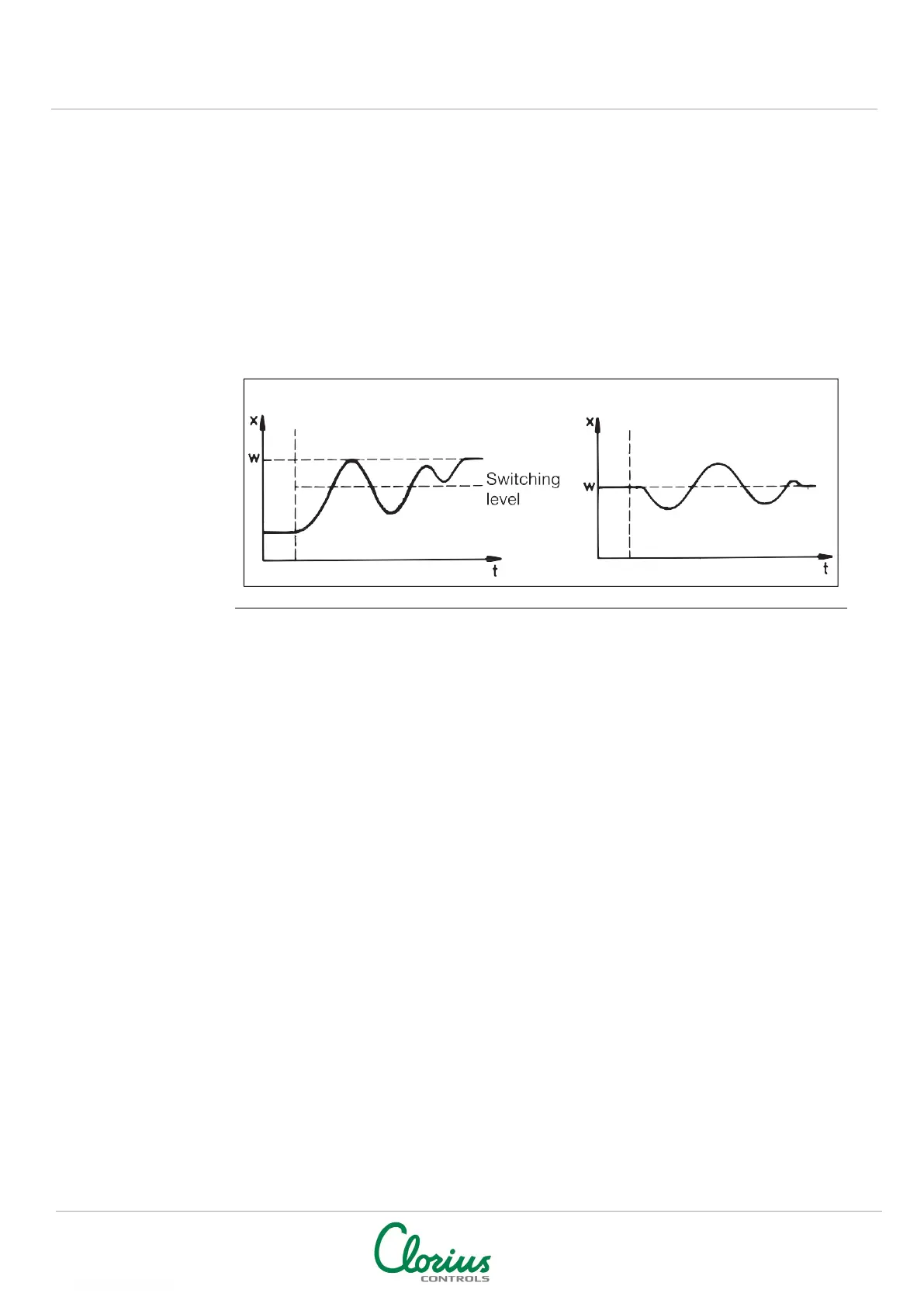
Oscillation
method
Autotuning (self-optimization, SO) establishes the optimum controller parameters for a
PID or PI controller.
Depending on the controller type, the following controller parameters can be defined:
Reset time (rt), derivative time (dt), proportional band (Pb), cycle time (Cy), filter time
constant (dF)
The controller selects one of two procedures (a or b), depending on the size of the
control deviation:
Step
response
method
This type of optimization involves determining the control parameters through an
output step that is applied to the process. First a standby output is produced until the
process value is “steady” (constant). Afterwards, an output step (step size), which
can be defined by the user, is automatically applied to the process. The resulting
response of the process value is used to calculate the control parameters.
Autotuning establishes the optimum control parameters for a PID or PI controller,
according to the selected control structure.
Depending on the controller type, the following control parameters can be
determined: Reset time (rt), derivative time (dt), proportional band (Pb), cycle time
(Cy), filter time constant (dF)
Autotuning can be started from any system status and can be repeated as often as
is required.
The controller outputs (continuous, relay, solid-state), the controller standby output
and the step size (min. 10%) must be defined.
Principal applications of the step response method
-
Autotuning instantly after “power on,” during the approach
phase Considerable time savings, setting: controller standby
output = 0 %.
-
The process does not readily permit oscillations (e.g., highly insulated
furnaces with small losses, long oscillation period)
-
Process value must not exceed setpoint.
If the output (with stabilized setpoint) is known, overshoot can be avoided
through the following adjustment:
standby output + step size <= output in stabilized condition
a) SO in the approach phase
Start of SO
b) SO at setpoint
Start of SO


 To Next Page