Need help?
Do you have a question about the CONTROL SOLUTIONS VFC800-WIFI and is the answer not in the manual?
Control Solutions' standard warranty terms and limitations of liability.
Expected battery life and factors influencing it for the VFC400-WiFi.
Explains text formatting used in the manual.
General introduction to the VFC400-WiFi logger and its capabilities.
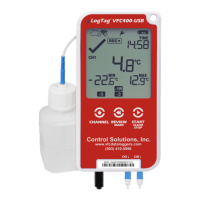
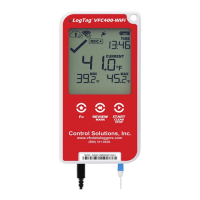
Details on logger case, buttons, display, LED, and sensors.
Explains communication methods, power supply, and PDF report generation.
Lists required hardware, software, and network for initial setup.
Lists optional items that can enhance logger functionality.
Steps for initial configuration and setup performed in an office environment.
Steps for preparing the logger at its operational location after office setup.
Step-by-step instructions for inserting AAA batteries into the logger.
Details standard configuration settings like description, passwords, and logging intervals.
Explains push button start, delayed start, and date/time start options.
How alarms are configured and visually indicated on the logger.
Options for configuring the format and content of generated files.
Parameters influencing the appearance of the PDF report.
Settings for advanced alarm behavior and logger options like power save.
Configuration for connecting the logger to wireless networks and online services.
Guide to setting up wireless/cloud connectivity and registering the logger.
How to connect the external sensor and USB power supply.
Process and timing of uploading temperature readings to the cloud.
Explains symbols indicating WiFi and cloud connectivity status.
How to manually test the logger's wireless and network connectivity.
How the display indicates the progress and success of the connection test.
Common problems and solutions for connecting to wireless networks.
Reasons for failure to connect to the cloud server and resolution steps.
Explanation of all the different parts of the logger's display screen.
Details on MIN/MAX data, battery status, and alarm markers.
Explains recording state indicators and WiFi/cloud symbols.
Explains time display, reading type, and alarm threshold markers.
Details on using USB power supply and AAA backup batteries.
Behavior and limitations of the logger in low power mode.
The function and replacement of the CR2032 backup battery.
How the audible alarm sounds and its interval variations.
How the logger's internal clock works and synchronizes.
Step-by-step guide to start the logger using the physical button.
How to start the logger with a pre-configured time delay.
What the display shows during active recording, including alarm status.
How alarm events are uploaded and indicated, including day summary shifts.
How the day alarm matrix shows historical alarm occurrences during recording.
How to mark a reading for inspection and its effect on data.
Procedure to clear the visual alarm indicator on the logger.
How to pause readings and their impact on statistics and alarms.
How the logger behaves and displays information when the sensor is disconnected.
How a full day sensor disconnection affects recorded statistics.
How the power save feature works and its configuration.
Procedure to reset the minimum and maximum temperature values.
How to review minimum and maximum statistics for the current day.
How to review minimum and maximum statistics for the previous day.
How to review minimum and maximum statistics from two days prior.
How to review statistics from six days ago.
How to review statistics from seven days ago.
How the day alarm matrix shows historical alarm occurrences during review.
How to manually stop the logger using the physical buttons.
Details on drivers installed when connecting to a Windows PC.
Notes on connecting to macOS, OSX, and Linux operating systems.
How to open and view generated PDF, CSV, and LTD files.
Explanation of the information presented in the PDF report.
How alarm status, file details, and logger info are shown in the report.
Summary of recorded data, trip statistics, and graphical chart explanation.
Explanation of symbols on charts and alarm limit lines.
A list of individual temperature readings with associated data.
Explanation of special characters marking readings in the data list.
A single row per day showing min/max, alarms, and inspection status.
Procedure to reset the logger to its original READY state.
How to put the logger into low-power hibernation mode.
What the display shows when the logger is in hibernation mode.
How to enable and disable airplane mode for wireless transmission compliance.
Step-by-step instructions for replacing the logger's batteries.
Model, temperature ranges, humidity, vibration, shock, EMC, environmental rating.
Temperature resolution, accuracy, sensor compatibility, clock accuracy, recording capacity, memory.
Sampling intervals, alarm functions, start methods, and case material.
Power sources, battery life, size, weight, and calibration details.
PDF features, WiFi specs, USB compatibility, download times, software requirements, accessories.
 Operating Environment
| temperature sensor measurement range | -40 °C to +99 °C |
|---|---|
| logger operating temperature range | -30 °C to +60 °C |
| storage temperature range | -10 °C to +40 °C |
 Power
Power| power source | 5V/5W from commercial USB power supply with Micro-USB plug |
|---|---|
| AAA battery power | 2 x 1.5V |
| backup battery | 1 x CR2032 3V LiMnO2 |
 Battery
| AAA battery life | typically around 2 months |
|---|---|
| CR2032 battery life | up to 10 years |
| battery life impact by alarm | The audible alarm reduces battery life significantly. |
 Weight and Dimensions
| size | 123 mm(H) x 63mm (W) x 12.5mm (T) |
|---|---|
| weight | 80g |
| vibration resistance | Withstands 5 drops from 1m |

 To Next Page