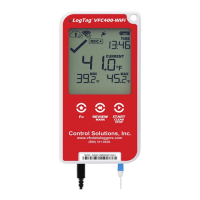
Need help?
Do you have a question about the CONTROL SOLUTIONS LogTag VFC400-USB and is the answer not in the manual?
Control Solutions's warranty terms, limitations of liability, and battery lifespan details.
Statement clarifying logger purpose and explanation of text formatting used.
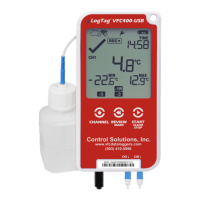
Description of the logger's case, buttons, mounting lug, and probe sockets.
Explanation of the logger's display, LED, power supply, external probes, and PDF output.
List of essential and recommended accessories for using the logger.
Steps for office setup, battery installation, and on-site connection of probes/power.
Detailed procedure for opening the case and inserting AAA batteries.
Guide to setting up the VFC400-USB for temperature data logging.
Steps to set up a logger delivered in a hibernated state.
Explanation of core settings like User ID, start method, and logging interval.
Details on start methods, delay, and alarm settings.
Completing the configuration process and connecting probes/power.
Detailed breakdown of all display segments, indicators, and markers.
Explanation of channel identifiers, battery status, alarm indicators, and recording states.
Details on MAX/MIN values, threshold arrows, and temperature units.
Explanation of power sources and understanding battery status indicators.
How the logger operates when batteries are empty and no external power is supplied.
Role of the backup battery and actions during power loss.
Details on the three-tone sounder and its activation settings.
How the logger's clock is set and how to manually adjust the time zone.
Guidelines and restrictions for adjusting the logger's time.
How display clock adjustments affect logged data and day summaries.
Procedure for starting the logger using the START/CLEAR/STOP button.
How to start the logger with a configured start delay.
How the display shows current temperature, MIN/MAX, and alarm status.
Understanding alarm indicators, day markers, and alarm events.
Explanation of week markers and how the day summary shifts.
How to manually switch between channels on the display.
Explanation of the auto-channel swap feature and its limitations.
Visual representation of alarm occurrences over consecutive days.
Procedure to clear active alarms on the logger's display.
Using the feature to ignore specific readings for calculations.
Marking readings with inspection marks and handling probe disconnection events.
Enabling and understanding the display's power saving function.
Procedure to reset the minimum and maximum temperature values.
How to access and cycle through recorded daily statistics using buttons.
Understanding MAX/MIN values, durations, and alarms for the current day.
Understanding MAX/MIN values, durations, and alarms for yesterday.
Understanding data, durations, and alarms from two days ago.
Understanding data, durations, and alarms from seven days ago.
Visual representation of alarm occurrences over consecutive days during review.
Steps to stop the logger using the START/CLEAR/STOP button.
Steps for plugging the VFC400-USB into a PC USB port.
Information on drivers needed for PC communication on Windows OS.
Information on using the logger with non-Windows operating systems.
How to browse and open PDF, CSV, or LTD files created by the logger.
Procedure for downloading recorded data to Control Solutions VTMC software.
Steps to prepare the logger for subsequent use after data analysis.
Introduction to the PDF report's combined information for both channels.
Explanation of file info, logger configuration, recorded data, and alarm information.
How to interpret symbols, readings, and charts in data files.
Explanation of symbols used for marked readings like paused or inspection.
How to read and interpret the day summary for each channel.
Understanding page numbering and markers for clock adjustments in summaries.
Steps to reset the logger to its original READY state.
How to hibernate the logger for power saving and its reactivation methods.
Instructions for replacing the logger's AAA batteries when depleted.
Graph showing the rated temperature accuracy of the VFC400-USB.
Graph showing the rated native temperature resolution of the VFC400-USB.
Alphabetical list of terms and definitions from A to D.
Alphabetical list of terms and definitions from I to L.
Alphabetical list of terms and definitions from L to P.
Alphabetical list of terms and definitions from S to U.
 General
| Type | Temperature and Humidity Data Logger |
|---|---|
| Humidity Range | 0% to 100% RH |
| Interface | USB |
| Power Source | Non-replaceable 3V lithium battery |
| Water Resistance | IP67 |
| Certifications | CE, RoHS |
| Battery Life | 1 year (typical) |
| Accuracy | ±0.5°C |
| Sensor Type | Internal |
| Resolution | 0.1°C |
| Operating Humidity | 0% to 100% RH |

 To Next Page