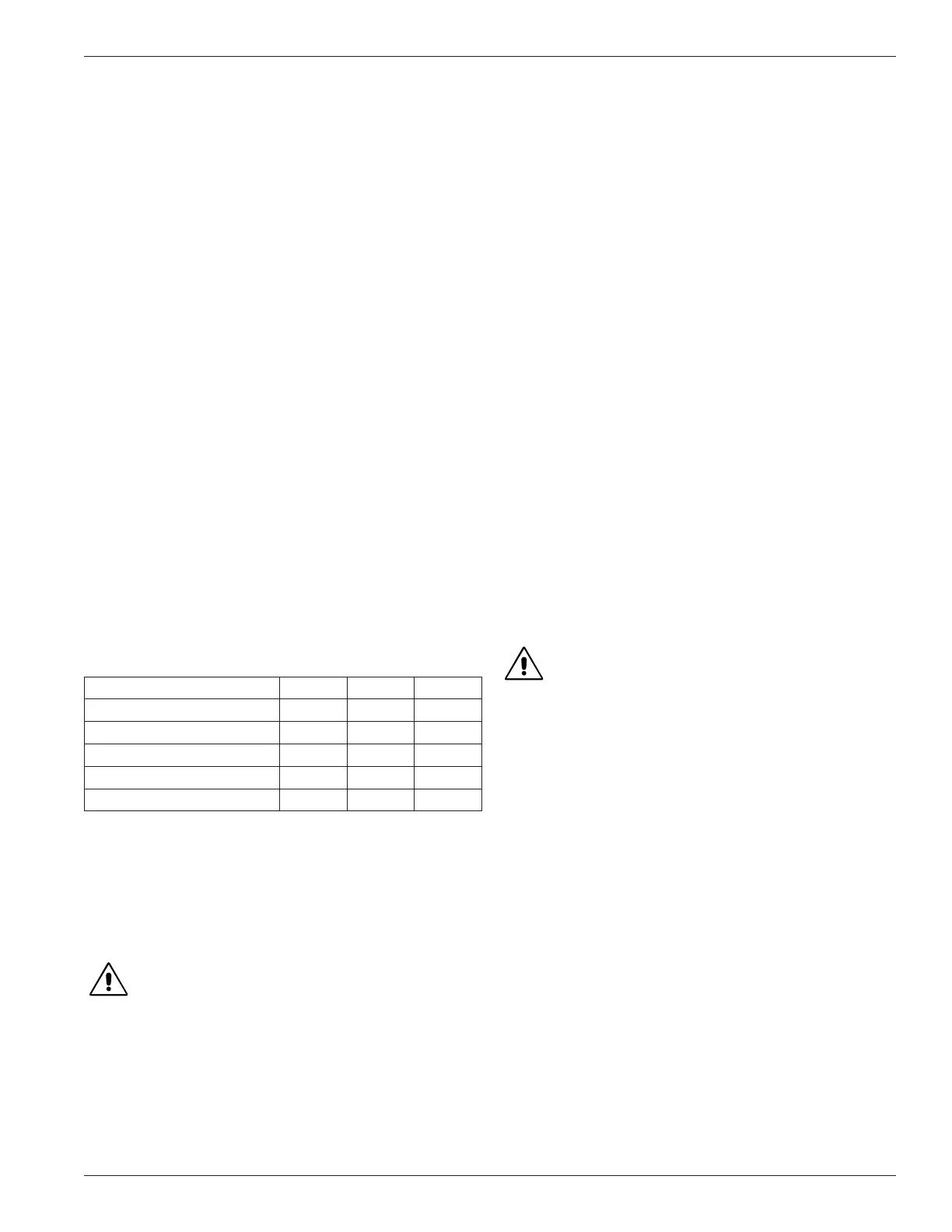
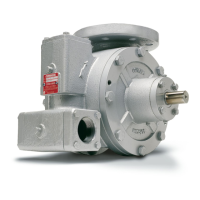
Chapter 5—Maintenance of the
Z-Series Coro-Vane
®
Pump
5.1 Purpose
By following an effective maintenance program,
unscheduled downtime can be eliminated. This program
should be used by the Operation Manager to get a
maximum utilization of manpower and equipment as
well as to prevent possible unsafe situations and/or
production delays due to equipment breakdown.
Normal wear parts are the mechanical seals, bearings,
vanes, and sideplates. All of these parts, plus O-rings
and grease seals, are offered in the Corken “repair kit”
listed in this manual directly after the Seal Replacement
Instructions. Use only genuine Corken replacement parts
when repairing the Z-Series pump. Follow the instructions
provided with the parts.
5.2 Scope
The Pump Maintenance Schedule table below includes
the items to be regularly checked and inspected with
a recommended time schedule. These are basic
maintenance recommendations, and each company
should develop their own comprehensive preventive
maintenance program schedule, tailor-made to their
individual operational procedures and requirements.
Pump Maintenance Schedule
Daily Monthly 3 Months
Lubricate bearings X
Inspect drive coupling X
Clean inlet strainer X
Check for leaks X
Inspect hose and ttings X
Maintenance must only be performed by a properly trained
and qualied individual that follows all the applicable
safety procedures.
5.3 Procedures
ALL REPAIRS TO THE PUMP MUST BE
PERFORMED BY QUALIFIED PERSONNEL IN
A SAFE MANNER, UTILIZING TOOLS AND/OR
EQUIPMENT THAT ARE FREE OF HAZARDS, AND
FOLLOWS THE APPLICABLE SAFETY CODES OF
PRACTICE SET BY THE LOCAL AUTHORITIES
HAVING JURISDICTION. MAKE SURE THE SYSTEM
PRESSURE HAS BEEN RELIEVED BEFORE
ATTEMPTING ANY REPAIR TO THE PUMP.
Your Corken Z-Series Pump requires regular maintenance
and care like all mechanical equipment. A neglected
or improperly repaired pump will result in premature
failure and cause unsafe conditions. To promote product
longevity and safety, maintenance must be performed by
properly trained technicians. Make sure all safety systems
are in place and the system pressure has been relieved
before attempting ANY maintenance.
Make sure the transfer hoses are not “kinked” which can
cause excessive pump discharge pressure. Always make
sure your hoses are not out of date.
When it becomes necessary to repair your pump or
remove it from the system, you must be absolutely certain
that all propane, anhydrous ammonia, or whatever product
being pumped is bled from the pump and connecting
piping. Once all the product has safely been bled from the
pump and connecting piping, make certain no pressure
is left in the system. SPECIAL CARE MUST BE TAKEN
DURING THE BLEED DOWN PROCESS TO AVOID
DANGER TO PERSONNEL AND PROPERTY IN THE
AREA. Bleeding a system too fast is a common mistake
and may result in “refrigerated” liquid being left in the
pump and piping even though the pressure gauge shows
no pressure. As the “refrigerated” liquid begins to warm,
more gas will escape causing a dangerous condition.
Take your time in bleeding your system and make proper
provisions to vent or capture the gas in accordance with
local regulations.
NOTE: ONLY A PROPERLY TRAINED
INDIVIDUAL SHOULD BE ALLOWED TO BLEED
A PUMPING SYSTEM.
1. Visual Inspection:
This includes checking for leaks, corroded areas,
condition of hoses, piping and ttings, and any unsafe
condition which may hinder the safety of the personnel
and/or the facility.
2. Clean Inlet Strainer Screen:
A clogged strainer screen will create too much ow
restriction and vapor will be formed causing the pump
to cavitate. This reduces the pump’s capacity and
accelerates the wear of the internal parts.
3. Inspect Drive Coupling and Driveline:
Check the coupling alignment and the condition of the
union for cuts, broken sections and wear.
4. Lubricate Pump Bearings:
There are two lubrication points on the Z-Series
pumps. A grease zerk is located on the top of each
bearing cap. To prevent over greasing the bearings,
a grease relief tting is located on the bottom of each
11



 To Next Page