3. If the outlet piping exceeds 50 ft (15.2 m) in length, a
check valve should be installed in the discharge line
near the pump outlet.
3.3 The Bypass System Must
Include the Following
1. If the pump discharge is shut off before the driver has
stopped, a dangerously high pressure can develop;
therefore, an external bypass valve must be installed. The
installation of an external bypass valve permits the pump
to discharge its full capacity back to the supply tank at a
predetermined pressure. NOTE: Even though the pump
may have an internal relief valve, it is not a substitute for an
external bypass valve. The internal relief valve is a safety
relief valve for the pump only and not the entire system.
2. Always install a Corken ZV200 or B177 external
bypass valve in the discharge line of pump. The
bypass valve may discharge into the supply tank at
any convenient liquid or vapor opening; however, it
should not connect to the pump inlet piping.
3.4 A Vapor Equalizing System
Should be Included
To obtain maximum performance from your Coro-Vane
®
pump,
a vapor equalizing system should be installed. This system is
simply a pipe connecting the vapor sections of the tank being
unloaded and the tank being lled. This equalizing line allows
vapor to move freely between the two tanks (in either direction)
and assures that both tanks remain at the same pressure.
As liquid is withdrawn from a tank, it must be replaced by an
equal amount of vapor or the pressure in the tank will drop.
If an equalizing line is not present, this vapor is formed by
“boiling” of the liquid and a reduction of the tank’s pressure.
Meanwhile, the tank being lled experiences a pressure
increase as the rising uid levels compresses the vapor
space above it. A vapor equalizing line will eliminate both of
these problems and will reduce pumping time, differential
pressure, noise and wear on the entire system. Slow transfer
rates will minimize these effects, and reduce the need for a
vapor equalizing line. However, today’s high transfer rates
require that a vapor equalizing line be installed.
Another way to consider this principle is to remember that it
takes two holes in an oil can for oil to be poured smoothly from
the can; one for the oil to exit and the other for the air to enter.
3.5 Driver Installation
The wiring of your electric motor is extremely important and
must be done by a competent electrical contractor. The
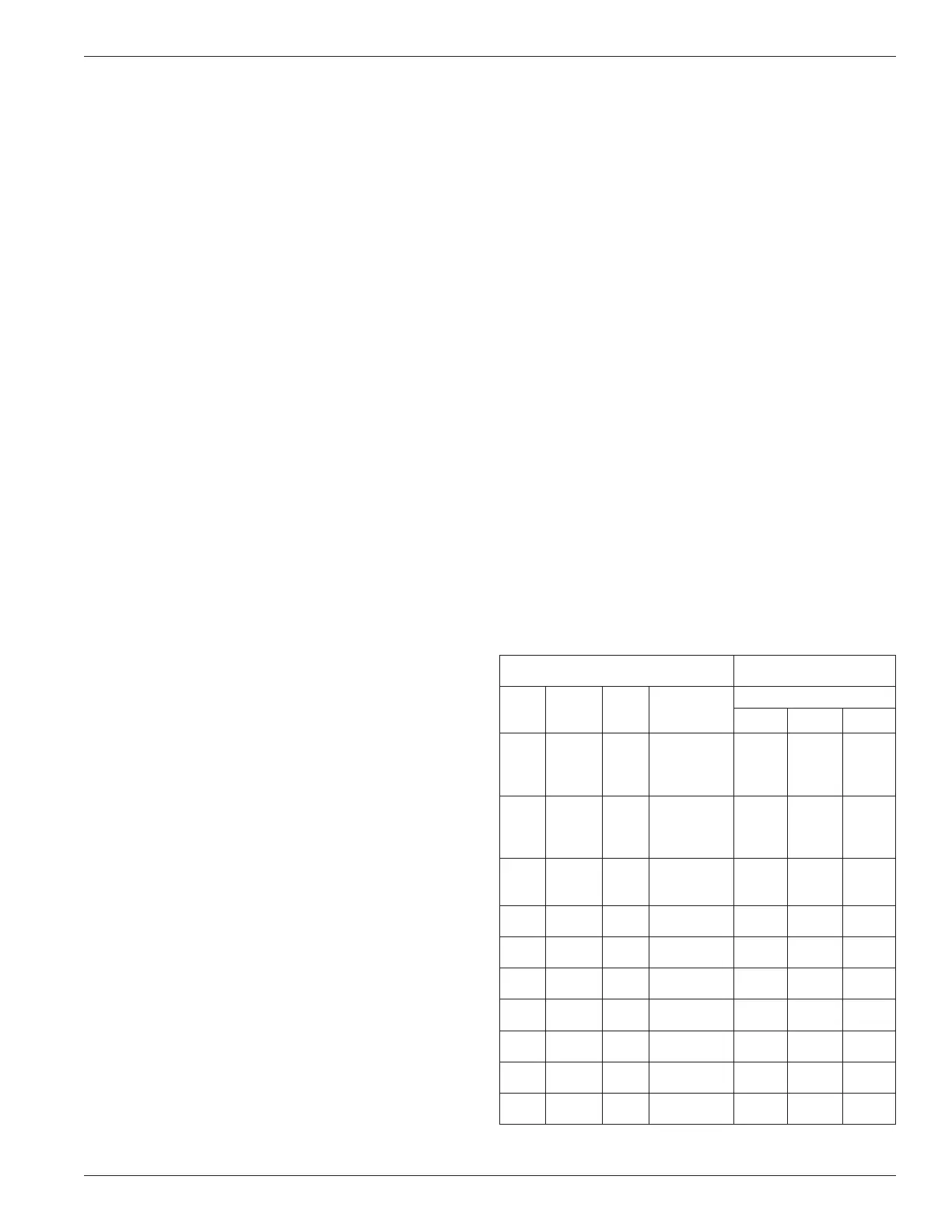
following wire sizing chart indicates the minimum standards
for wire sizes.
Improper motor wiring will cause expensive motor
difficulties from low voltage. If you suspect you have low
voltage, call your power company. Connecting your motor
for the voltage you have available is important too. The
motors furnished with the stationary pumps are usually
dual voltage, so you must be sure of the voltage your power
company is supplying you. Your motor will be completely
ruined if it is connected to the wrong voltage.
A humid climate can cause problems, particularly in explosion
proof motor applications. The normal breathing of the motor,
and alternating between being warm when running and cool
when stopped, often will cause moist air to be drawn into
the motor housing. This moist air will condense, and may
eventually add enough free water to the inside of the motor
to cause it to fail. To prevent this, make a practice of running
the motor and pump at least once a week on a bright, dry
day for an hour or so (pumping through the bypass system).
In this period the motor will heat up and vaporize the
condensed moisture, and drive it out of the motor. No motor
manufacturer will guarantee an explosion-proof or totally
enclosed motor against damage from moisture.
Engine drivers pose a special consideration. The
manufacturer’s instructions must be followed. When the
stationary pump is equipped with an engine from the factory,
the engine speed should normally not exceed 1,800 RPM.
Excessive engine speed will overload the engine and cause
early failure. The engine loses 3% of its power for every
1,000 ft (305 m) above sea level, so if your installation is at a
higher altitude than normal, consult the factory.
Motor
Recommended
wire size, AWG
1
Hp
Motor
phase
Volts
Approximate
full load
amperes
Length of run (ft)
0–100 to 200 to 300
3 1 115 34.0 6 4 2
220 17.0 12 8 8
3 230 9.6 12 12 12
460 4.8 12 12 12
5 1 115 56.0 4 1 1/0
230 28.0 10 6 4
3 230 15.2 12 12 10
460 7.6 12 12 12
7-1/2 1 230 40.0 8 6 4
3 230 22.0 10 10 8
450 11.0 12 12 12
10 3 230 28.0 8 8 8
460 14.0 12 12 12
15 3 230 42.0 6 6 6
460 21.0 10 10 10
20 3 230 54.0 4 4 4
460 2 7.0 8 8 8
25 3 230 68.0 2 2 2
460 34.0 6 6 6
30 3 230 80.0 1 1 1
460 40.0 6 6 6
40 3 230 100.0 2/0 2/0 2/0
460 52.0 4 4 4
50 3 230 130.0 3/0 3/0 3/0
460 65.0 2 2 2
1
Based upon 3% voltage loss copper wire type TW. Single phase
motor calculations are based on two times distance.
9



 To Next Page