Principles of the Z-Series Sliding
Vane Pump (Coro-Vane
®
)
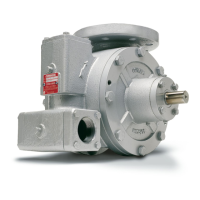
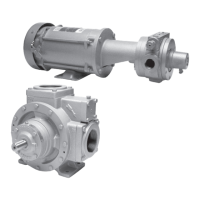
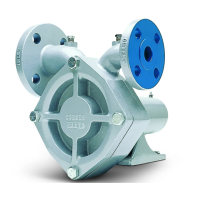
The Z-Series truck pump is a special type of rotary positive
displacement pump, known as a sliding vane pump.
The sliding vane pump has many of the positive displacement
advantages of the gear pump, plus the ability to compensate
for wear, and operate at a lower noise level.
The sliding vane pump consists of a rotor turning in a
cam (liner) machined eccentrically in relation to the rotor;
thereby displacing the liquid trapped between the rotor,
cam and vanes. The Z-Series pumps are made with vanes
produced from advanced polymers which exhibit extremely
low coefficients of friction. The vanes are self-adjusting for
wear which gives the pump long life.
Exclusive Features of the
Z-Series Coro-Vane
®
Pump
The pumping of volatile liquids is one of the most difficult of all
pumping jobs, and pumping from a delivery truck makes it even
more difficult, so more attention must be given to the design and
manufacture of the pump and to its installation and operation.
In addition to being especially suited for handling volatile
liquids, the Z-Series pump has a number of features to help
make it more easily operated and maintained.
This model has been registered and listed by the
UNDERWRITERS’ LABORATORIES, INC. for use in the
handling of LP-Gas and Ammonia.
The CASE AND HEADS are made of ductile iron for extra
strength and toughness.
The VANES are manufactured of advanced polymers to
provide excellent life and quiet operation. After long service, the
vanes are simply and inexpensively replaced.
Both the CAM and the SIDEPLATES are easily replaced should
the need arise. Sideplates may be reversed for extended
service life.
The MECHANICAL SEAL is designed for longer life under greater
loads and may be inspected or replaced without disturbing the
piping of the pump. No special tools are needed.
BEARINGS are heavy-duty roller type for long bearing life.
PRESSURE GAUGE connections, 1/4 in. pipe thread, are provided.
The RELIEF VALVE is built-in and nonadjustable. The
valve is preset at the factory.
NOTE: EVEN WITH THIS INTERNAL SAFETY VALVE,
AN EXTERNAL BYPASS VALVE MUST BE INSTALLED.
Chapter 1—Installation of the
Z-Series Coro-Vane
®
Truck Pump
Before installing of your pump, remove all temporary
plastic plugs.
The installation of the Z-Series pump is simple. However,
in order for the pump to deliver optimum performance, the
principles discussed in this book should be followed. The piping
details are furnished to illustrate methods proved by hundreds
of installations. Your own needs may require slight variations,
but every effort should be made to follow the recommendations
identied in this manual.
For the transfer of ammable liquids like LPG, the pump
must be installed according to the applicable local safety
and health regulations. The installer and/or the user must
take into account the following:
• Potential risk due to local conditions regarding the
installation and operation (e.g. poor ventilation and
additional risks due to other elements in the vicinity, etc.).
• Qualication of the personnel.
• Type of liquid being transferred.
• Specic safety measures to be applied (e.g. gas
detection, automatic shut-off valves, personal protection
equipment, etc.).
See Appendix A for shipping weight and Appendix D for
outline dimensions.
A rotation arrow is located on the side of the pump so
check the Power Take-off (PTO) to determine its direction
of rotation. The Z-Series pump will match either PTO
rotation. Connect the drive shaft to the pump shaft that
turns the pump in the direction of the arrow.
The PTO selection is important. The pump requires a
PTO with an average output speed of 420 to 800 RPM
when the truck engine is operating at the proper speed to
maintain oil pressure and water circulation.
The DRIVESHAFT connecting the pump to the PTO should
be of the “splined” or slip type. This type driveshaft permits
the shaft to adjust for PTO movement and twisting of the truck
frame. A xed driveshaft transfers the forces directly into the
pump and PTO and will shorten the life of both considerably.
The yokes of the driveshaft universal joints must be positioned
as shown. Improper positioning will soon wear them out and
potentially destroy the bearings in the pump and PTO.
INLET PIPING should be as short as possible with
minimum restrictions so that the pressure drop is limited.
Inlet piping is not generally required on the Z3200 or
Z4200. These pumps are bolted directly to the tank
internal valve and must be installed in accordance with
the valve manufacturer’s instructions.
5



 To Next Page