4D-Link DSL-5300 User Manual
Section 1 - Product Overview
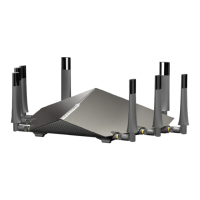
• Faster Wireless Networking - The DSL-5300 uses Smart Connect, a D-Link feature, when combined with
additional 5 GHz antennas, can provide up to a full 5300 Mbps
*
wireless connection with concurrent 801.11ac
and 802.11n wireless clients. It operates on both the 2.4 GHz and 5 GHz bands to allow separation of trac so
users can participate in high-bandwidth activities, such as video streaming, online gaming, and real-time audio,
without aecting low-priority trac like email and web surng.
• Compatible with 802.11n/g/b/a Devices - The DSL-5300 is fully compatible with the 802.11n, IEEE 802.11g and
802.11a standards, so it can connect with existing 802.11n, 802.11g, 802.11b, and 802.11a wireless devices.
• Advanced Firewall Features - The web-based user interface displays a number of advanced network
management features including:
• Content Filtering - Easily applied content ltering based on MAC address, URL, and/or domain
name.
• Scheduling - The Firewall, wireless, and port forwarding features can be scheduled to be active on
certain days, or for a duration of a set number of hours.
• User-friendly Setup Wizard - Through its easy-to-use web-based user interface, the DSL-5300 lets you control
what information is accessible to those on the wireless network, whether from the Internet or from your
company’s server. Congure your router to your specic settings within minutes.
• Fast VDSL2 - VDSL2 support for up to 100 mbps broadband speeds lets you make the most of your high-speed
connection. Plenty of bandwidth for every family member to each stream their own HD content and ultra-
responsive for the most intense games, real-time video conferencing, or large le transfers.
* Maximum wireless signal rate derived from IEEE Standard 802.11a, 802.11b, 802.11g, 802.11n, and 802.11ac specications. Actual data throughput will vary. Network conditions
and environmental factors, including volume of network trac, building materials and construction, and network overhead, lower actual data throughput rate. Environmental
conditions will adversely aect wireless signal range.
Features


 To Next Page