- Fasten the forward end of the reef
pendant lines to the luff webbing/rings
with bowlines or patent hook.
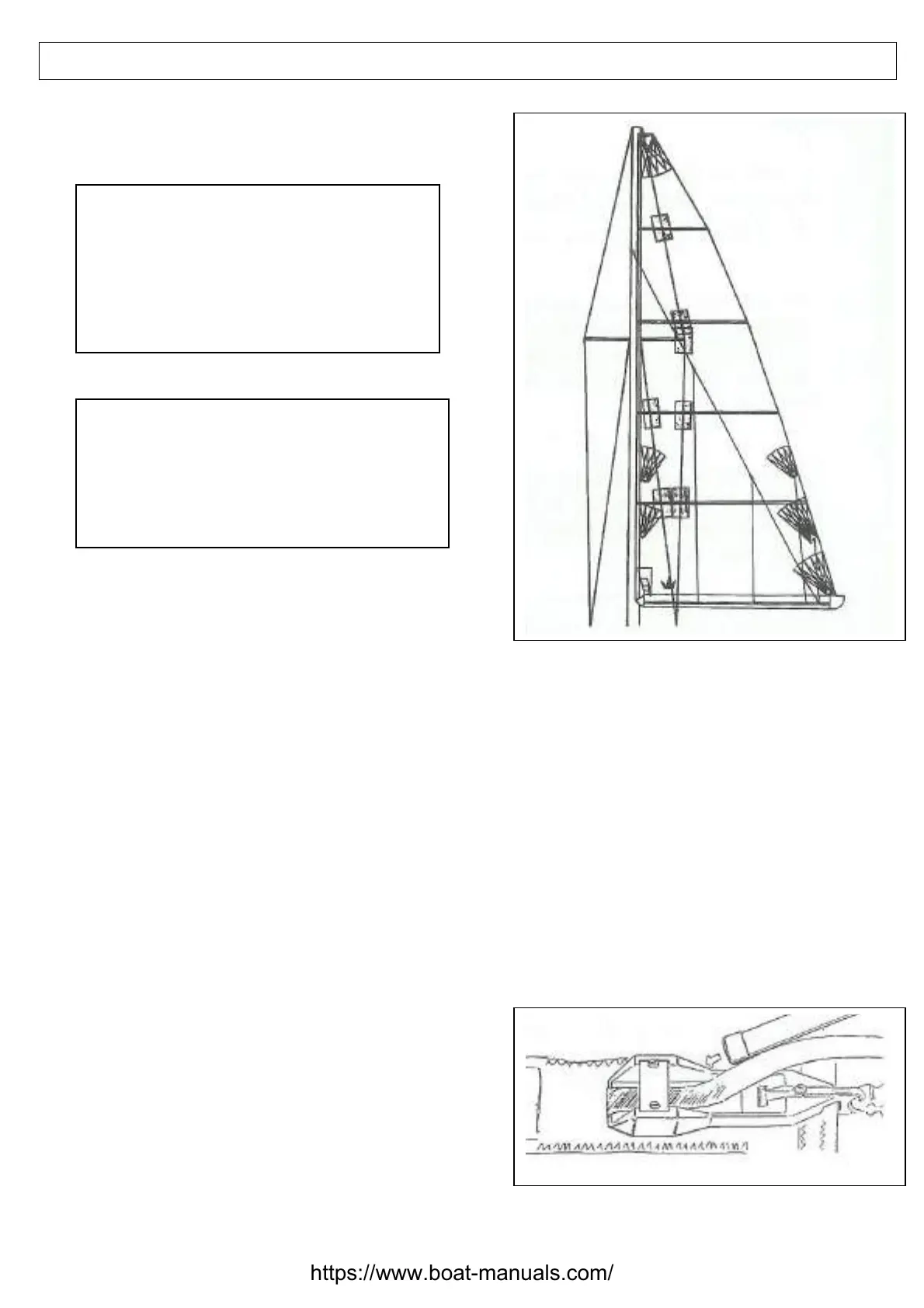
Patches
When a boat is running with the mainsail
eased off, the sailcloth comes into contact
with the spreaders and shrouds. This
increased mechanical load can lead to
chafe, damaging the material and seams.
A battened mainsail is particularly prone to
chafe; therefore 14 patches are supplied
with the mainsail. These should be affixed
at precisely the points where the sail and
shrouds or spreaders come into contact.
Wait until the mainsail shows the first signs
of light soiling at the points where the
patches should be stuck on.
The area to be protected from the vertical
sections of the upper shrouds can be
measured, and patches can affixed here
before the boat is taken out for the first
time. Patches are stuck to both sides of the
sail at all points.
Fig. 15 Patches protect the mainsail against chafe.
Inserting and tensioning the sail battens
The sail battens are supplied bent into a
circle, and so are under tension. Caution is
advised when unpacking them.
Ensure that the ends of the battens are
always protected by plastic caps that are
glued in place.
First lead the fabric tongue on the
tensioning sleeve back through the
tensioner.
Fig. 16a
It takes two people to bend on the heavy
sail. Make sure that the sail slides are
inserted into the mast track in the correct
order, and that they are not upside down.
Put a figure-of-eight knot in the forward
reef pendant lines before unbending the
sail, to prevent them from disappearing
into the boom.
15
https://www.boat-manuals.com/


 To Next Page