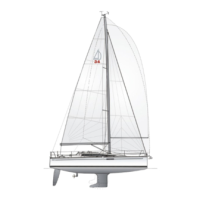
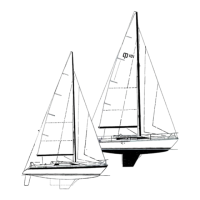
Nine basic rules for trimming 7/8
th
rig:
A summary by Peter Schweer of the editorial
staff of YACHT magazine.
“1. Greater drive can be gained from a
rounded sail profile than from a flat profile. This
is illustrated by the following comparison:
Transport planes have a deep wing profile –
they need maximum lift to transport heavy
payloads. Jet planes, gliders, catamarans, ice
yachts etc, by contrast, have flat profiles.
These are designed for high speed and low
shape or friction resistance.
2. More power is required to drive a boat
through a choppy sea than a calm sea.
- Full sail in a swell
- Flat sail in flat water
3. Provided the boat can still be sailed upright,
the mainsail leech should be closed, providing
maximum drive. As the wind continues to
strengthen, a closed leech increases heeling
moment and, in most instances, weather helm.
4. Above all, the mainsail leech should not
block airflow when close-hauled. The leech
should therefore be adjusted to suit the sea
state.
- Open leech in a swell
- Closed leech in flat water
Optimum setting of the sail is achieved when
all the telltales on the leech are streaming
horizontally aft.
5. The headsail car positioning is adjusted
correctly when the leech and foot are under
roughly equal tension when sheeted in. The
mainsail camber and the aft part of the
headsail must be roughly parallel to one
another.
6. Wool telltales on both sides of the
headsail in the area of the luff are an
ideal way of monitoring the optimum sail
setting. Three pars of telltales, on above
the other, are sufficient.
- If the windward telltales begin the
flutter, bear away
- If the leeward telltales turn
forward, point higher
7. To attain the greatest possible height
when close-hauled, the headsail
sheeting point should be brought as far
inboard as possible. When reaching, the
sheeting point is moved further outboard
and forward, opening the so-called “slot”
between the mainsail and the headsail,
and closing its open leech.
8. Optimum close-hauled sail
characteristics are only achieved –
especially in medium wind strengths
upwards – if the headsail luff sags as
little as possible to leeward. This calls
for high rig tension in the upper shrouds.
9. When close-hauled or reaching in heavy
weather, never release the headsail
sheet while the mainsail is still sheeted
in tightly. The boat will immediately luff
up in a strong squall. “
Dehler 35 cws
22
https://www.boat-manuals.com/


 To Next Page