Trimming the headsail
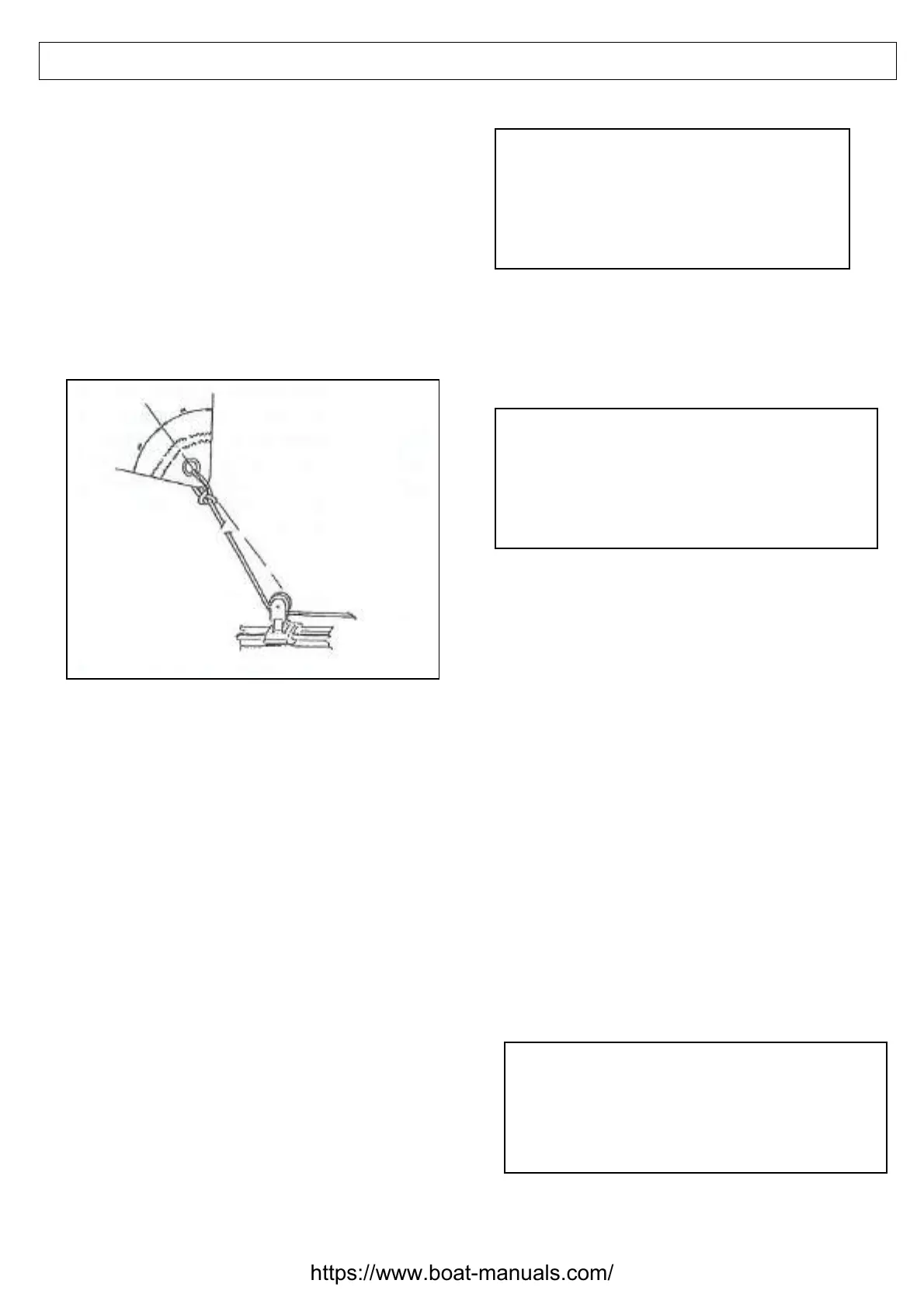
The sheeting angle of the jib or cruising jib
is normally correct if the sheet car is slightly
forward of either a line bisecting the clew
extended downwards, or of an imaginary
centre seam (see Fig. 24 below). The
sheet tension must be distributed equally
between the leech and the foot.
Fig. 24 The correct sheeting angle: the car is forward
of an extended imaginary line bisecting the clew.
If the sheeting car is too far forward, there is
a risk of the leech being stretched. The sail
can then no longer be trimmed.
A slight shivering of the leech in certain sail
trim positions is unavoidable, and is of no
significance.
The leeches of the jib and cruising jib are
fitted with a trimming line. Use these lines
only sparingly: if the line is over-tensioned,
the leech will “hook” and the sail will lose
drive.
When close-hauled, sheet in just enough for
the sail to always have a slight twist in the
leech.
Trimming the Mainsail
The critical advantage of a 7/8
th
rig over a
masthead rig is the fact that the mainsail can
be more efficiently matched to different wind
conditions.
The mainsail is trimmed for various wind
conditions by hardening or easing halyard,
Cunningham, kicking strap, clew outhaul and
standing backstay. Refer to the basic trimming
rules of trimming on Page 22.
You will therefore need to “work” further with
the sail, as this is the only way to find out the
speed potential of your boat.
The trimming lines are made from
perlon and change their stretch with
loading. Re-trimming is therefore
You should check for correct sail shape by
glancing repeatedly at the headsail leech.
There is nothing worse than an over or
Telltales on the edge of the leech will make
it easier to adjust the mainsail to suit
various points of sailing.
24
https://www.boat-manuals.com/


 To Next Page