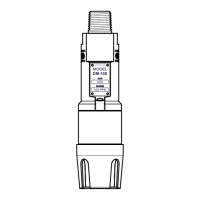
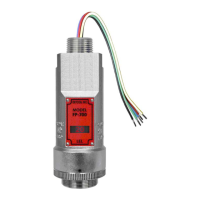
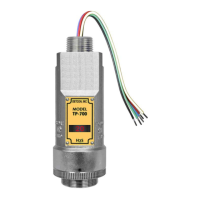
Model TP-700
TP-700 Instruction Manual Rev. 4.1 Page 12 of 42
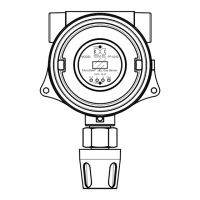
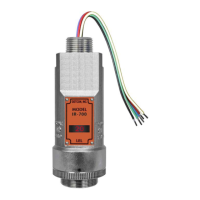
a) Remove the junction box cover. Identify the terminal blocks for customer wire connections.
b) Observing correct polarity, terminate the 3-conductor 4-20mA field wiring (+, -, and mA) to the sensor
assembly wiring in accordance with the detail shown in Figure 11. If the 4-20mA output is not used, the
green wire from the sensor must be connected to the (-) terminal on the Transient Protection Module.
NOTE: If the 4-20mA output is not being used, the Green wire from the sensor must be
connected to the Black wire at the (-) terminal on the Transient Protection Module to
ensure proper sensor operation.
c) If applicable, terminate the RS-485 serial wiring as shown in Figure 11. Use the second plug (Out) as
termination point on the customer side to facilitate a continuous RS-485 serial loop.
The RS-485 (if applicable) requires 24 gauge, two conductor, shielded, twisted pair cable between sensor and
host PC. General Cable Commodore part number ZO16P0022189 is recommended.
NOTE: Install a 120Ω resistor across A & B terminals on the last sensor in the serial loop.
d) Trim all exposed wire leads if they are not permanently landed in the terminal block.
e) Replace the junction box cover.
NOTE: A 6-32 threaded exterior ground point is provided on the sensor housing for an external
ground. If the Sensor Housing is not mechanically grounded, an external ground strap must be
used to ensure that the sensor is electrically grounded.
2.7 Initial Start Up
CAUTION: Do not apply power to the sensor assembly in a hazardous area unless the junction box
cover is tight and all electrical seals have been installed
Upon completion of all mechanical mounting and termination of all field wiring, apply system power in the
range of 11.5-30VDC (24VDC typical) and observe the following normal conditions:
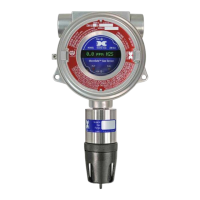
a) TP-700 display reads “0”, and no fault messages are flashing.
b) A temporary upscale reading may occur as the sensor heats up. This upscale reading will decrease to “0”
ppm within 1-2 minutes of power-up, assuming there is no gas in the area of the sensor.
NOTE: A desiccant cap with a desiccant packet is attached to the sensor cell housing to avoid
damage during storage and shipping. This prevents water from contacting the sensor film, and
as a result helps to retain the stability of the factory span calibration.
c) Remove the desiccant cap about 10 minutes after applying power to the sensor and install the weatherproof
splashguard accessory supplied with the sensor.
IMPORTANT NOTE: Do not remove the desiccant cap and cover until power is applied to the
sensor. Store the desiccant caps with the desiccant packets in a sealed container (i.e. zip-lock
Bag) for future use. It is mandatory to reinstall the desiccant cap and packet during any periods
without power lasting more than 1 hour. An active desiccant packet is blue in color and turns


 To Next Page