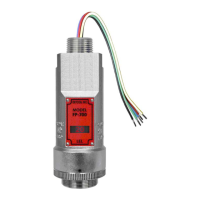
Model TP-700
TP-700 Instruction Manual Rev. 4.1 Page 13 of 42
pink when consumed. (re-order P/N 960-240010-000). Do not use the desiccant packet if it is
pink in color, order new packets as required.
NOTE: The 4-20mA signal is held constant at 4mA for the first two minutes after power up.
2.7.1 Initial Operational Tests
After a warm up period of 1 hour, the sensor should be checked to verify sensitivity to H
2
S gas.
Material Requirements
• Detcon PN 613-120000-700 700 Series Splash Guard with integral Cal Port -OR-
• Detcon PN 943-000006-132 Threaded Calibration Adapter
• Detcon PN 942-010112-025 Span Gas; 25ppm H
2
S in balance Air at fixed flow rate between 200 -
500cc/min (10ppm for 0-20ppm range)
• Detcon PN 985-241100-321 In-Line Humidifying Tube
2
S in Nitrogen background gas mixtures. This will cause significant reading
inaccuracies.
a) Connect the In-Line Humidifying Tube between the cal gas cylinder and the sensor. The humidifying tube
will introduce the ambient relative humidity into the Cal Gas as it passes through the tube.
b) Attach the calibration adapter to the threaded sensor housing. Apply the test gas at a controlled flow rate of
200 - 500cc/min (200cc/min is the recommended flow). Allow 1-2 minutes for the reading to stabilize.
Observe that during the 1-2 minutes the ITM display increases to a level near that of the applied calibration
gas value.
c) Remove test gas and observe that the ITM display decreases to “0”.
Initial operational tests are complete. Detcon H
2
S gas sensors are factory calibrated prior to shipment, and
should not require significant adjustment on start up. However, it is recommended that a complete calibration
test and adjustment be performed 16 to 24 hours after power-up. Refer to span calibration instructions in Section
3.4.


 To Next Page