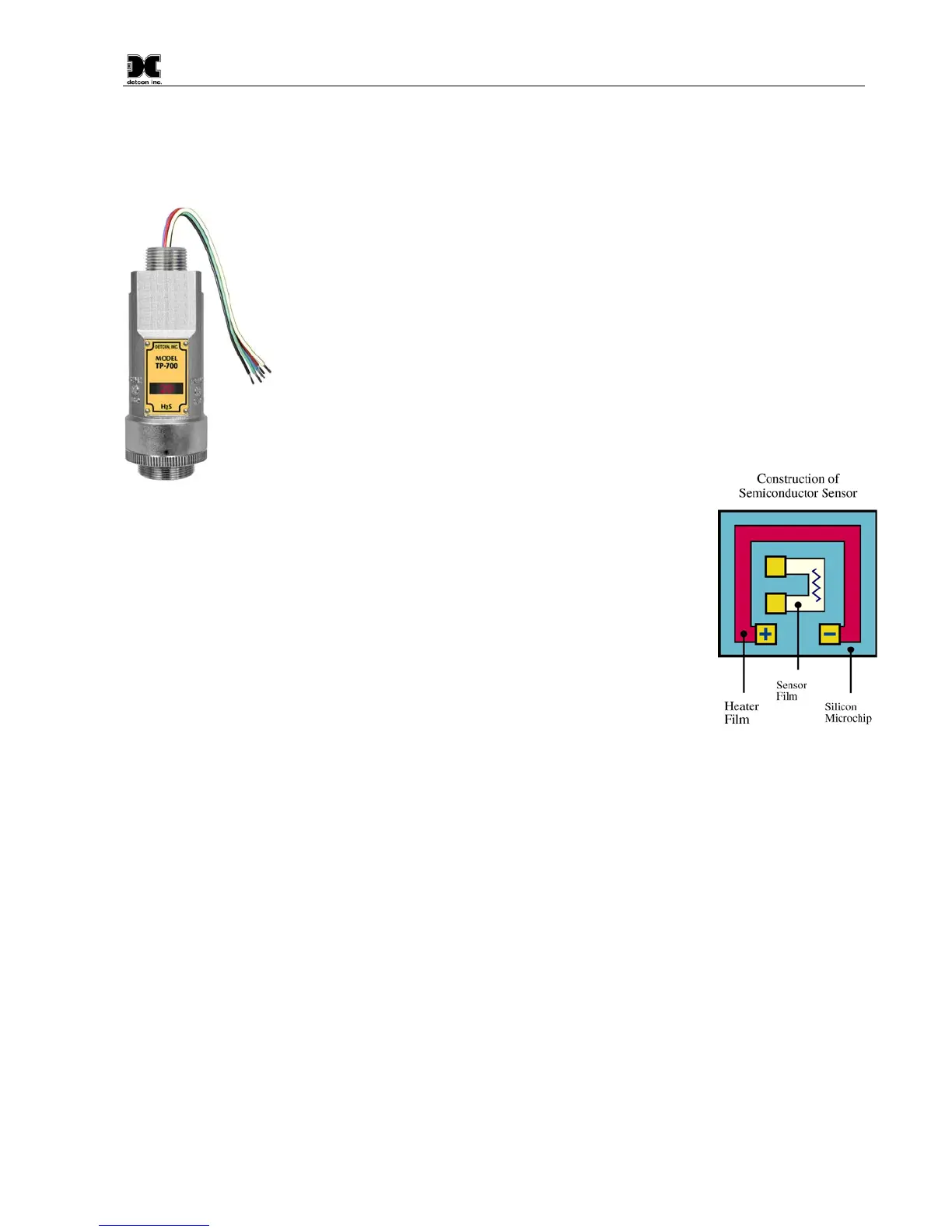
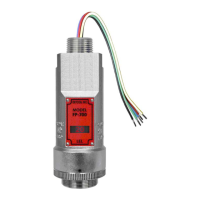
Model TP-700
TP-700 Instruction Manual Rev. 4.1 Page 1 of 42
1. Introduction
1.1 Description
Detcon Model TP-700 hydrogen sulfide sensors are non-intrusive “Smart” sensors
designed to detect and monitor H
2
S in air. Ranges of detection are 0-20ppm, 0-50ppm,
0-100ppm, and 0-200ppm. The sensor features an LED display of current reading, fault
and calibration status. The Sensor is equipped with standard analog 4-20mA and
Modbus™ RS-485 outputs. A primary feature of the sensor is its method of automatic
calibration, which guides the user through each step via fully scripted instructions
displayed on the LED display.
The microprocessor-supervised electronics are packaged in an encapsulated module and
housed in an explosion proof casting, called the ITM (Intelligent Transmitter Module).
The ITM includes a four character alpha/numeric LED used to display sensor readings,
and the sensor’s menu driven features when the hand-held programming magnet is used.
Solid State H
2
S Sensor Technology
The sensor technology is a patented solid-state mixed metal oxide semiconductor.
The sensor consists of two thin films, a temperature sensitive heater film, and a
hydrogen sulfide sensitive sensor film. Both films are deposited on a silicon
microchip by vacuum deposition. The heater film elevates the operating temperature
of the sensor film to a level where a good sensitivity and response to hydrogen sulfide
is achieved. The sensor film is a proprietary mixed metal oxide that shows an
extremely stable and dynamic response to hydrogen sulfide gas.
Range of sensitivity is from parts per billion to percent by volume. The rugged
sensor is capable of maintaining its operating characteristics for periods of up to 7-
10 years in most industrial environments and as such, is supported by a 10-year
conditional warranty.
Principle of Operation
Method of detection is by diffusion/adsorption. Air and H
2
S diffuse through a sintered stainless steel filter
(flame arrestor) and contact the heated surface of the metal oxide sensor film. As hydrogen sulfide gas molecules
react with oxygen ions on the film, there is a decrease in electrical resistance proportional to the gas
concentration. The heater film elevates the temperature of the sensor film creating convection and promoting a
quick response to changing gas concentrations. Electronically, the heater film is used to maintain a constant
temperature of the sensor film enhancing stability and repeatability. The sensor response is reversible and results
in continuous monitoring of ambient air conditions.
1.2 Sensor Electronics Design
Intelligent Sensor Module
The Intelligent Transmitter Module (ITM) is a fully encapsulated microprocessor-based package that accepts a
plug-in field replaceable H
2
S sensor. Circuit functions include extensive I/O circuit protection, sensor pre-
amplifier, sensor temperature control, on-board power supplies, microprocessor, LED display, magnetic
programming switches, a linear 4-20mA DC output, and a Modbus™ RS-485 output. Magnetic program
switches located on either side of the LED Display are activated via a hand-held magnetic programming tool,
thus allowing non-intrusive operator interface with the ITM. Calibration can be accomplished without


 To Next Page