OPERATION
75
TRANSPORT
TRANSPORT ON PUBLIC ROADS - FIGURE 90
WARNING: When a trailer or other piece of equipment is attached to a forage harvester using a manual, electric
or hydraulic quick release coupler (item 3), the locking pin (item 4) must be installed before accessing a public
road or hilly terrain. An appropriately rated safety chain for the equipment being towed must also be installed.
Also, the safety cover for the hitch release switch must be lowered on the control box and the control box must be turned
off. Finally, the hydraulic flow to the forage harvester must be stopped to avoid any unexpected action.
WARNING: Securely attach the forage harvester to the tractor. Use an approved hitch pin of the appropriate
size with a mechanical restraint system and attach a safety chain with a capacity of at least 20,000 lb (9071 kg)
(Figure 18, Figure 19 Cat. II drawbar extension on pages Figure 18 & Figure 19 Cat. II drawbar extension
respectively).
WARNING: Never hitch a loaded trailer behind a forage harvester on a public road.
Before transporting the harvester on the road, take the following precautions.
1. Clean the harvester of any debris that may fall on the road during transportation.
2. Set the drawbar (item 3, Figure 90 Transport on public roads) in transport position. Secure it using the locking pin
(item 4) provided.
3. Raise the header and lock the lift cylinder by pulling the locking handle completely outwards (See item 6,
FIGURE 90 Transport on public roads).
4. For models equipped with the ‘Stinger’ spout extension, rotate it to transport position (full forward position) and
lower it completely. (The lowest cylinder position is limited to maintain a suspension stroke). In this position,
make sure the spout is properly locked (FIGURE 89).
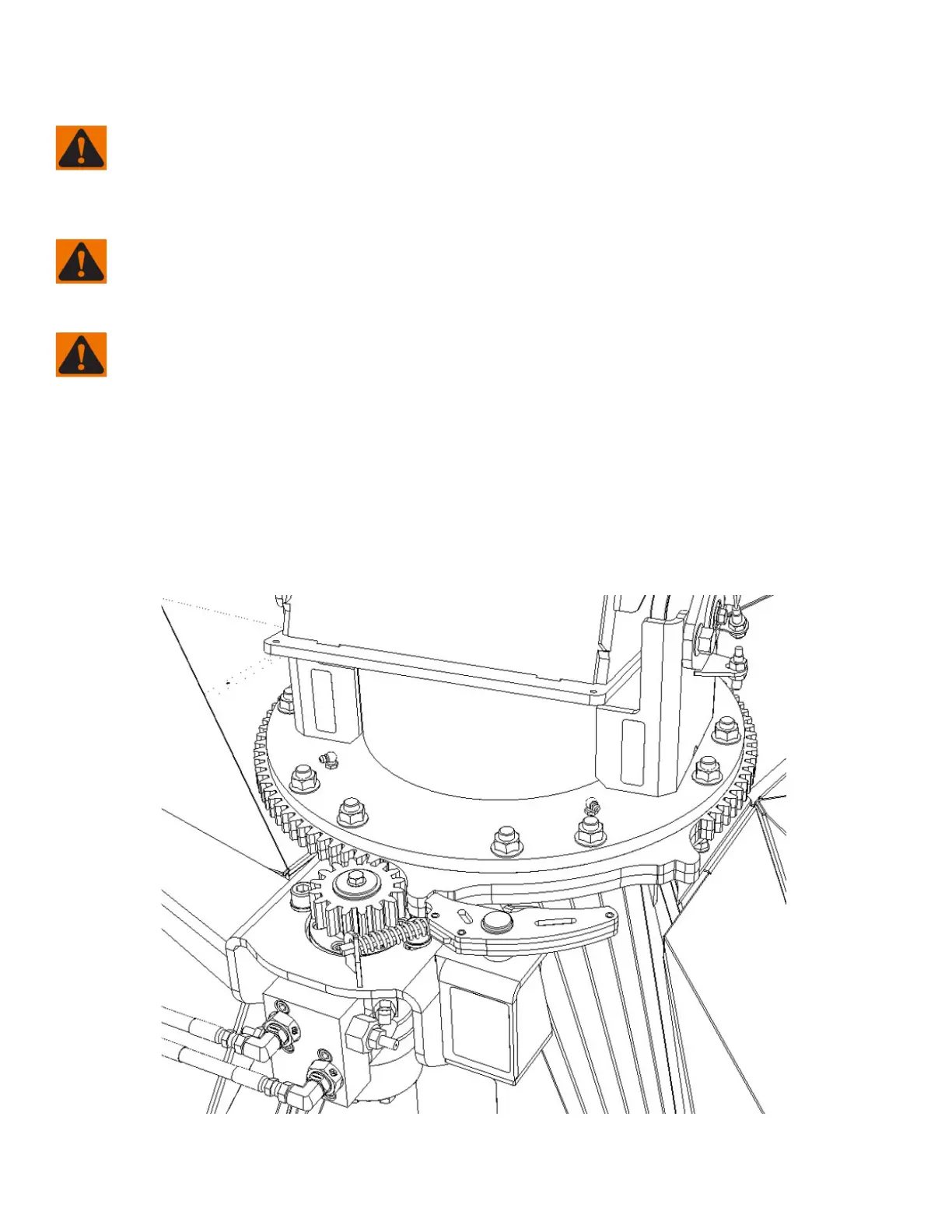
Figure 89 Spout in locked position


 To Next Page