The TPMS will continue to warn the driver of low tire
pressure as long as the condition exists, and will not
turn off until the tire pressure is at or above recom-
mended cold tire pressure. Once the low tire pressure
warning has been illuminated, the tire pressure must
be increased to the recommended cold tire pressure in
order for the TPMS Warning Light to be turned off.
NOTE:
When filling warm tires, the tire pressure may need to
be increased up to an additional 4 psi (28 kPa) above
the recommended cold placard pressure in order to
turn the TPMS Warning Light off.
The system will automatically update and the TPMS
Warning Light will extinguish once the updated tire
pressures have been received. The vehicle may need to
be driven for up to 20 minutes above 15 mph
(24 km/h) to receive this information.
For example, your vehicle has a recommended cold
(parked for more than three hours) tire pressure of
33 psi (227 kPa). If the ambient temperature is 68°F
(20°C) and the measured tire pressure is 28 psi
(193 kPa), a temperature drop to 20°F (-7°C) will
decrease the tire pressure to approximately 24 psi
(165 kPa). This tire pressure is sufficiently low enough
to turn on the TPMS Warning Light. Driving the vehicle
may cause the tire pressure to rise to approximately
28 psi (193 kPa), but the TPMS Warning Light will still
be on. In this situation, the TPMS Warning Light will turn
off only after the tires have been inflated to the vehi-
cle’s recommended cold tire pressure value.
CAUTION!
•
The TPMS has been optimized for the original
equipment tires and wheels. TPMS pressures and
warnings have been established for the tire size
equipped on your vehicle. Undesirable system
operation or sensor damage may result when
using replacement equipment that is not of the
same size, type, and/or style. The TPMS sensor is
not designed for use on aftermarket wheels and
may contribute to a poor overall system perfor-
mance or sensor damage. Customers are encour-
aged to use Original Equipment Manufacturer
(OEM) wheels to ensure proper TPMS feature
operation.
•
Using aftermarket tire sealants may cause the
TPMS sensor to become inoperable. After using an
aftermarket tire sealant it is recommended that
you take your vehicle to an authorized dealership
to have your sensor function checked.
•
After inspecting or adjusting the tire pressure,
always reinstall the valve stem cap. This will pre-
vent moisture and dirt from entering the valve
stem, which could damage the TPMS sensor.
NOTE:
•
The TPMS is not intended to replace normal tire
care and maintenance, or to provide warning of a
tire failure or condition.
•
The TPMS should not be used as a tire pressure
gauge while adjusting your tire pressure.
•
Driving on a significantly underinflated tire causes
the tire to overheat and can lead to tire failure.
Underinflation also reduces fuel efficiency and tire
tread life, and may affect the vehicle’s handling and
stopping ability.
•
The TPMS is not a substitute for proper tire mainte-
nance, and it is the driver’s responsibility to main-
tain correct tire pressure using an accurate tire
gauge, even if underinflation has not reached the
level to trigger illumination of the TPMS Warning
Light.
•
Seasonal temperature changes will affect tire pres-
sure, and the TPMS will monitor the actual tire pres-
sure in the tire.
The TPMS uses wireless technology with wheel rim-
mounted electronic sensors to monitor tire pressure
levels. Sensors, mounted to each wheel as part of the
valve stem, transmit tire pressure readings to the
receiver module.
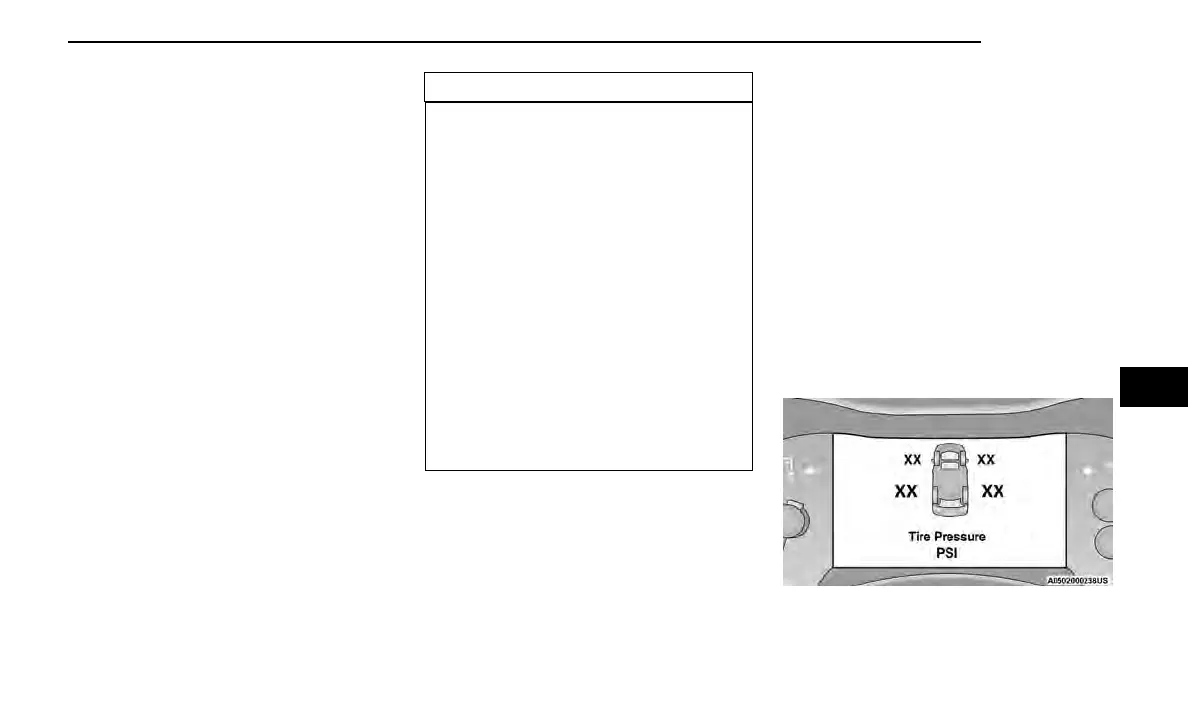
Tire Pressure Monitoring System Display
SAFETY 159
6














 To Next Page