NOTE:
It is particularly important for you to regularly check the
tire pressure in all of your tires and to maintain the
proper pressure
page 260.
The TPMS consists of the following components:
•
Receiver module
•
Four TPMS sensors
•
Various TPMS messages, which display in the instru-
ment cluster, and a graphic displaying tire pressures
•
TPMS Warning Light
Tire Pressure Monitoring System Low
Pressure Warnings
The TPMS Warning Light will illuminate in the
instrument cluster, and an audible chime will
be activated, when one or more of the four
active road tire pressures are low. In addi-
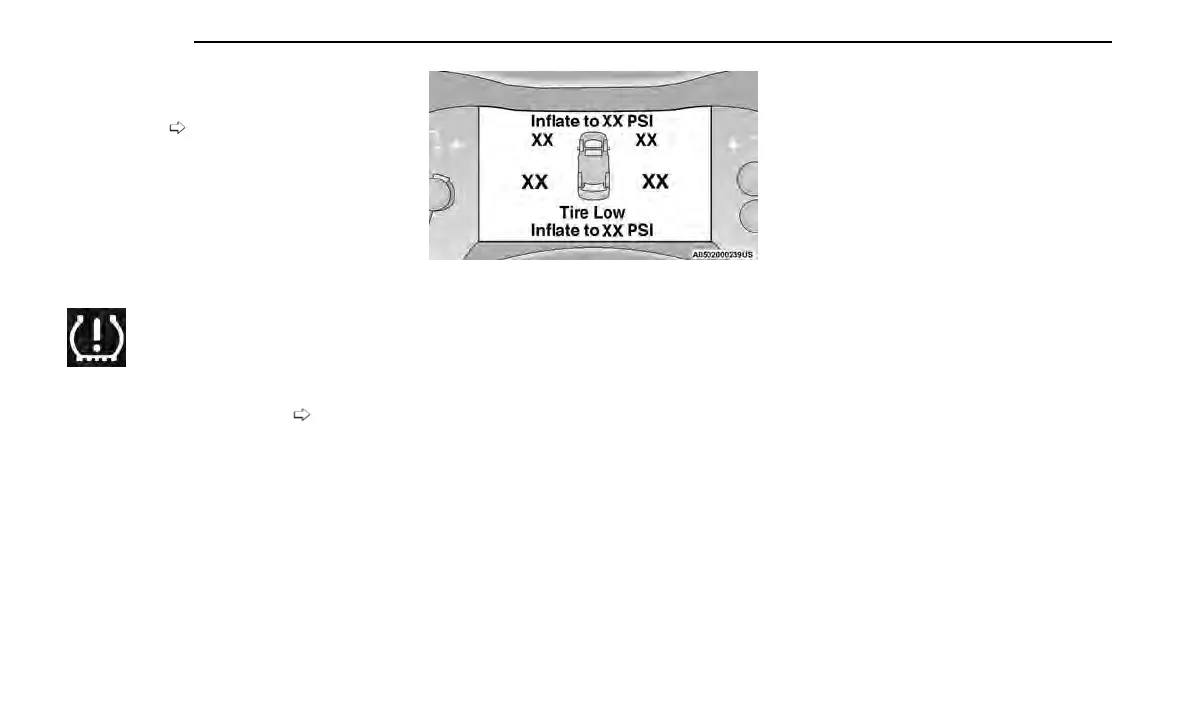
tion, the instrument cluster will display an "Inflate to XX"
message and a graphic display of the pressure value(s)
with the low tire(s) in a different color
page 69.
NOTE:
Your system can be set to display pressure units in PSI,
BAR or kPa.
Should a low tire condition occur on any of the four
active road tire(s), you should stop as soon as possible,
and inflate the low tire(s) that is in a different color on
the graphic display to the vehicle’s recommended cold
tire pressure displayed in the “Inflate to XX” message.
NOTE:
When filling warm tires, the tire pressure may need to
be increased up to an additional 4 psi (28 kPa) above
the recommended cold placard pressure in order to
turn the TPMS Warning Light off.
The system will automatically update, the graphic dis-
play of the pressure value(s) will return to its original
color and the TPMS Warning Light will extinguish once
the updated tire pressure(s) have been received. The
vehicle may need to be driven for up to 20 minutes
above 15 mph (24 km/h) to receive this information.
Service TPMS Warning
The TPMS Warning Light will flash on and off for 75
seconds, and remain on solid when a system fault is
detected. The system fault will also sound a chime. The
instrument cluster display will display a “SERVICE TPM
SYSTEM” message for a minimum of five seconds. This
message is then followed by a graphic display, with “--“
in place of the pressure value(s), indicating which Tire
Pressure Monitoring System sensor(s) is not being
received.
If the ignition switch is cycled, this sequence will repeat,
providing the system fault still exists. If the system fault
no longer exists, the TPMS Warning Light will no longer
flash, the "SERVICE TPM SYSTEM" message will not be
present, and a pressure value will be displayed instead
of dashes. A system fault can occur by any of the
following:
•
Jamming due to electronic devices or driving next to
facilities emitting the same radio frequencies as the
TPMS sensors.
•
Lots of snow or ice around the wheels or wheel
housings.
•
Using tire chains on the vehicle.
•
Using wheels/tires not equipped with TPMS
sensors.
Low Tire Pressure Monitoring System Display
160 SAFETY















 To Next Page