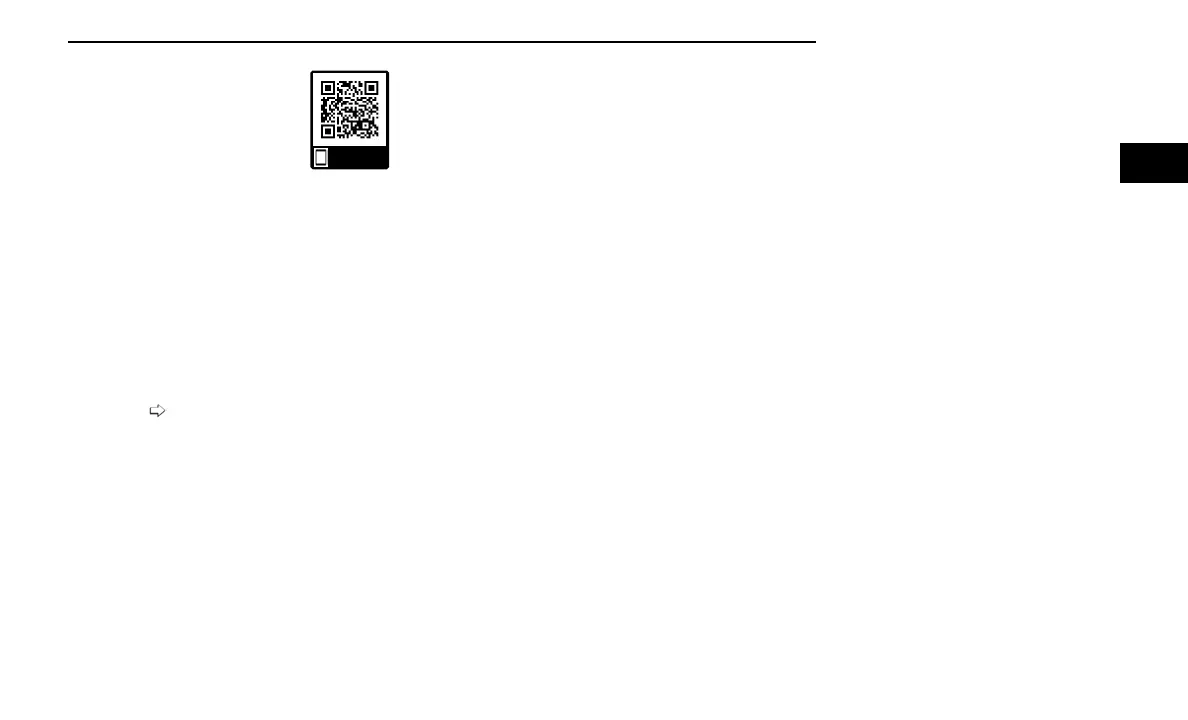
Use this QR code to access your digital
experience.
•
HomeLink® replaces up to three
hand-held transmitters that operate
devices such as garage door openers,
motorized gates, lighting, or home
security systems. The HomeLink®
unit is powered by your vehicle’s 12 Volt battery.
•
The HomeLink® buttons that are located in the
overhead console or sun visor designate the three
different HomeLink® channels.
•
To operate HomeLink®, push and release any of the
programmed HomeLink® buttons. These buttons will
activate the devices they are programmed to with
each press of the corresponding HomeLink® button.
•
The HomeLink® indicator light is located above the
center button.
NOTE:
HomeLink® is disabled when the Vehicle Security sys-
tem is active
page 260.
BEFORE YOU BEGIN
PROGRAMMING HOMELINK®
For efficient programming and accurate transmission of
the Radio Frequency (RF) signal, it is recommended
that a new battery be placed in the hand-held transmit-
ter of the device that is being programmed to the
HomeLink® system. Make sure your hand-held trans-
mitter is programmed to activate the device you are
trying to program your HomeLink® button to.
Ensure that your vehicle is parked outside of the garage
before you begin programming.
It is recommended that you erase all the channels of
your HomeLink® before you use it for the first time.
ERASING ALL THE HOMELINK®
CHANNELS
To erase the channels, follow this procedure:
1. Place the ignition switch in the ON/RUN position.
2. Push and hold the two outside HomeLink® buttons
(I and III) for up to 20 seconds, or until the
HomeLink® indicator light flashes.
NOTE:
Erasing all channels should only be performed when
programming HomeLink® for the first time. Do not
erase channels when programming additional buttons.
IDENTIFYING WHETHER YOU HAVE
A ROLLING CODE OR NON-ROLLING
CODE DEVICE
Before programming a device to one of your
HomeLink® buttons, you must determine whether the
device has a rolling code or non-rolling code.
Rolling Code Devices
To determine if your device has a rolling code, a good
indicator is its manufacturing date. Typically, devices
manufactured after 1995 have rolling codes. A device
with a rolling code will also have a “LEARN” or “TRAIN”
button located where the antenna is attached to the
device. The button may not be immediately visible when
looking at the device. The name and color of the button
may vary slightly by manufacturer.
NOTE:
The “LEARN” or “TRAIN” button is not the button you
normally use to operate the device.
Non-rolling Code Devices
Most devices manufactured before 1995 will not have a
rolling code. These devices will also not have a “LEARN”
or “TRAIN” button.
PROGRAMMING HOMELINK® TO A
GARAGE DOOR OPENER
To program any of the HomeLink® buttons to activate
your garage door opener motor, proceed as follows:
NOTE:
All HomeLink® buttons are programmed using this pro-
cedure. You do not need to erase all channels when
programming additional buttons.
1. Place the ignition switch in the ON/RUN position.
2. Place the garage door opener transmitter 1 to
3 inches (3 to 8 cm) away from the HomeLink® but-
ton you wish to program, while keeping the
HomeLink® indicator light in view.
3. Push and hold the HomeLink® button you want to
program while you push and hold the garage door
opener transmitter button you are trying to replicate.
4. Continue to hold both buttons and observe the
HomeLink® indicator light. The HomeLink® indica-
tor light will flash slowly and then rapidly. Once this
happens, release both buttons.
NOTE:
Make sure the garage door opener motor is plugged in
before moving on to the rolling code/non-rolling code
final steps.
Scan me
GETTING TO KNOW YOUR VEHICLE 37
2






 To Next Page