Vehicle System System Operation 31
Shoe Type Brake
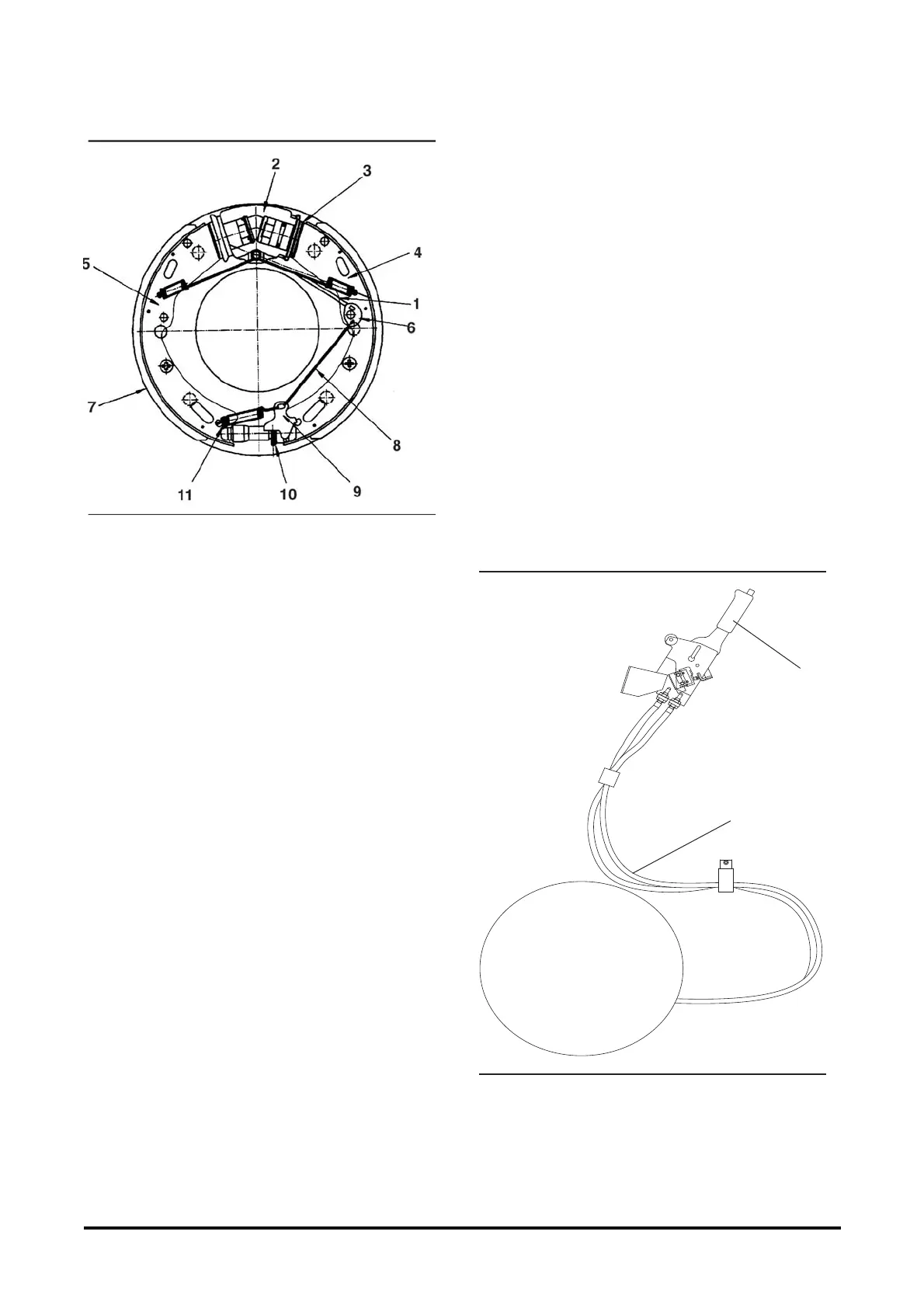
Brake with Automatic Adjustment (Right Side Shown)
(1) Upper adjustment link. (2) Cylinder assembly. (3) Piston.
(4) Secondary shoe. (5) Primary shoe. (6) Toggle lever. (7)
Support plate. (8) Lower adjustment link. (9) Adjustment lever.
(10) Adjustment screw. (11) Adjustment spring.
When the brake pedal is pushed down, the master
cylinder sends brake fluid to wheel cylinder (2).
Wheel cylinder pistons (3) are pushed out and move
primary shoe (5) and secondary shoe (4). The brake
shoes move until they make contact with the brake
drum.
When the brake action first starts, primary shoe (5)
comes in contact with the brake drum as it is in
rotation. This contact of the primary shoe puts some
force on secondary shoe (4) to help put it in position
against the drum.
Automatic Adjustment
Brakes with automatic adjustment are adjusted on
the reverse braking action. In this example the drum
rotation is counterclockwise (in reverse) which
causes a counterclockwise rotation of the brake
shoes.
Secondary shoe (4) moves away from cylinder (2)
that causes link (1) to move toggle lever (6) in a
clockwise rotation. Link (8) is connected to the lower
part of toggle lever (6) and to adjustment lever (9).
By this connection, adjustment lever (9) is moved in
a counterclockwise rotation.
When the brakes are released at the end of a
reverse brake application, adjustment spring (11)
puts adjustment lever (9) into its original position. If
the brake shoe lining has worn enough to let lever
(9) engaged, lever (9) will rotate screw (10) to put
the brake into the correct adjustment.
Parking Brake
Parking brakes use the shoe brake system
described above. The brakes are activated
mechanically instead of the hydraulic function. The
brakes are designed to hold the truck positively for
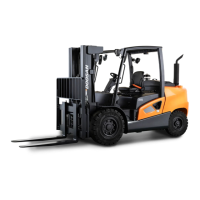
sure of parking by using parking lever (1) and cables
(2).
2
1



 To Next Page