Vehicle System Testing and Adjusting 67
Brake System
Brake System Air Removal
Systems With Remote Reservoir
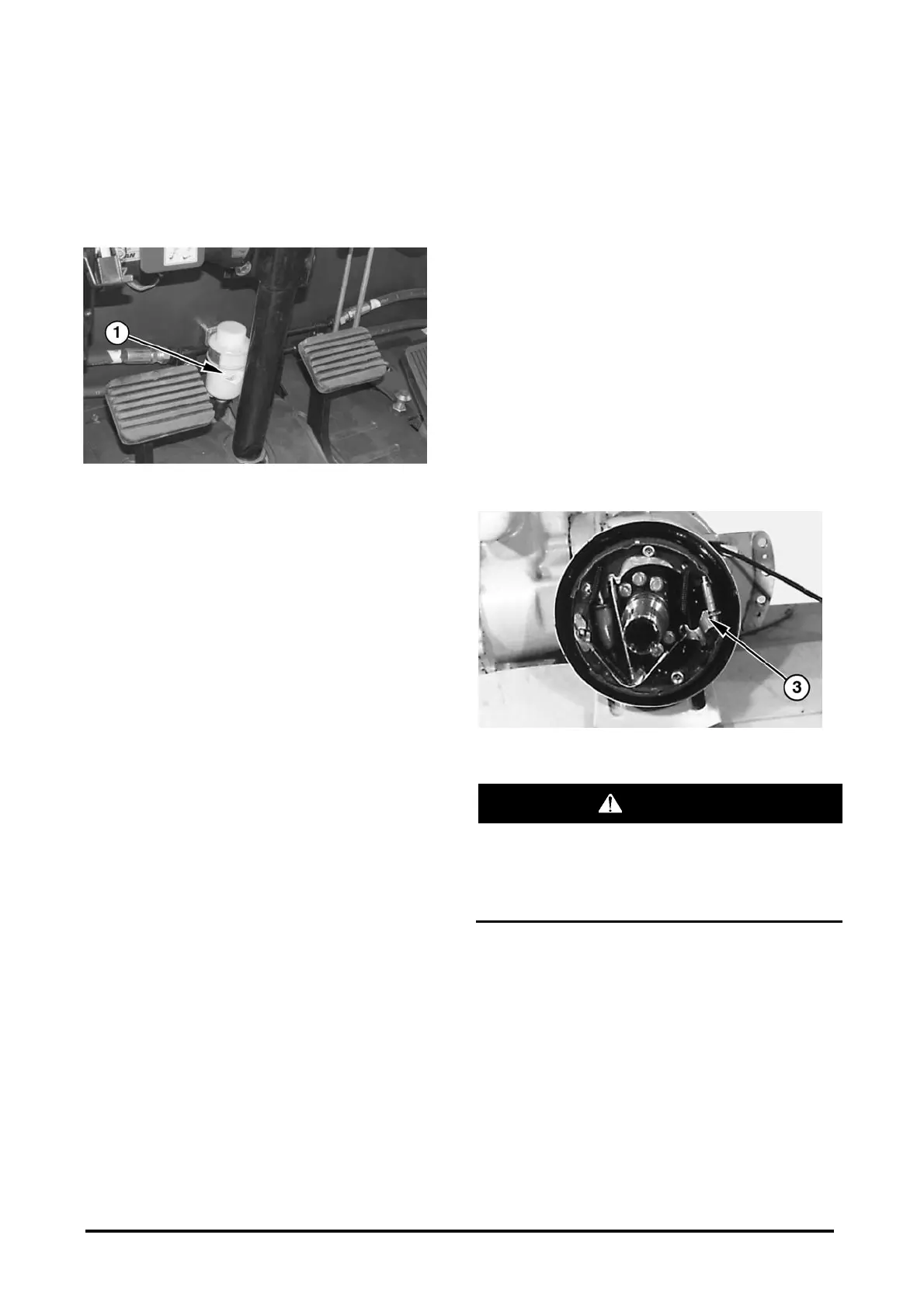
Remote Reservoir Location
(1) Remote reservoir.
When the brake pedal resistance is spongy (not
solid), it is usually an indication that there is air in
the brake hydraulic system. The cause may be low
fluid or oil level, leakage in the system, a broken
brake line or a brake line that is not connected.
To remove air from the brake system, do the
procedure that follows :
1. Fill remote reservoir (1) with the correct brake
fluid to 12 mm (.50 in) from the filler cap. See the
Operation and Maintenance Manual for the
correct brake fluid.
2. Put pressure on the brake pedal and open bleed
screw to let air out of the system. Close bleed
screw while pressure is still on the brake pedal
and then, let the pedal return to the original
position.
3. Do Step 2 again as many times as necessary until
the brake fluid is free of air.
4. Use the procedure in Steps 2 and 3 again, except
this time use the right bleed screw.
5. Fill remote reservoir (1) again, with the correct
fluid, to the level explained in Step 1.
Brake Adjustment
The brakes make an adjustment automatically when
an application is made in reverse, but only after an
application has been made in the forward direction.
With each reverse brake application, there happens
an adjustment until the lining-to-drum clearance is
made small enough to stop the movement of the
automatic adjustment linkage.
To do this on the vehicle condition, execute the
braking while driving in backward. Repeat about (15)
times.
Manual brake adjustment is necessary only when
new brake shoes are installed and the automatic
adjustment has been moved.
To make a manual adjustment to the brakes:
Brake Adjustment
(3) Adjustment screw.
WARNING
Wood blocks or jack stands of the correct
capacity must be used under the machine to
prevent the machine from a fall that is not
expected. Failure to do so can result in injury or
death.
1. Put wood blocks or jack stands of the correct
capacity under the machine.
2. Remove the plugs from wheel brake plate to
access the adjusting screw.
3. Put a brake adjustment tool such as a driver
through the hole and into a tooth on the
adjustment screw (3).



 To Next Page