Vehicle System Testing and Adjusting 61
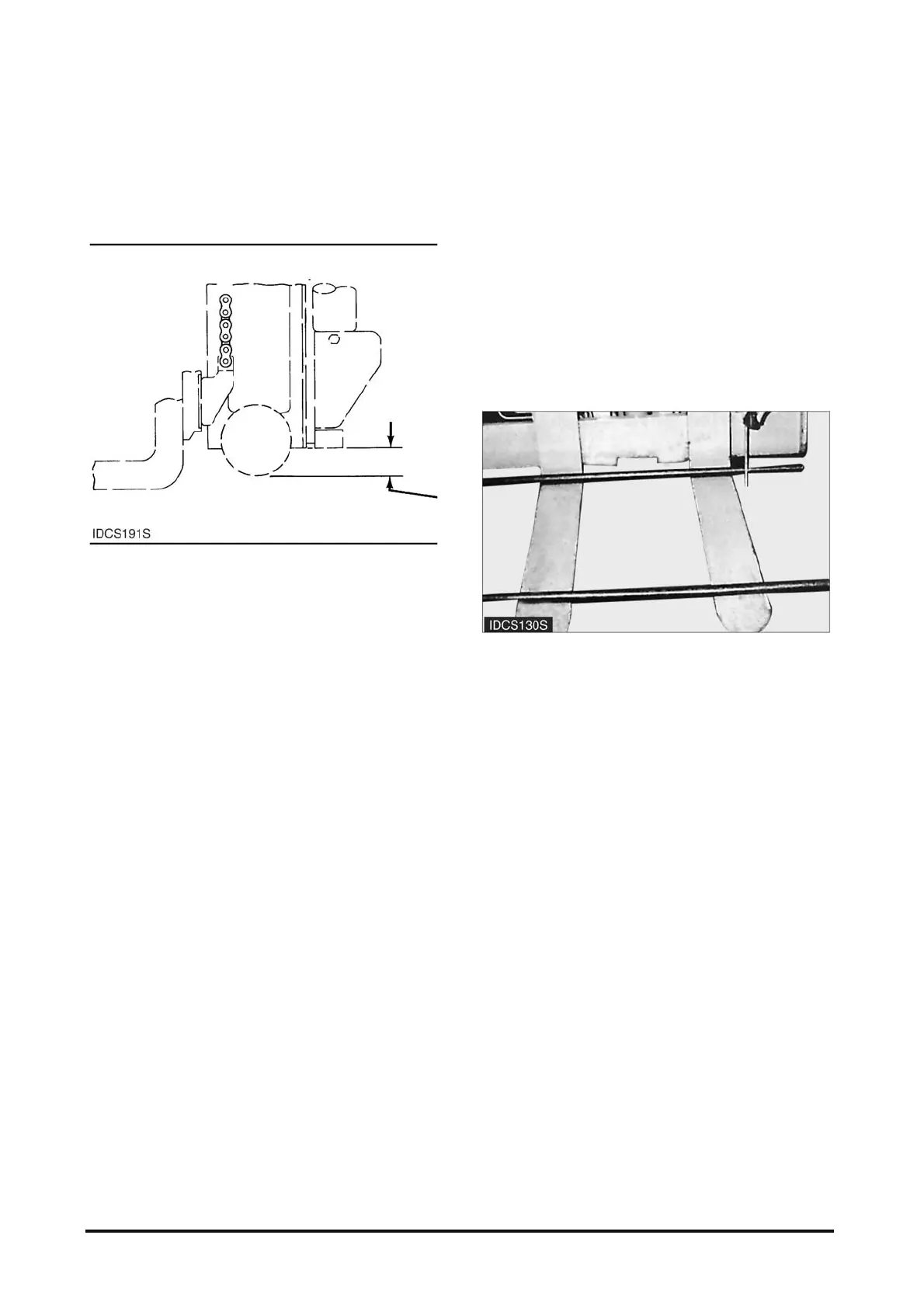
Carriage and Mast Height Adjustment
1. Move the mast either forward or backward so it is
in the vertical position.
2. Lower the carriage completely.
(Typical example)
3. On Full Free Lift and Full Free Triple Lift models,
the bottom of the inner mast must be even with
the bottom of the stationary mast.
4. Measure the distance from the bottom of the inner
upright to the bottom of carriage bearing.
5. The measurement (A) must be as follows:
STD .............................................................Zero
FFL& FFTL................ 41 L 1.5 mm (1.61 L .06 in)
NOTE: On Standard Lift models the bearing must be
even (flush) with the inner mast. If the above
measurements are not correct, make adjustments to
the chains to get the correct measurement. See
Chain Adjustments in TESTINGAND ADJUSTING.
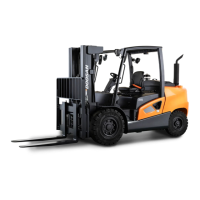
Forks Parallel Check
1. Lift the mast and operate the tilt control lever, until
the top surface of the forks is parallel with the floor.
Place two straight bars, that are the same width
as the carriage, across the forks as shown.
Measure the distance from the bottom of each
end of the two bars to the floor. The forks must be
parallel within 3 mm (.12 in) for Full Tapered and
Polished (FTP) forks, all other forks 6.4 mm
(.25in), for their complete length.
2. If not parallel, determine which one is defective
and replace it.
Forks Parallel Check (Typical Example)



 To Next Page