Tamarisk
®
Camera Control Software User Guide
5.7 LENS CALIBRATION
All Tamarisk
®
camera cores are calibrated as stand alone units prior to leaving the factory to ensure
product specifications are met. This includes all lensed and no-lens versions commonly referred to as
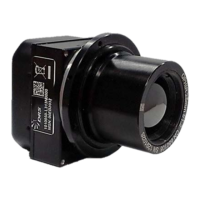
thermal imaging modules or TIMs. TIMs start as fully assembled cameras and are calibrated with a
specified lens. After calibration, the lens is removed and the unit is ready for shipment.
However, as cores are often just one component of an integrated systems, the factory calibration may
not always prove to be the most optimal. Therefore the Lens Calibration Utility has been designed to
enable integrators to compensate for nonuniform conditions that may have been introduced when
embedding the Tamarisk
®
camera core into a system or when installing a new lens or any other
process that may have altered the isothermal nature of the camera core.
Please refer to section 3.1 (Lens Calibration Requirements) for a list of recommended equipment and
software version requirements.
5.7.1 Lens Calibration – Theory of Operation
During the calibration process, the camera stares at two uniform scenes of different temperature;
the response of each pixel is automatically captured, tabulated and saved to one of 5 user selected
memory locations known as Tables. Using this pixel data, individual gain and offset values for
each pixel are calculated resulting in a matrix or table of correction coefficients for the entire
pixel array. When applied, these correction coefficients compensate for the non-uniformities of
the system and pixel behavior characterized for the given set of conditions under which the
calibration was performed. When performed with an optical assembly between the focal plane
array and the uniform scenes, these coefficients will “calibrate out” the non-uniformity of the the
optical design.
Additionally, the Lens Calibration utility permits the upload/download of calibration tables; this is
very useful when configuring multiple cameras with the same configuration as the data may be
stored on an external PC and uploaded to each camera during its build/configuration cycle.
Other useful applications include: In the case of an optical zoom lens, the user may want to
calibrate the zoom lens at different zoom settings and store the data for future use. Or, the user
may calibrate the camera under different environmental conditions (hot, cold, mild temperatures)
and save this data to one of the 5 tables and then call on the table as needed.
5.7.2 Lens Calibration - Getting Started
In this section a step-by-step procedure for accessing the Lens Calibration Utility.
1. To install the latest version of the Camera Control Software including the Lens Calibration
utility please follow instructions outlined in section 3.2.
2. Clicking the Lens Calibration tab for the first time, the user is prompted to enter a pass key.
To obtain a pass key, please contract your DRS representative. Figure 36 illustrates the pass
key screen. The hash number is used to generate a unique pass key. The computer and pass
key are tied together. The pass key is a 25 character alpha numeric string which is typed or
pasted into the text box.


 To Next Page