Page 81
Pulmonary Function Test • Publication 014181-001 Rev 02 • www.datasci.com ©2023 Data Sciences International
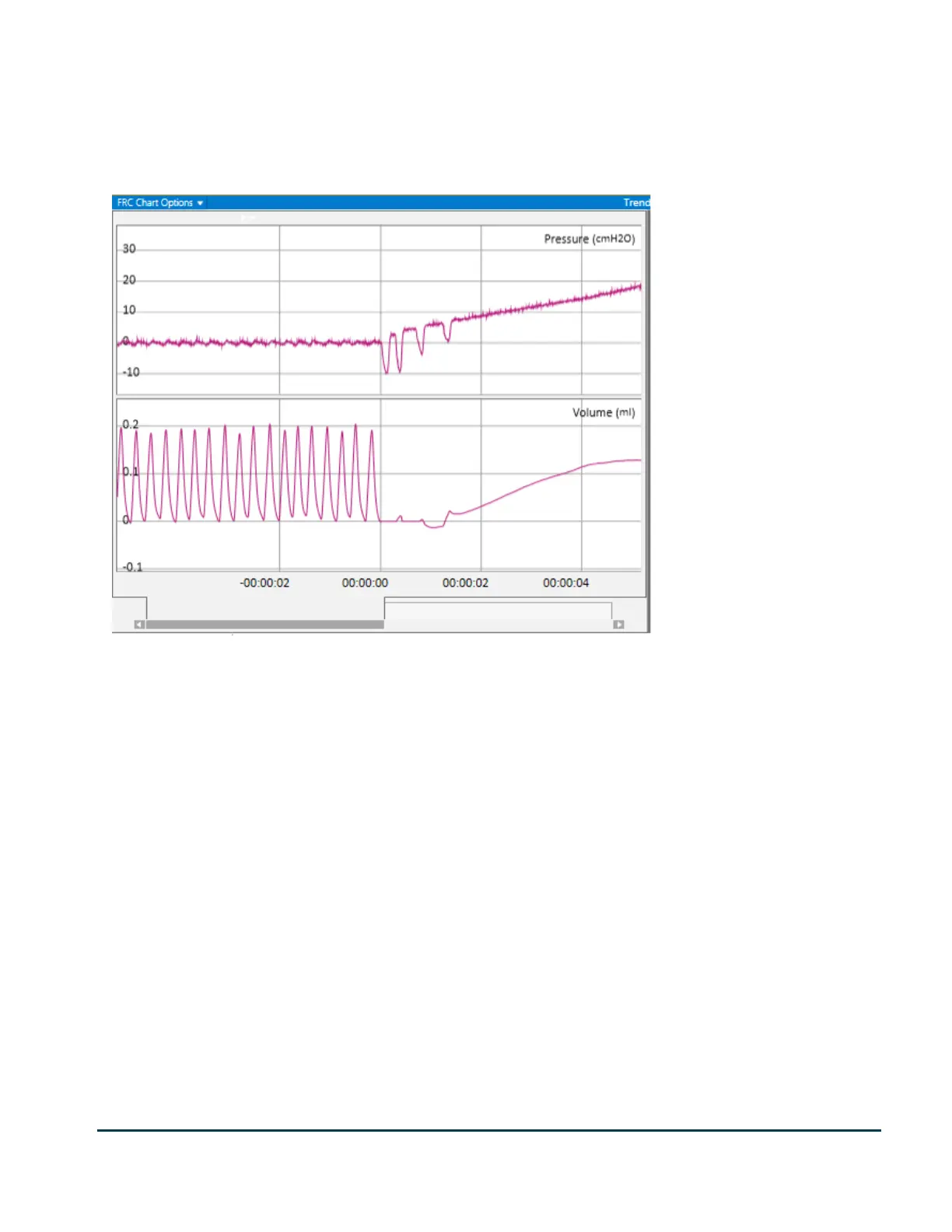
No Efforts During FRC Occlusion
If you ventilate the subject prior to running the FRC test, it is possible that when FinePointe occludes the airway,
the subject is hyperventilated and does not try to breathe. The data returned may look something like the
following:
The volume appears to drift away. FinePointe actually uses the Pressure to determine if an effort is present. The
data above does technically have an effort or two, but this data should be rejected since the subject did not try to
breathe past those couple of effort. To correct this, turn off the ventilator until the subject begins to breathe again
on its own. Once the subject is breathing regularly again, you can start your test.
Data Assumptions Met
You can also get an indication of how well the pressure and volume data agrees with the model by looking at the
R2 parameter. FinePointe attempts to compute FRC on as many samples as it can. Not every pressure and volume
pair yields the same FRC result. This parameter is a number between 0 and 1 representing the how well each pair
agrees. If all the pairs agree precisely, the result will be 1. If something has gone wrong, making them all differ,
then the result can start to fall. Experience will tell you what is a good R2, and certainly if you intend to reject the
worst one, criterion which can help you decide is the R2 result. Achieving R2 better than 0.95 should not be
difficult.
If you see R2 results below 0.9, you should look for a leak around the tracheal tube or possibly in the manifold.


 To Next Page