Introduction
1-2
1
Switch Architecture
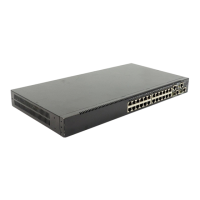
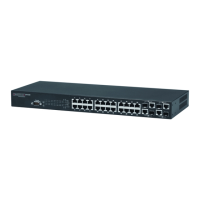
The ES3526YA/ES3550YA employs a wire-speed, non-blocking switching fabric
2
.
This permits simultaneous wire-speed transport of multiple packets at low latency on
all ports. The switches also features full-duplex capability on all ports, which
effectively doubles the bandwidth of each connection.
The switches uses store-and-forward switching to ensure maximum data integrity.
With store-and-forward switching, the entire packet must be received into a buffer
and checked for validity before being forwarded. This prevents errors from being
propagated throughout the network.
The switches include built-in stacking ports that allow multiple units to connected
together through a 4 Gbps stack backplane. The switch stack can be managed from
a master unit using a single IP address.
Network Management Options
With a comprehensive array of LEDs, the ES3526YA/ES3550YA switches provide
“at a glance” monitoring of network and port status. The switches can be managed
over the network with a web browser or Telnet application, or via a direct connection
to the console port. The switches includes a built-in network management agent that
allows them to be managed in-band using SNMP or RMON (Groups 1, 2, 3, 9)
protocols. They also have an RS-232 serial port (DB-9 connector) on the front panel
for out-of-band management. A PC may be connected to this port
for configuration
and monitoring out-of-band via a
null-modem serial cable. (See Appendix B for wiring
options.)
For a detailed description of the advanced features, refer to the Management Guide.
Description of Hardware
10BASE-T/100BASE-TX Ports
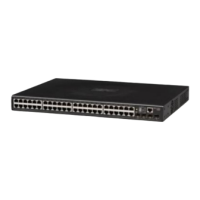
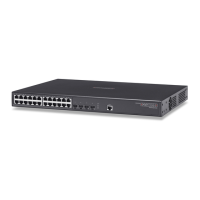
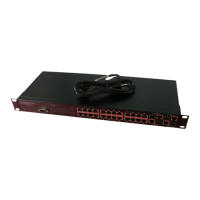
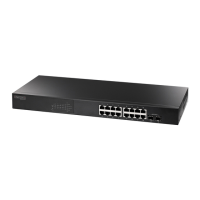
The ES3526YA/ES3550YA switches contain 24/48 10BASE-T/100BASE-TX RJ-45
ports. All ports support automatic MDI/MDI-X operation, so you can use
straight-through cables for all network connections to PCs or servers, or to other
switches or hubs. (See “10BASE-T/100BASE-TX Pin Assignments” on page B-1.)
Each of these ports support auto-negotiation, so the optimum transmission mode
(half or full duplex), and data rate (10 or 100 Mbps) can be selected automatically. If
a device connected to one of these ports does not support auto-negotiation, the
communication mode of that port can be configured manually.
2. Non-blocking switching is used for traffic crossing ports attached to the same switch ASIC;
while blocking is employed for traffic passing between different switch chips. The ES3526YA
only has one switch chip; ES3550YA has two – ASIC#1: Ports 1-12, 25-36, 49, 51 and ASIC#2:
Ports 13-24, 37-48, 50, 52.



 To Next Page