10
Antennas
General information on antennas can be found on the
next page. Here, we show two examples of antennas
for portable operation that can be set up quickly.
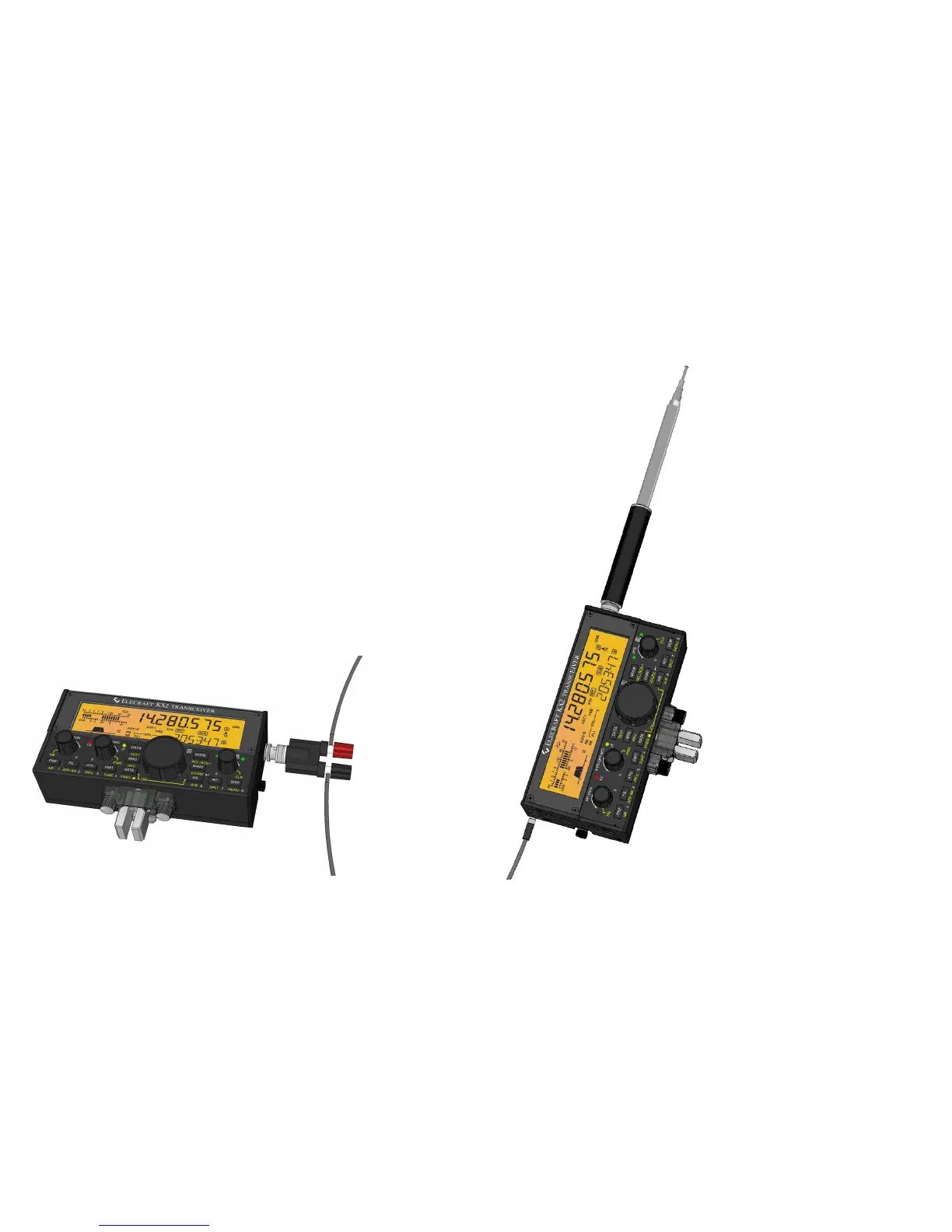
The illustration at left shows a simple wire antenna
connected to a KX2 via a BNC-to-binding post adapter
(Elecraft BNC-BP or equivelant). The wire tied to the
red post (antenna hot lead) is attached to a tree or other
tall support. The wire tied to the black post (radio
chassis ground) is the equally important counterpoise,
which is typically laid on the ground.
A length of about 25 feet for each wire, matched to the
KX2’s output using an antenna tuner (see ATU, pg. 11)
will typically provide good performance on 40-10 m.
(Without an ATU, resonant lengths are required for
each band.) This antenna is ideal for outings where all
gear must fit into a small bag (e.g, our model CS-40).
At right, a KX2 is shown in hand-held orientation
with a telescoping whip antenna. An Elecraft AX1
or similar lightweight whip is recommended.
(Such antennas are electrically short, making
contacts more challenging. Best results will
be obtained on 20 meters and higher.)
When using a whip antenna, you’ll also need a
counterpoise wire, shown here attached via
a mini-banana plug (Elecraft model
KX2GNDPLUG). A length of about
13 feet is a good compromise for 20-10
meters. This is sometimes called a
“trailing ground” by those who operate
pedestrian mobile (/PM). If you step
on the counterpoise wire, or get it
snagged, the mini-banana plug
will pull out safely, avoiding
damage to the KX2.


 To Next Page