63
Theory Of Operation
This section includes a functional description of the KX2’s RF, control panel (CP), and option boards; a block
diagram; and a glossary of selected technical terms. Also see the KX2 FAQ (www.elecraft.com).
RF Board
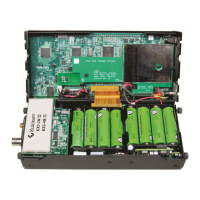
The RF board contains all of the KX2’s RF circuitry as well as low-level baseband (AF) stages in the receive path.
The relay-switched low pass filters are used during both transmit and receive. The signal on the antenna side of the
filters pass through a forward/reflected power and SWR bridge to the antenna jack (BNC), or to the optional
KXAT2 automatic antenna tuner. Latching relays are used to minimize power consumption. Transmit/receive
(T/R) switching splits the common signal path from the antenna and low pass filters to either the transmitter power
amp or receiver input. T/R switching uses PIN diodes and CMOS switches for clean, silent transitions.
The RF band-pass filters are used for both transmit and receive. Filters are selected with PIN diodes. The band
pass filters significantly attenuate receive signals at harmonics of the RX frequency, particularly the odd harmonics.
Following the band pass filters and T/R switching are the RF preamplifier and an attenuator. These provide
various tradeoffs between overall receive gain and noise figure (or MDS).
The RX mixer converts the RF signal to quadrature (8 kHz IF I and Q signals), which are low-pass filtered and
amplified before being passed to the CP board for analog to digital conversion (ADC).
The TX AF Amp and TX mixer block converts baseband (AF I and Q) modulating signals to an RF signal which
is then routed to the T/R switching and band pass filters. This signal provides excitation to the 10 W power
amplifier (PA). The PA uses a pair of RF power MOSFETs. Temperature monitoring of the MOSFETS allows
automatic reduction of power if they become too hot during long transmit periods.
The optional KXAT2 automatic antenna tuner (ATU) option connects between the BNC antenna jack and the RF
board’s SWR/power bridge and low pass filters. It uses a latching relay-switched “L network” with seven inductors
and seven capacitors capable of matching a wide range of antenna impedances. The KXIO2 option incorporates a
real-time clock (RTC) function, useful for logging and time-keeping. It also has two general-purpose outputs that
can be used to turn on relays, etc., in external gear. These are open-drain outputs (the drain lead of a MOSFET
transistor). They act like contact closures to ground.


 To Next Page