66
Glossary of Selected Terms
The following terms are often used in the discussion of amateur radio transceivers and related equipment. All are
applicable to the KX2, used here to illustrate some of the concepts. Also see the ARRL Handbook.
________________
A-to-D or ADC (analog-to-digital converter): An integrated circuit that converts analog signals such as audio or
RF into digital form. Digital signals can then be processed by a digital signal processor, or DSP (see below).
AF, RF, and IF: AF stands for audio frequencies—usually, sounds that you can hear. RF, or radio frequencies, are
the actual frequencies of the radio signals (or TV, or cell phone, etc.). IF, or intermediate frequencies, are generally
somewhere between RF and AF. In a receiver, it is usually advantageous to convert RF signals to a lower IF at
which is it more practical to obtain gain or selectivity. These IF signals are then further converted to AF and
amplified further so they can be used to drive headphones or speakers.
Attenuator: A circuit that reduces signals to a safe level for use by subsequent stages in a receiver or transmitter.
The KX2’s receiver includes a switchable attenuator (pg. 17).
ATU (automatic antenna tuner): A device inserted between a transmitter (or transceiver) and an antenna that
establishes an optimal match between the two, thus allowing full power transfer. (See KXAT2, pg, 33.)
D-to-A or DAC (digital-to-analog converter): An integrated circuit that converts digital signals into analog form,
such as audio or RF. Also see DSP, below.
dB (decibel): A measure of signal increase or decrease, or of one signal relative to another signal. In human terms,
one dB represents a “just noticeable difference” between two signals. Mathematically, dB is derived from the
logarithm of the ratio of two signals. Receivers must handle signals over a huge range—in excess of 100 dB. dBm
is a more specific term that means “dB relative to 1 milliwatt” (1 mW) of power. 1 mW is thus “0 dBm.”
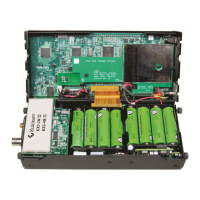
DC-to-DC converter: A device that converts one DC voltage into another. For example, the KX2 includes a very
efficient DC-to-DC converter that converts 12 V (nominal) at the DC input jack to 3.3 V for use by its low-voltage
circuitry. The advantage of a DC-DC converter is that when it steps voltage down, it steps current up (or vice-
versa). In this case, the 300 mA the KX2 consumes at 3.3 V might require only 100 mA at the 12 V power source.
DSP (digital signal processor): A highly specialized numeric computer, implemented on a single integrated
circuit, that processes signals digitally. Inputs to the DSP must generally be converted from analog to digital form
(see A-to-D, above), while outputs from the DSP must be converted from digital to analog (see D-to-A). Use of DSP


 To Next Page