The two outputs could be used singly or in combination to switch an external
device such as an antenna switch, select taps on a loading coil, etc. This could be
especially useful during mobile operation. (Note: Elecraft does not yet offer any
products that make use of the AUX outputs, but may in the future.)
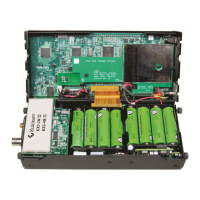
Low-battery warning threshold. The default (10.0 volts) is sufficient for use with
some 12 V batteries such as gel cells, as well as for the specified 11 V Li-ion
battery pack. If the internal battery or external supply/battery voltage drops below
the selected level, the operator will be alerted with BAT LOW messages every
few minutes. Regardless of this setting, the KX2 will turn itself off if the supply
voltage drops below 7.5 V.
To extend battery life, turn the backlight and preamp off when not needed, and use
headphones rather than the internal speaker.
LCD backlight on/off. The display is transflective, so it can be seen in sunlight
with the backlight turned off. Turning it off will extend battery life.
Sets the carrier-operated-relay (COR) threshold. The COR is used to detect, and
protect the KX2’s receiver from a transmitter being used nearby. 0.1 watts is the
default and recommended level. See Troubleshooting for other suggestions.
Iambic keying mode (A or B ). The default is mode A, which is a little more
forgiving for first-time operators. Mode B may be preferred by operators who
learned to do “squeeze-keying” with another keyer having this or a similar mode.
Both modes provide dot- and dash-memories—enabling fast code speeds—but
with slightly different “element-insert” timing.
Specifies whether the left keyer paddle (tip contact on the KEY jack) is DOT or
DASH. A third selection, HAND, allows either tip or ring to function as a hand
key, or as an input for an external keying device (keyer, computer, etc.).
Specifies whether the left lever of a KXPD2 (or KXPD3) keyer paddle is DOT or
DASH. A third selection, HAND, allows either lever to function as a hand key, or
as an input for an external keying device (keyer, computer, etc.).
When set to ON, the upper half of the S-meter becomes a tuning aid for CW,
PSK31/63 (PSK D mode), or RTTY (FSK-D mode) signals. Also, when CWT is
on in CW or PSK D modes, the manual signal spotting function of the KYR-


 To Next Page