Also see Receive Opposite Sideband calibration, pg. 39.
Your KX2’s serial number, e.g. 05000. Cannot be changed.
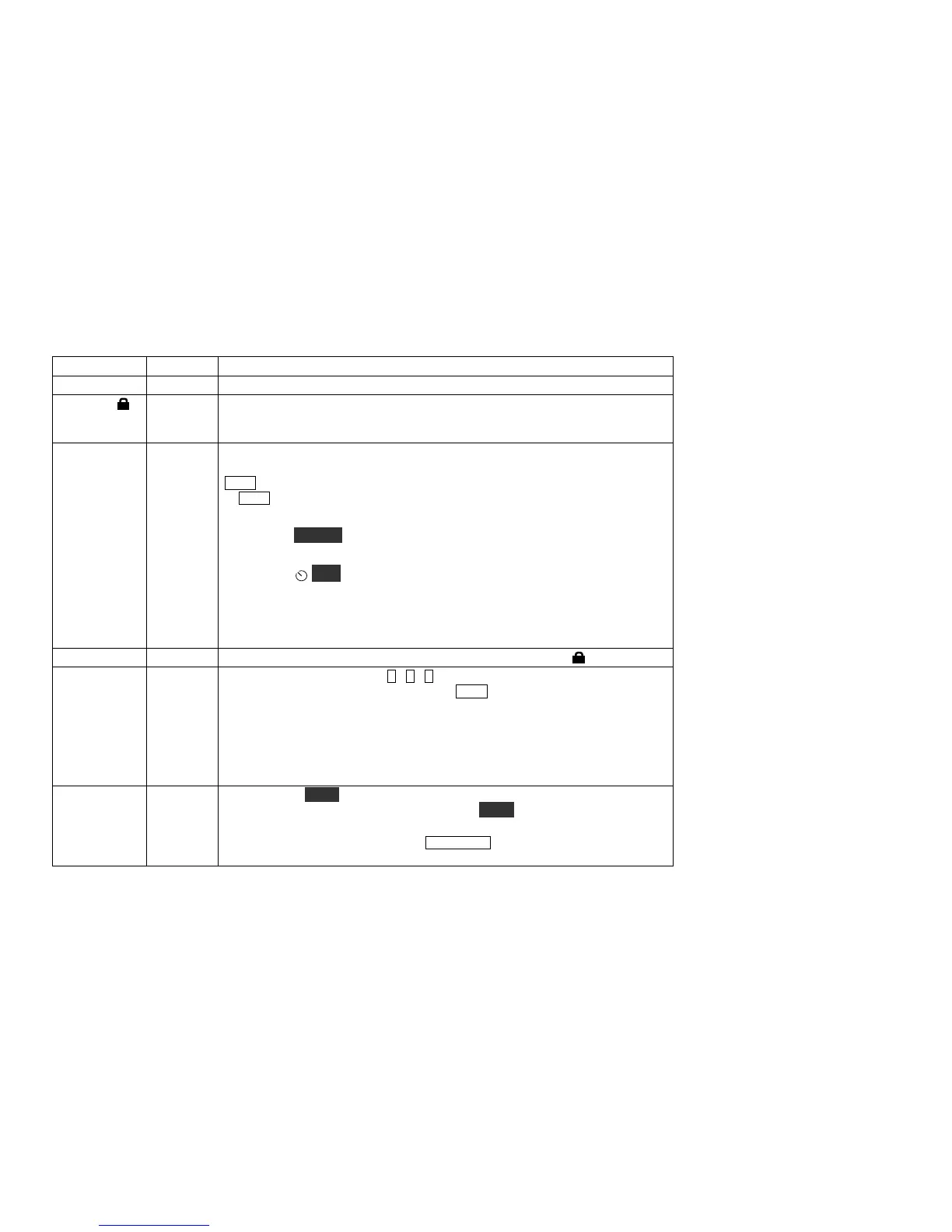
To turn on switch test, rotate VFO A until the parameter becomes SCN ADC.
Then hold any switch to see its scan row and column ADC reading.
If set to ON, switch presses generate audible feedback tones. If set to CODE nn,
Morse code characters are generated at nn WPM on control activation. The normal
DISP switch function (special displays) is not available in this case. Instead, a tap
of DISP reads out the operating mode and frequency in kHz, e.g. “U 238” for USB
on 7.238 MHz. (Plain-text description of the full Morse UI available on request.)
Holding the APF/AN switch during power-on will also turn on Morse feedback.
Switch tone volume is the same as CW sidetone volume. It must be adjusted in CW
mode, using MON.
Pitch of switch tones and Morse characters: In general, a low-to-high tone pair
(or high-pitched Morse) is generated when a switch function is turned on, and
high-to-low (or low-pitched Morse) when it is turned off. Some switches do not
generate tones because they might interfere with received or transmitted audio.
Set to ON to reveal Tech Mode menu entries (those marked with
in this list).
Real-time-clock view/set. Tap 1 / 2 / 3 to set HH / MM / SS. To see the time and
other displays during normal operation, tap DISP (see pg. 23). Time is only
maintained if a KXIO2 option module and an internal battery are installed.
Also see the RTC ADJ menu entry, which may be used to improve the long-term
accuracy of the real-time clock.
Note: The clock circuitry must be powered by the KX2’s internal battery or an
attached power supply. Refer to the KXIO2 menu entry for details.
If set to NOR, TUNE power level follows the POWER knob. Otherwise, the
parameter sets a fixed power level (0-10 W) for TUNE, overriding the present
POWER knob setting.
Note: TUN PWR does not pertain to ATU TUNE, which uses 2 or 3 W (KXAT2)
or 5 W (KXAT100).


 To Next Page