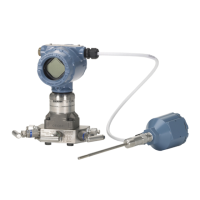
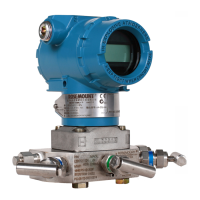
2808B DP Transmitters / 1B-11
1B.5 DP MEASUREMENT APPLICATIONS
2808-XXB Transmitters measure the differential pressure of pressurized liquids, gases, or
steam. They can also be used to measure a column of liquid in a tank or vessel. A discussion
of some basic applications follows:
Liquid Application. When measuring the differential of pressurized liquids, mount the
DP Transmitter below the orifice plate to minimize entry of air into the Transmitter and its
con-necting lines. As shown in Figures 1B-7 and 1B-8, the HI side of the Transmitter must
con-nect to the upstream side of the orifice otherwise Transmitter readings will be reversed.
Figure 1B-7 - Liquid, Horiz. Pipe Figure 1B-8 - Liquid, Vert. Pipe
These installations should include process shutoff and bypass valves as shown in the
illustrations. For normal Transmitter operation, both process valves must be open and the
bypass valve closed. The lines are bled by using the vent plugs on both flanges of the
Transmitter.
When calibrating the Transmitter, a zero differential can be generated by opening the
bypass valve and closing both shutoff valves. Calibration is covered in Section 3.
Gas Application. The gas industry typically measures differential pressure, static
pressure, temperature, and other variables associated with gas flow. Figures 1B-9 and 1B-
10 show a Model 2808-35B Transmitter measuring the differential pressure across an
orifice plate. A Model 2808-15B measures the static pressure at the upstream side of the
plate. In both illustrations the transmitters are mounted above the orifice plate so that
liquids and sediment drain away by gravity. It is essential that the HI side of the DP
Transmitter connect to the upstream side of the plate otherwise the DP readings will be
incorrect. Similarly, if the GP Transmitter is connected to the downstream side, SP
readings will be incorrect.
These installations should include process shutoff valves and bypass valves. The shutoff
valves permit the Transmitter to be checked or serviced without disrupting the process. For
normal Transmitter operation, both process valves are open and the bypass valve is closed.
Vent plugs on both flanges of the transmitter may be used to bleed the lines.


 To Next Page
 Loading...