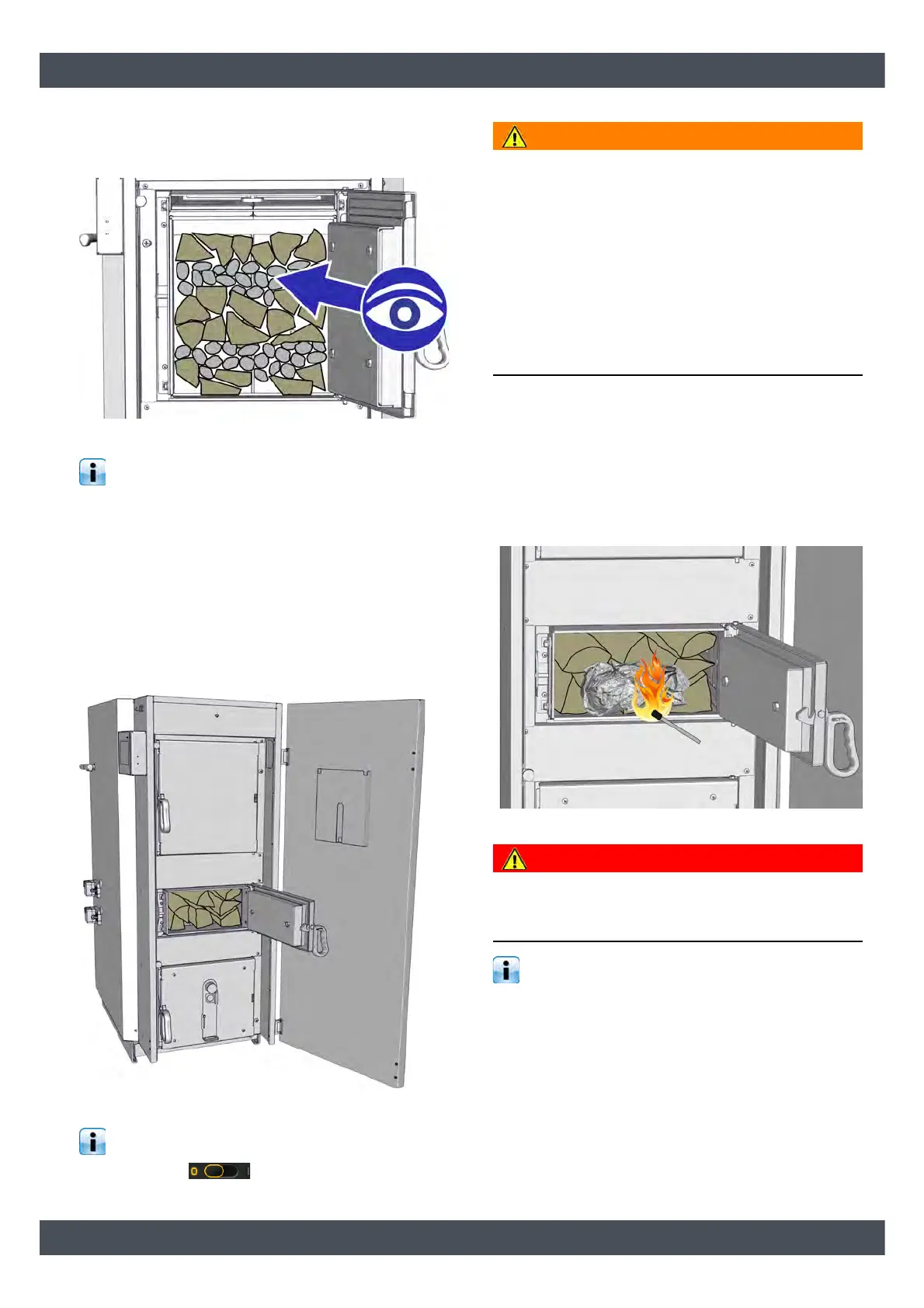
round logs, wood waste) between the layers with
additional logs. The smaller the pieces of additional
fuel are, the more logs must be added between them.
Fig. 6-12: Additions
Under no circumstances should secondary fuel
(brushwood, coarse wood chips, round logs,
wood waste) be used for the bottom layer. Such fine
material burns too quickly, resulting in incomplete
combustion in the combustion chamber, which is still
cold during start-up. As a result, the heat exchanger
may become soiled with tar deposits.
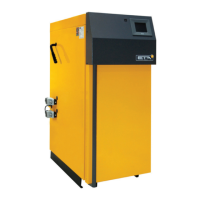
Closing the fuel chamber door, opening the
ignition door
Close the fuel chamber door and then open the ignition
door.
Fig. 6-13: Ignition door open
If the boiler is not to be started up yet, close both
doors and, in the boiler overview, switch off the
boiler using the switch.
WARNING!
Ignition of the wood by embers
If the wood that has been added has already ignited,
for example from embers in the fuel chamber, the
boiler may not be switched off. A sudden inflow of air
in the presence of smouldering wood may result in an
explosion.
Do not turn off the boiler and continue heating.
Leave the ignition door slightly open until the
exhaust temperature reaches above 100 °C. Only
then should you close the ignition door and the
insulating door.
Igniting fire with cardboard and newspaper
Place crumpled paper or a few pieces of cardboard in
front of the first layer of wood and ignite it. The draught
fan sucks the flame over the tightly stacked logs,
causing them to ignite more quickly. For heavy, smooth
hardwood, larger pieces of wood may be needed for
start-up.
Fig. 6-14: Ignition
DANGER!
No ignition aids such as petrol
Never use petrol, turpentine or similar materials as an
"ignition aid". Risk of explosion!
The ignition door should be kept open after
ignition in order to monitor the progress of the fire.
Do not close the ignition door until the boiler has
reached an exhaust temperature of 100 °C.


 To Next Page