70 www.eta.co.at
Information about measurement Emission measurement
9 Emission measurement
9.1 Information about measurement
9.1.1 Introduction
If possible, perform emissions measurements in
winter only
It is preferable to measure emissions in winter so that
heat consumption to the heating system is ensured
during the emissions measurement.
In spring and fall, the consumers in the heating
system usually need less heat. If emissions are
measured during this time, excess heat cannot be
safely removed from the heating system. As a remedy,
temporarily switch the heating circuits to continuous
"Day" operation. Also temporarily raise the target room
temperature by a few degrees so that the heating
circuits switch on safely. After measuring emissions,
switch back to the original operating mode and room
temperature.
Timely cleaning of the boiler for emissions
measurement
The customer will be notified of the date of emissions
measurement. Thoroughly clean the boiler and flue
duct 3 to 5 days before measuring emissions. Refer to
the documents included with the boiler (maintenance
instructions, operating instructions) for the necessary
steps. Once this is complete, heating can resume as
usual.
If you wait to clean until just before the emissions mea-
surement, large amounts of flue ash will be present in
the flue gas, resulting in false measurement results.
Regular cleaning and maintenance of the boiler is
essential for having low emissions and therefore good
measurement results. You can perform cleaning by
yourself but we recommend contracting a technical
expert for maintenance. Then the heating system will
be well prepared for the emissions measurement.
Required heat-up time and residual oxygen level
Emissions may be measured only once the boiler has
reached the necessary operating temperature (not
only the feed temperature). Therefore, once switched
on, the cooled boiler must run for a certain amount of
time (heat-up time) in order to reach the required
operating temperature. These times are indicated in
the following table. Measuring during this heat-up time
is thus prohibited.
Tab. 9-1: required heat-up time
Once the boiler has reached the operating tempera-
ture, the residual oxygen level must be between 4%
and 8%. This is indicated in the boiler's text menu
under:
Tab. 9-2: Current residual oxygen content
If the boiler is at operating temperature and the
residual oxygen level is above 8%, then leak air
is probably getting into the boiler through improperly
sealed boiler doors, the maintenance cover, or
Lambda probe. The cause must be eliminated.
9.1.2 Flue pipe
Provide a short, ascending flue pipe to the
chimney
The flue pipe from the boiler to the chimney must be
short, leakproof and ascending. "Attractive" right-angle
flue offsets with two or more bends are bad in a flue
pipe. The optimum to strive for is the shortest pipe from
the boiler to the chimney with a minimum of directional
changes. The flue pipe to the chimney must be
leakproof. Use heat-resistant silicone as a sealant for
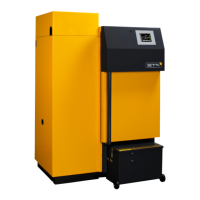
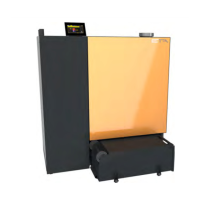
Boiler Heat-up time (hours)
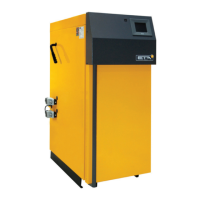
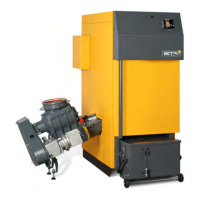
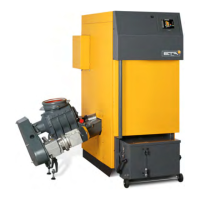
eHACK 20-80
ePE-K 60-80
1:30 h
eHACK 100-240
ePE-K 100-240
2:00 h
HACK 20-90
PE-K 32-90
1:15 hrs
HACK 110-130
PE-K 105-140
1:40 hrs
HACK 200
PE-K 180-220
2:00 h
Log boiler 1:30 h
TWIN pellet burner 1:35 h
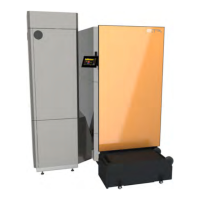
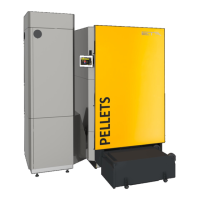
PelletsUnit
PelletsCompact 20-32
0:45 h
PelletsCompact 33-50 1:00 h
PelletsCompact 60-105 1:15 h
Boiler
Residual O2


 To Next Page