56 www.eta.co.at
[Heating circuit] function block ETAtouch controller
When should the heating curve be adjusted?
If the rooms are not warming up, you should check the
following points first before changing the heating curve
in the control system. Cold rooms are often not only
caused by an incorrectly set graph.
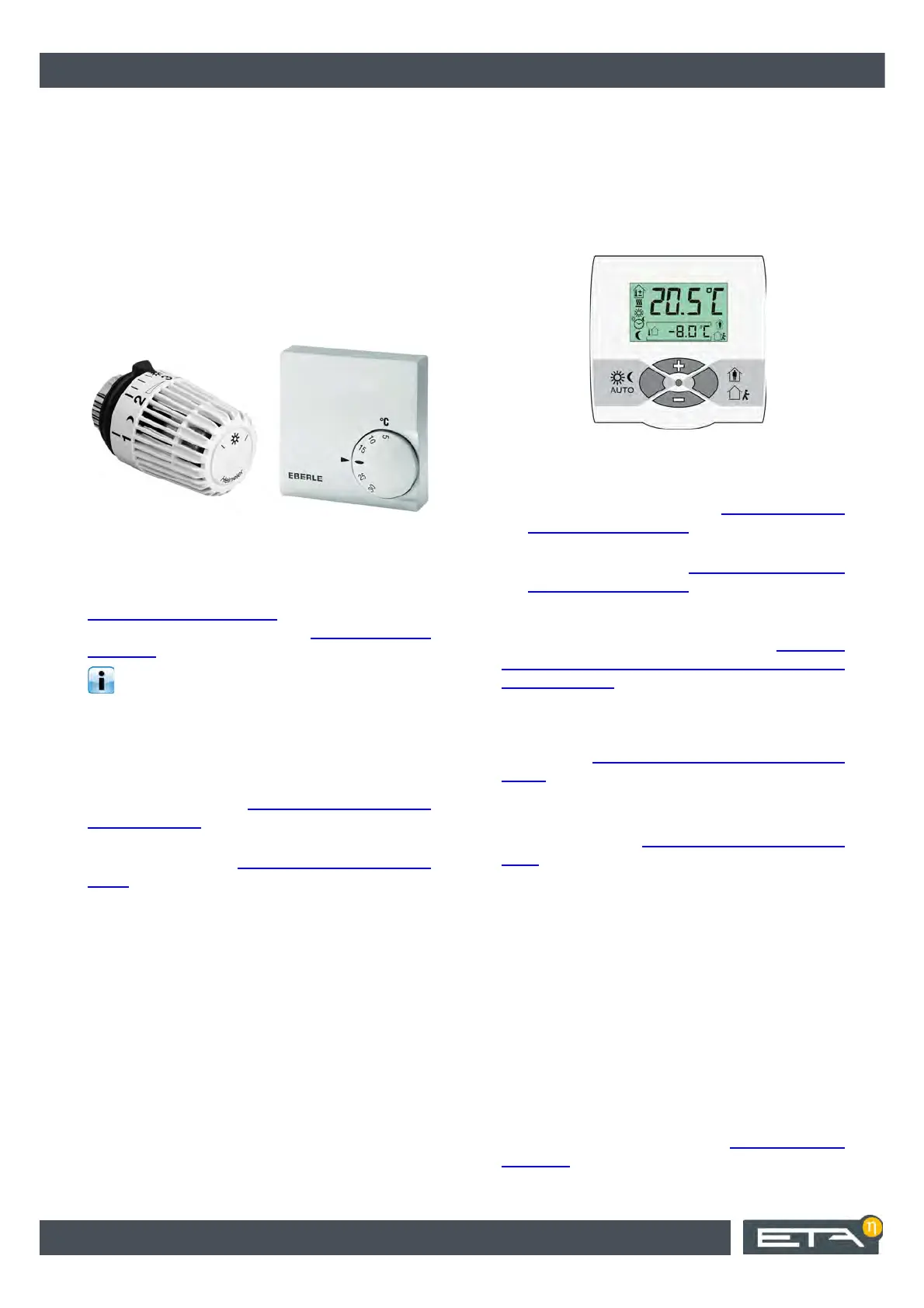
Rooms with radiator thermostats or room
thermostats
• Check the current setting of the radiator thermostat
or the room thermostat. If a room is not warm, open
the thermostat fully or increase the temperature
setting on the thermostat.
Fig. 7-61: Radiator thermostat and room thermostat
If the room is still not warm in heating mode (within
the preset heating times), the temperature slider in
the control system must be set higher (see chapter
7.6.1 "
Operating elements") or the heating curve
needs to be adjusted (see 7.6.1 "
Operating
elements").
If the room is too warm in heating mode,
leave the radiator thermostat and room
controller open, and instead lower the temperature
slide in the control system or the heating curve.
If the rooms are too warm or cold in reduced
operation mode (outside the heating times), only
the [Set-back difference] parameter needs to be
adjusted. See chapter Fig. 7-65: "
Adjust reduced
operation mode".
• Check the adjusted heating limits in the control
system, see chapter 7.6.3.2 "
Setting the heating
limits". Heating limits that are set too high or too
low can be the reason for rooms being too cold or
too warm.
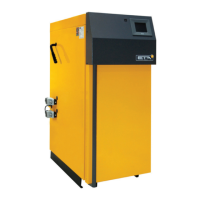
Check operating mode and target room
temperature on the ETA room sensor
• If a room is too cold, check the room sensor, or in
the control system set the operating mode and the
desired room temperature. It is possible that the
heating circuit has been switched off or the room
temperature is set too low.
Fig. 7-62: ETA room sensor
• Check the settings of the following parameters in
the text menu of the heating circuits:
–[Room effect], see chapter 7.6.4 "
Text menu -
Adjustable parameters"
–[Switch-on diff. room] and [Switch-off diff.
room] see chapter 7.6.4 "
Text menu -
Adjustable parameters"
• If during heating mode the rooms are constantly
too cold (within the set heating times), the heating
curve must be adjusted. See chapter Fig. 7-63:
"Adjust heating curve (at outdoor temperatures
above freezing)".
If the rooms are too cold in reduced-temperature
mode (outside the heating times), only the [Set-
back difference] parameter needs to be adjusted.
See chapter Fig. 7-65: "
Adjust reduced operation
mode".
Check the heating time settings
• Check the heating time settings in the control
system, see chapter 7.6.2 "
Setting the heating time
slots".
For heating systems with buffer storage, often
heating times that are too short are the reason for
insufficiently warm rooms. Short heating times
(less than 5 hours continuous heating) are particu-
larly ill-advised for underfloor heating because
such systems react very slowly.
Optimal operation is enabled with low feed tem-
peratures (=[Flow at +10 °C] and [Flow at -10 °C])
for the heating curve and long continuous heating
times (10-14 hours). Thus, the heat is transferred
evenly throughout the room. Therefore, it is
advisable (in heating systems with a buffer) to first
set a longer heating time and wait a few days. If the
rooms are then still too cold, the heating curve
must be adjusted. See chapter 7.6.1 "
Operating
elements".


 To Next Page