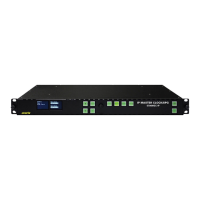
Model 5600ACO2 Automatic Changeover Unit
2.1.2. Balanced AES, DARS and Analog Audio Connections
DARS/AES/ANALOG: These 12 pin terminal strips are for connecting the balanced version of
the AES and DARS signals as well as two balanced analog audio signals. The output
cables can be secured into the removable portion of the terminal strips using a small
screwdriver. The removable part of the terminal strip is then inserted into the rear panel
and secured using the hold down screws. The pinout of these connectors is shown in
Table 2-1.
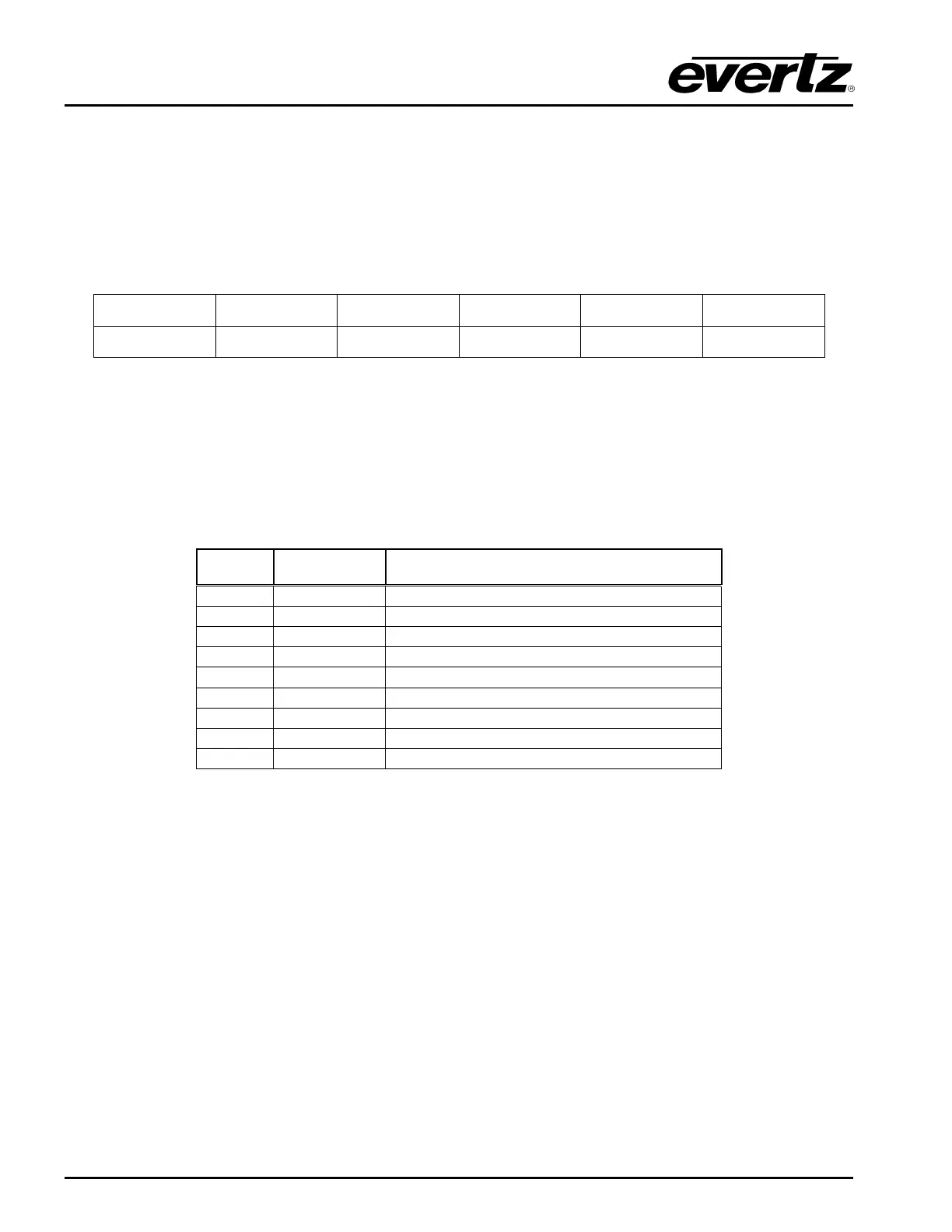
DARS OUT + GND AES OUT + GND LEFT + RIGHT +
DARS OUT - GND AES OUT - GND LEFT - RIGHT -
Table 2-1: DARS/AES/ANALOG Terminal Strip Pin Definitions
2.1.3. Linear Time Code, Parallel Remote Control and Auxiliary Connections
AUX I/O: These two 9 pin male ‘D’ connectors contain GPI inputs and outputs and two LTC
outputs from the 5600MSC units and should be connected to the AUX I/O Connectors
on the respective 5600MSC units using the straight through 9 pin cables provided. The
pinout of the AUX I/O connector is as follows:
Pin # Name Description
1 LTC1+ LTC 1 + output from 5600MSC.
2 GPO1 GPO 1 output from 5600MSC
3 LTC2+ LTC 2 + output from 5600MSC
4 GPI1 GPI 1 input from 5600MSC
5 GND Signal Ground.
6 GPI2 GPI 2 input from 5600MSC
7 GPO2 GPO 2 output from 5600MSC
8 LTC2- LTC 2 - output from 5600MSC
9 LTC1- LTC 1 – output from 5600MSC
Table 2-2: AUX I/O Pin Definitions
LTC 1 OUT, LTC 2 OUT: These two male XLR connectors provide the balanced LTC1 and LTC2
time code outputs from the changeover.
ACO CTRL/STATUS: The top row of the 12 pin terminal strip has two GPI inputs to control the
5600ACO2 and two GPI Outputs that provide tallies to indicate the status of the
5600ACO2.
MSC: The bottom row of the 12 pin terminal strip has the two GPI Outputs from the A and B
5600MSC units and a pair of GPI inputs that will be connected to both the A and B
5600MSC units.
The cables can be secured into the removable portion of the terminal strips using a small
screwdriver. The removable part of the terminal strip is then inserted into the rear panel
and secured using the hold down screws. The pinout of this connector is shown in
Table 2-3.
Page 2-2
Revision 1.3 INSTALLATION



 To Next Page