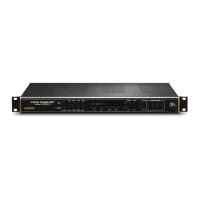
HD9084 HDTV Caption Encoder Manual
GLOSSARY Page 7-5
MODIFIED JULIAN DATE (MJD): The Modified Julian Date is a continuous count of the number of
days elapsed since 17 November 1858. It is often more useful than conventional
calendar dates for record keeping over long periods of time, since the MJD's of two
events can easily be subtracted to determine the time difference in days. Usually, the
MJD is specified as a number with 5 significant digits. As an example, the MJD for 1
January 1995 is 49718, meaning that this many days have elapsed between 17
November 1858 and 1 January 1995. The Modified Julian date is calculated by
subtracting 2400000.5 days from the Julian Date. Thus the Modified Julian Day 1
begins at Greenwich midnight.
LED: Light Emitting Diode.
LINEAR TIME CODE (LTC): A digital code used for timing and control purposes on videotape and
associated audiotape machines. It is recorded on a longitudinal track with audio
characteristics and is referred to as LTC (Sometimes this code is also referred to as
longitudinal code or SMPTE). Each 80 bit code word is associated with one television
frame, and consists of 26 time bits, 6 flag bits, 32 user bits and 16 sync bits. Date
information may be optionally encoded into the user bits. This code is often used for
distribution time of day information to station clock displays and automation systems.
The SMPTE 12M standard defines LTC.
PAC: Preamble Address Code. These codes are embedded into the line 21 caption data.
They define the caption text position on the screen, and set special features such as
colour, italics and underline.
PIXEL: The smallest distinguishable and resolvable area in a video image. A single point on
the screen. In digital video, a single sample of the picture. Derived from the words
picture element.
PSIP: Program and System Information Protocol, defined in ATSC A/65.
RESOLUTION: The number of bits (eight, ten, etc.) determines the resolution of the signal. Eight bits
is the minimum resolution for broadcast television signals.
SERIAL DIGITAL (SDI): Digital information that is transmitted in serial form. Often used informally
to refer to serial digital television signals.
STANDARD TIME: The civil time adopted for a country or region. (See also Daylight Saving Time)
TIME ZONE OFFSET: The difference in time between the local time and UTC
TRS: Timing reference signals used in composite digital systems. (It is four words long).
TRS-ID: Abbreviation for "Timing Reference Signal Identification". A reference signal used to
maintain timing in composite digital systems. (It is four words long.)
UNIVERSAL COORDINATED TIME
UNIVERSAL TIME, COORDINATED (UTC): Universal Coordinated Time (UTC) is an international time
standard that defines a time that doesn't depend on where we are on Earth. Universal
Time (UTC), Greenwich Mean Time (GMT), and Zulu Time (Z), are based at the prime
meridian (0° longitude) of Earth and are used to avoid confusion of time zones.


 To Next Page