139
ELECTRICAL AND IGNITION
TACHOMETER CIRCUIT TESTS
7
TACHOMETER CIRCUIT
TESTS
Check voltage at the battery. Use this reading as
a reference for battery voltage.
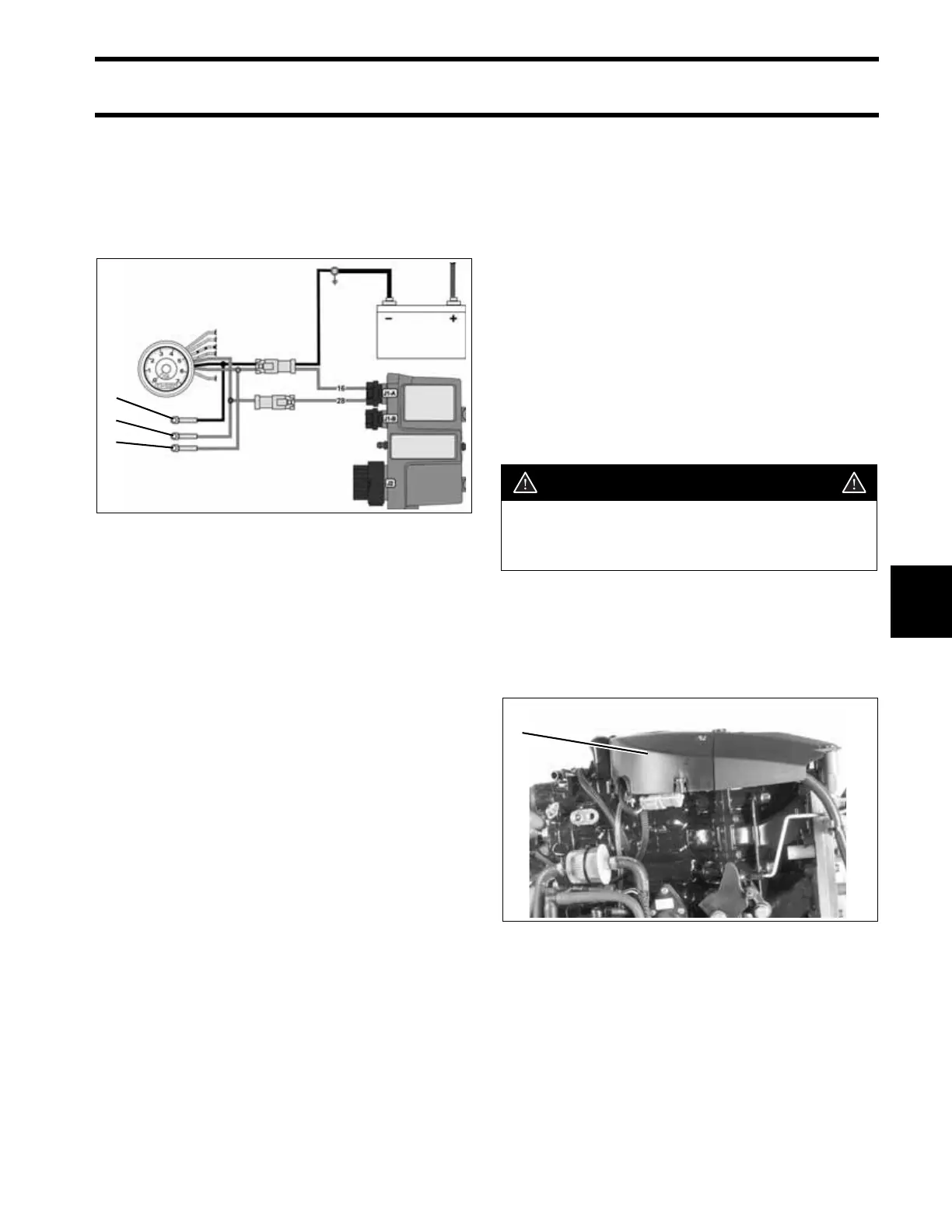
Connect the red meter lead to the tachometer pur-
ple wire and the black meter lead to the tachome-
ter black wire (key ON, outboard NOT running).
• If meter shows battery voltage, go to next step.
• If meter shows less than battery voltage, check
the purple, red/purple, and black wiring circuits;
fuse, key switch, and battery connections.
Disconnect gray and black wires at tachometer.
Set Fluke 29 Series II meter, or equivalent, to Hz
scale. Connect meter between gray wire and
black wire. With outboard running at 1000 RPM,
meter should indicate 90 to 105 Hz.
• If meter reads 90 to 105 Hz, replace tachome-
ter.
• If meter reads low or no signal, confirm output
on gray wire at pin 16 of EMM J1-A connector.
– Reading OK – Check condition of tachometer
circuit (gray wire). Repair as needed.
– Reading not OK – Check connection at EMM;
replace faulty EMM.
FLYWHEEL AND
STATOR SERVICING
IMPORTANT: Weak flywheel magnets can
cause low alternator output and affect outboard
performance. Weak flywheel magnets can also
cause low readings on ignition test equipment,
such as a peak-reading voltmeter, which might
cause unnecessary parts replacement.
An accurate test of alternator output can help
determine the flywheel’s condition. Refer to
CHARGING SYSTEM TESTS on p. 127.
Flywheel Removal
Remove the recoil starter assembly (rope start
models). Refer to RECOIL STARTER REMOVAL
on p. 311.
Remove the electrical cover from flywheel cover.
1. Purple lead
2. Black lead
3. Gray lead
006551
2
1
3
WARNING
To prevent accidental starting while ser-
vicing, disconnect the battery cables at
battery.
1. Electrical cover 002084
1





 To Next Page