Page 12 © Boule Medical AB, March 2018. Article no. 1504496
1. Introduction
Safety Instructions
Safety Instructions
Boule incorporates safety features within the analyzer in order to protect the operator from injury,
the analyzer from damage and the test results from inaccuracies.
Intended Use
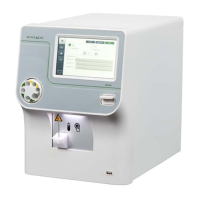
The Exigo H400 system is an automated hematology analyzer for in vitro diagnostic use under
laboratory conditions. The Exigo H400 is used for enumeration of white blood cells (WBC);
the absolute number and percentage concentration for granulocytes/neutrophils (GRA/NEU),
lymphocytes (LYM), monocytes (MON); eosinophils (EOS); red blood cells (RBC); hemoglobin
(HGB); mean cell volume of red cells (MCV); hematocrit (HCT); mean cell hemoglobin (MCH);
mean cell hemoglobin concentration (MCHC); red cell distribution relative and absolute widths
(RDW%, RDWa); platelets (PLT); and mean platelet volume (MPV) in K2EDTA and K3EDTA anti-
coagulated veterinary blood samples.
Operator Requirements
Operator must have basic laboratory skills and be aware of good laboratory practice.
Read user manual prior to use.
Analyzer Restrictions
Do not use the analyzer outdoors.
Do not modify the analyzer.
Do not remove the cover. (Authorized personnel only)
Do not use the analyzer for other purposes than described in this manual or by Boule technical
bulletin covering an application.
Do not spill liquids on the analyzer in such a way that it can leak through the analyzer casing.
Do not drop or place objects on the analyzer.
Do not use this device in close proximity to sources of strong electromagnetic radiation
(e.g. unshielded intentional RF sources), as these can interfere with the proper operation.
Do not use power supply other than supplied by Boule.
Limitations
Boule products do NOT make diagnoses on patients. Boule intends its diagnostic products
(systems, software and hardware) to be used to collect data reecting the patient’s hematological
status. This data, in conjunction with other diagnostic information and the evaluation of the
patient’s condition, can be used by a trained clinician to establish a patient’s diagnosis and to
dene clinical treatment.
Reagent Precautions
If a reagent comes in contact with eyes, rinse with running water for several minutes. If
symptoms occur seek medical attention.
If the reagent comes into contact with skin, wash aected area with water.
If swallowed, rinse out mouth. If persistent symptoms occur seek medical attention.


 To Next Page