Page 74 © Boule Medical AB, March 2018. Article no. 1504496
8. Technology
WBC Dierentials
WBC Dierentials
Floating Discriminator Technology
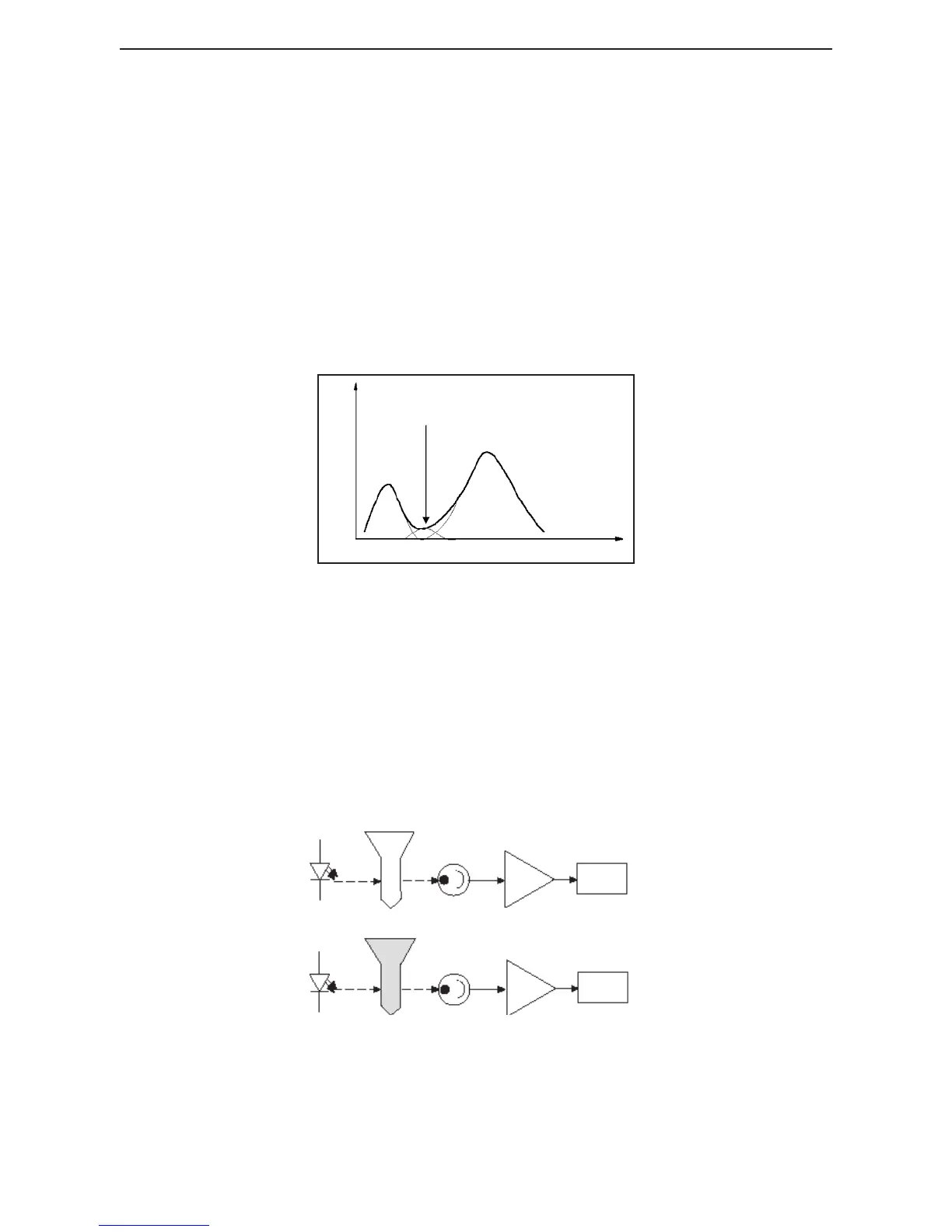
The Exigo H400 system uses a oating discriminator technology to estimate the best separation
between 3 populations of white blood cells (lymphocytes, granulocytes and mono-cell fractions).
After the analyzing process, the analyzer nds two main modes (Granulocyte Peak and Lymphocyte
Peak) within the total distribution. If no Lymphocyte mode is found the analyzer estimates one
from the available histogram. By extrapolating the two main populations a third population can be
mathematically calculated. This third population is classied as the mono-cell area, which mainly
consists of monocytes. See gure below:
MONO
n
Volume ()
LYM GRAN
Figure 117: WBC Dierential
Photometric Method – HGB Hemoglobin
The hemoglobin is determined from the same dilution as the WBC. For each sample a blank
is measured as a reference, this means that any drift in reagent, cuvette-absorption, or diode is
eliminated. The photometer system consists of a photodiode, a cuvette with a length of 15 mm and
a lter at a wavelength of 535 nm. The HGB readings are slightly corrected for turbidity in case of
extreme WBC counts. The diode is switched o if the instrument is in standby mode, giving it an
extended lifetime. See gure below.
Diode Cuvette
Sample
value
Blank
value
Photo cell Amplier Display
HGB140
HGB000
Figure 118: HGB method


 To Next Page