Page 34 © Boule Medical AB, March 2018. Article no. 1504496
4. Sample Collection
Handling of capillary blood samples
X Capillary Blood Sample Collection and Analysis
This section describes how to analyze capillary whole blood samples with the use of the Micro
Pipette Adapter (MPA). Only Boule supplied, plastic, high precision EDTA micropipettes should be
used when running MPA. Glass micropipettes can cause damage to analyzer if inserted incorrectly.
1 Choose Analysis Prole Select Analysis Prole to analyze blood in.
Note: The EOS parameter is not available through MPA mode.
2 Remove MPA adapter Remove MPA adapter from the analyzer by gently pulling the
handle. (The analyzer will give an instruction to put back the
loaded MPA adapter to start the analysis cycle).
3 Remove old micropipette Remove previous sample micropipette from the MPA adapter
(if applicable).
4 Place the MPA adapter on the table.
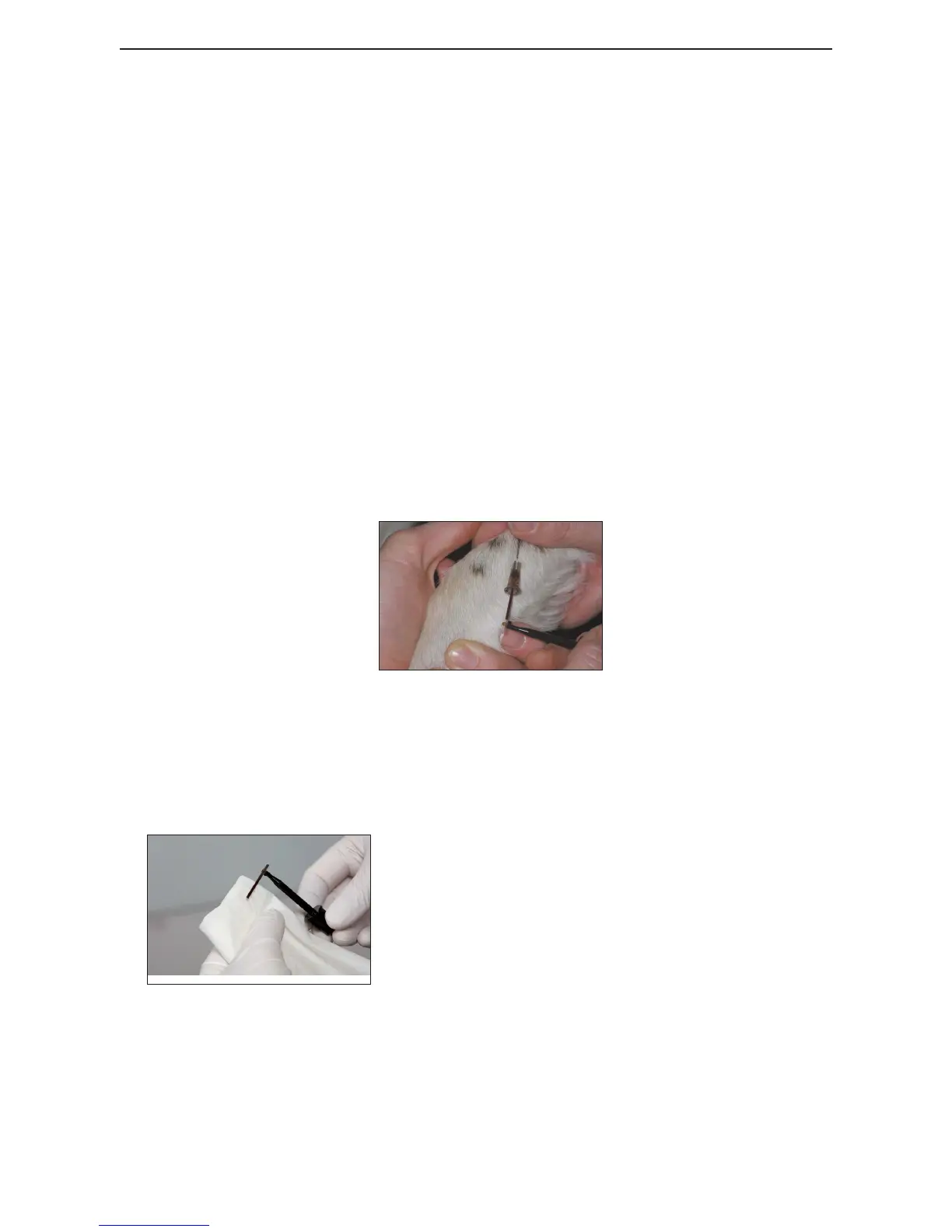
5 Perform the puncture Choose site for skin puncture and aspirate the sample as shown
below:
Figure 46: Capillary Blood Collection
6 It is important to perform a deep and rm puncture to
obtain free owing drops of blood, which decreases
incorrect or non-reproducible results.
Properly discard lancet per laboratory protocol.
7
Figure 47: Preparing micropipette
Use the micropipette holder to grasp a micropipette.
(Holding the micropipette towards one end or the other,
instead of in the middle, is best for lling and insertion.)
Aspirate the sample, holding the micropipette at a slightly
downward angle, for quickest ll.
Fill the micropipette completely with fresh whole blood and
wipe o excessive blood on the outside surface.
Be careful not to wick blood from open ends of the
micropipette.
Ignoring these instructions might cause incorrect and non-
reproducible results.
Dispose of all materials according to laboratory protocol.


 To Next Page