86 87
EN EN
889 5550
VI. Connecting electrical
devices and generator
load-capacity
y It is possible to connect electrical devices intended
for connection to standard mains power 230V~50Hz
power sockets.
• WARNING
y The generator must not be transported or moved to
adifferent location while it is running. Turn it off before
moving it.
y For powering electrical devices it is necessary to
respect the following conditions, otherwise the
powered electrical devices or the generator may
be damaged:
y The total nominal (operating) power input of all
the connected electrical devices must not exce-
ed the nominal (operation) electrical power out-
put of the generator. To determine the nominal
power input of an electrical device, it is possible
to use an affordable socket power input meter (a
wattmeter). The total power output of the gene-
rator is understood to mean the total drawn
power input of all the electrical appliances con-
nected to the generator for agiven power vol-
tage. The rated operating power output of the
generator is sufficient for powering the majority
of electrical devices -see later "Information
about power input of electrical devices".
y Turn on (start /put into operation) electrical
devices gradually one after the other with
atime interval in between and not all devices
at the same time. The large surge power input
caused by all the connected electrical devices
being turned on may cause avoltage spike and
damage the connected electrical devices.
y To be safe, it is better to connect sensitive
electrical devices such as computers, TVs, offi-
ce equipment, etc. via overvoltage protection.
Extension cords with sockets having overvol-
tage protection can be purchased in stores.
y The generator must not be concurrently used
for powering sensitive electrical devices (e.g.
computer, TV, office equipment) and an electri-
cal device with apower electric motor, which
has an impulse ramp-up (starting) power input
and fluctuating power input based on the
load placed on the electric motor such as for
example hand power tools, compressors, high-
-pressure washers, etc. since this may result in
"peak" voltage spikes (fluctuations), which may
damage sensitive electrical devices.
y In the event that the generator is used as abac-
kup electrical energy source for powering TN-C-S
(TN-C) networks (i.e. fixed electrical grids in
apartments, houses, etc.), the connection of the
generator must be performed only by an electri-
cian with the necessary qualifications, since it
must be put into balance with the IT network of
the generator with the TN-C-S (TN-C) grid. The
generator may be connected to aTN-C-S (TN-C)
grid only via an overvoltage protection that is
built into the TN-C-S (TN-C) grid. In the event of
damages resulting from non-professional con-
nection of the generator, the manufacturer of
the generator bears no responsibility.
y When using the generator as abackup el. power
source, start up the generator at least once
every two months to check its working order.
INFORMATION ABOUT POWER INPUT
OF ELECTRICAL DEVICES
• ATTENTION
y The power input specied on the rating label of the
electrical device containing an electric motor is, in the
case of most electrical devices, the expression of the
power of the electric motor, i.e. the load that the electric
motor can handle rather than expressing the power
input during standard method of use of the electrical
device, since the value of the power input increases with
the load placed on the electric motor.
Power electric motors in hand power tools have aramp
up input power, which is greater than the power input
when astandard load is applied to the electric motor,
however, most of the time it does not reach the power
input specied on the rating label of the electrical devi-
ce or in exceptional circumstances exceeds it by up to 30
%of the stated value. When astandard operating load is
applied to hand power tools, the power input is signi-
cantly below the value specied on the rating label.
y When selecting agenerator based on its electrical
power output, the deciding factor is the power input
value specied on the rating label of the electrical
device, the year of manufacture of the electrical
device and the type of electrical device and the
number of intended electrical devices that are to
be powered from the generator, since the power
inputs of the individual electrical devices are added
up. The deciding factor for the use of an electrical
device with apower input that is approaching the
electrical power output value of the generator
should be the soft start function on the electri-
cal device, which ensures aslower ramp up of the
electric motor and thereby reduces the current spike
that would otherwise not enable the given electrical
device to be used with the intended generator with
alower electrical power output.
y Before purchasing agenerator or connecting an
electrical device/s to the generator, to get agene-
• ATTENTION
y Norm ČSN 65 6500 stipulates that unless fuel is sto-
red in an enclosed air-tight, light-proof container at
atemperature of 10-20°C, the recommended period
for which the petrol is usable is 3months.
Petrol deteriorates, meaning that the most volatile
(ammable) components evaporate from the petrol and,
likewise, when ambient temperatures uctuate petrol
may be contaminated by condensating air moisture,
which based on the age of the petrol may result in pro-
blems with starting the engine, reduced power, increase
carbonisation of the spark plug, exhaust pipe, etc.
We recommend adding apetrol conditioner to
the petrol (petrol dewatering uid). It helps
agreat deal in the event of problems with
starting, improves the characteristics of the pet-
rol, extends the lifespan of the engine and reduces carboni-
sation of the exhaust pipe. Petrol conditioner can be purcha-
sed at fuel stations. Based on our experience, aproven con-
ditioner is from the Wynn' sbrand under the name DRY FUEL
from the Belgian manufacturer. When using the conditioner,
follow the instructions for its use that are provided on the
packaging of the product. Based on our experience, it is
sucient to add asmaller amount of conditioner to the pet-
rol than specied by the manufacturer, however it also de-
pends on the quality and age of the petrol, since the petrol
may be deteriorated already when sold at the fuel station.
Prior to using the petrol, allow the conditioner to act in the
petrol for 15-30 minutes. In the event that the conditioner is
added directly into the fuel tank of the generator, it is neces-
sary to stir the blend by appropriately moving the generator,
to enable the conditioner to act on the entire volume of
petrol and to wait 15-30 minutes before starting the engine.
Monitor the amount of petrol in the fuel tank using the
fuel level gauge.
Never pour petrol into the generator while it is running
and allow the generator to cool down before pouring it in.
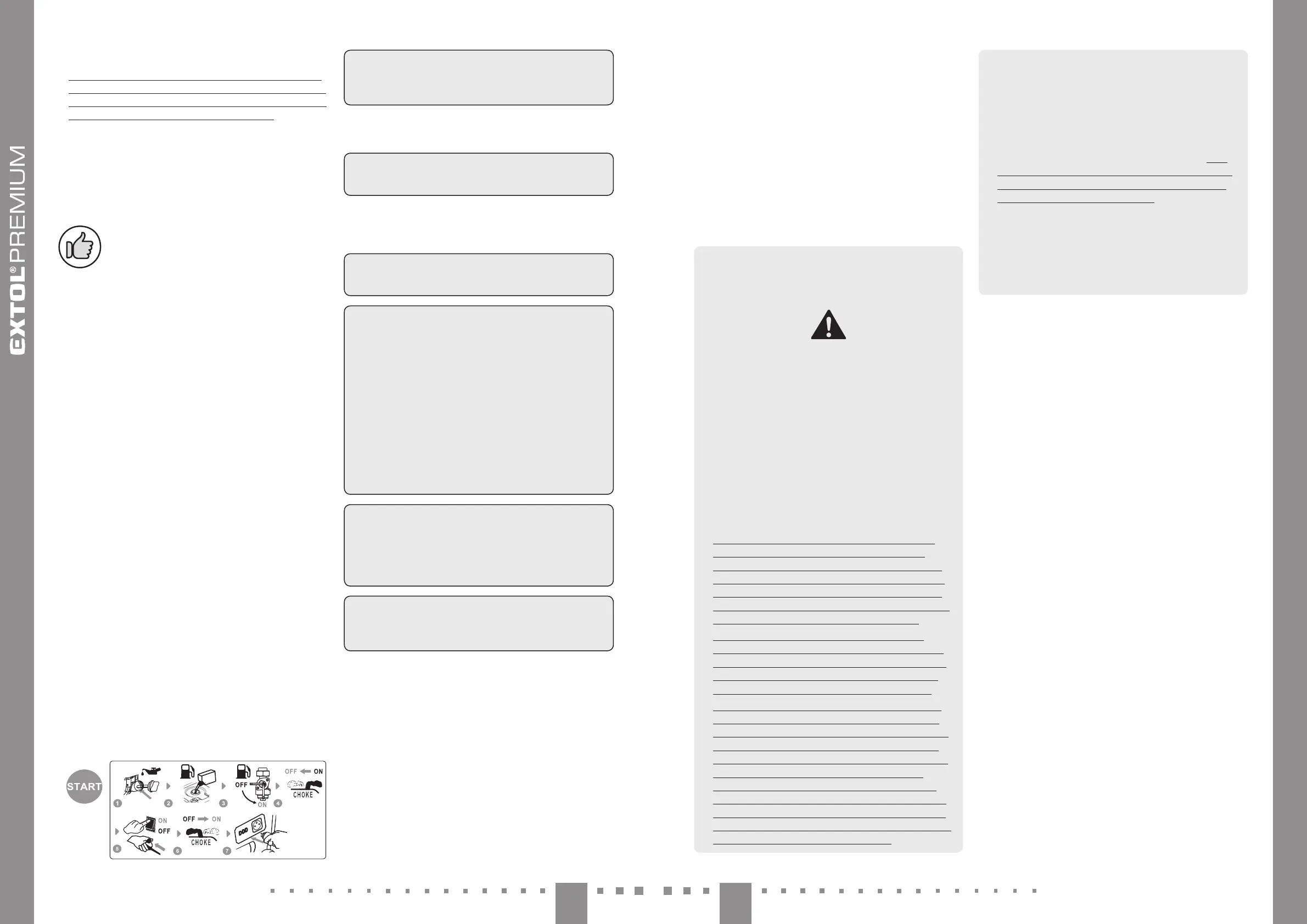
V. Starting
the generator
• WARNING
y Before starting up the generator, always check the gene-
rator for damage (unconnected wires, leaks in the fuel
system, missing safety elements and components, etc.).
Prior to using the generator for powering electrical devi-
ces, perform apreliminary test and make sure that there
are no faults. In this way you can prevent injury, damage
to the generator or the connected electrical devices.
1. Open the fuel supply into the carburettor by
turning the fuel valve lever (g. 4, position 2)
to the position of the "ON"symbol.
Wait afew moments before starting so that the petrol
can flow into the carburettor.
2. Set the choke lever (g. 4, position 4) to the "OFF"
position (see symbol on the label, g. 4, position 5).
y If the engine is sufficiently warm from previous operation
of the generator, it may not be necessary to set the choke
lever to the "OFF" position, but this must be tried out.
3. Set the power switch (g. 1, position 1) to the
"ON" position.
4. Gently partially pull out the starter pull cord (g.
4, position 1) and then pull on the pull cord slowly
afew time and return it to its initial position and
repeat the process several times so that the cylin-
ders move, which is important for the rst com-
missioning o the generator or if the generator
has not been used for an extended period of time.
Then gently partially pull out the pull cord and
then to start up the generator pull on it quic-
kly. Subsequently, holding the pull cord in your
hand, return it back to the original position, i.e.
by releasing it and allowing it to rapidly wind
on there is arisk of damaging the starter set.
5. After starting the engine, set the choke lever
(g. 4, position 4) to the "ON" position (see
symbol on the label, g. 4, position 5).
If the choke lever is not set to the "ON" position,
the engine will be throttled.
6. Insert the fork of the electrical devices into the
socket in accordance with the requirements in
chapter VI.
• WARNING
y The generator must not be transported or moved
to adifferent location while it is running. Turn it off
before moving it.
• ATTENTION
y In the event that there is an unusual noise, vibrations or
operation while the generator is running, immediately
turn off the generator and identify and rectify the cause
of this unusual operation. If the unusual operation is
caused by afault inside the device, have it repaired at
an authorised generator service centre for the HERON®
brand through the vendor or directly at an authorised
service centre (service locations are listed at the HERON®
generators website address at the start of this manual).


 To Next Page
 Loading...