94 95
EN EN
889 5550
SPARK PLUG FUNCTION TEST
• ATTENTION
y First ensure that there is no spilled petrol or other
flammable substances in the vicinity. When testing
functionality, use suitable protective gloves. When wor-
king without gloves there is arisk of injury by electrical
shock! Before removing the spark plug, make sure that
the spark plug is not hot!
1. Screw the spark plug out of the engine.
2. Seat the spark plug into the ignition connector ("cap").
3. Move the power switch to the "ON" position.
4. Hold the thread of the spark plug against the body
of the engine (e.g. on the cylinder head) and pull
on the handle of the pull starter.
5. If there is no sparking, replace the spark plug with
anew one. In the event that no sparking occurs
even with the new spark plug, it is necessary
arrange arepair at an authorised service centre.
If the sparking is in order, reinstall the spark plug
and continue starting the engine according to the
manual.
MALFUNCTION INDICATOR
Indicator Fig.1, position 9
lit/ashing red during overload or if there is no voltage in
the sockets (power supply malfunction).
Indicator Fig.1, position 10
lit red when there is insucient oil.
Indicator Fig.1, position 8
lit red when there is agenerator operation malfunction.
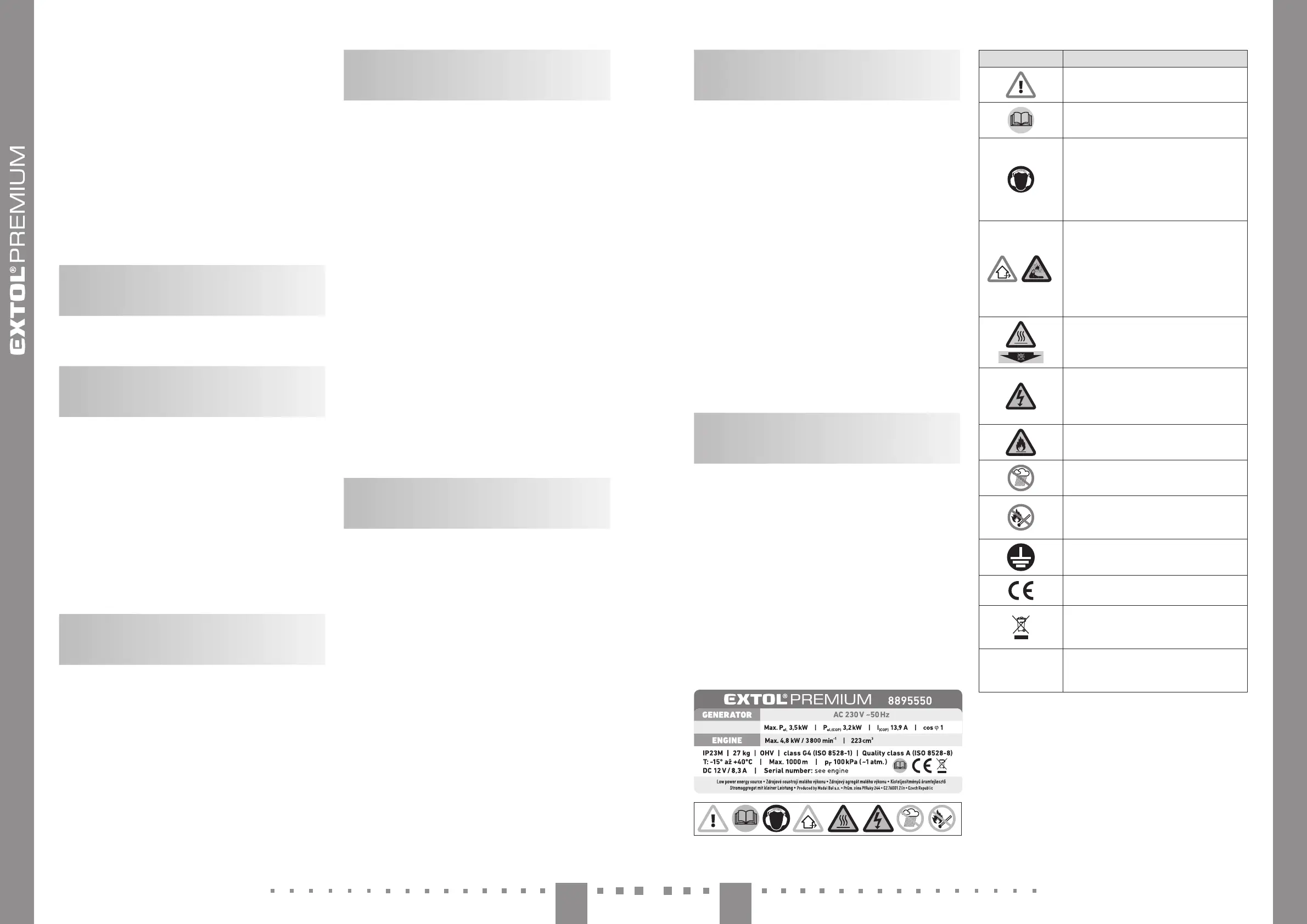
XII. Meaning of markings
and pictograms
y All technical parameters specified on the rating label
are provided in chapter II. Technical specifications.
Pictogram Meaning
Attention/Safety warnings.
Read the user's manual before opera-
ting the pressure cleaner.
When moving in the near vicinity of
the generator, the user and persons
in the vicinity must use certied ear
protection with asucient level of
protection. The eect of the noise may
induce irreversible hearing damage.
The pressure washer must not be
operated in indoor areas and in insu-
ciently ventilated environments, e.g. in
outdoor holes or trenches, etc., where
the exhaust gases are not suciently
ventilated. The exhaust gas is toxic.
Risk of poisoning by carbon monoxide.
Hot surface. Danger of burns.
Do not touch the hot surface.
Electrical hazard. Injury by electrical
shock due to an inappropriate met-
hod of use or ambient conditions with
respect to this fact.
Fire hazard. Never cover the generator.
Do not expose the generator to rain
and high humidity.
Prevent the access of any ame or spark
sources. Risk of ignition of ammable
fumes -particularly when relling fuel.
Grounding terminal.
It meets the respective EU
harmonisation legal directives.
Electrical equipment at the end of its
lifetime must not be thrown out into
communal waste, see below.
Serial
number (SN)
Serial number. Represents the year
and month of manufacture and pro-
duction batch designation
Table 3
• ATTENTION
y Hand the petrol with the dirty material from the
carburettor in an enclosed container to ahazardous
waste collection facility. Do no pour it down the
drain, on soil or throw it out with communal waste.
• ATTENTION
y The user can perform the carburettor purging operation
using the carburettor mud bolt themselves, however, any
work on the carburettor may only be performed by an
authorised generator service centre for the HERON® brand.
y The air-fuel ratio and the carburettor are set by the manu-
facturer and it is not permitted to make any changes to
these settings. Any amateur tampering with the carburet-
tor settings may result in serious damage to the engine.
CLEANING THE SETTING TANK
OF THE FUEL VALVE
y This may only be performed by an authorised generator
service centre for the HERON® brand.
MAINTENANCE OF THE EXHAUST
PIPE AND SPARK CATCHER
Leave the de-carbonisation of the exhaust and clea-
ning of the spark catcher to an authorised service cen-
tre for the Heron® brand.
X. Transport and storage
The engine and the exhaust pipe are very hot during
operation and remain hot for along time after the
generator is turned off, therefore, do not touch them.
To prevent burns during handling and combustion
hazards during storage, allow the generator to cool
down before handling and storing it.
TRANSPORTING THE GENERATOR
y Transport the generator exclusively in ahorizontal posi-
tion, suitably secured against movement and impacts in
the transportation area.
y Set the engine shut-off switch to the "OFF" position.
y The fuel supply valve must be closed and the fuel tank
lock must be firmly pulled tight.
y Never start up the generator during transport. Always
take the generator out of the vehicle prior to starting it.
y When transporting it in an enclosed vehicle, always keep
in mind that under strong solar radiation and ahigher
ambient temperature inside the vehicle, temperature
will increase extremely and there is arisk of combustion
or explosion of petrol fumes.
BEFORE STORING THE GENERATOR
FOR AN EXTENDED PERIOD OF TIME
y When storing it, ensure that the temperature does not
fall below -15° C or increase over 40°C.
y Protect it against direct sunlight.
y Drain all fuel from the fuel tank and fuel hoses, and
close the fuel valve.
y Purge the carburettor.
y Change the oil.
y Clean the external part of the engine.
y Screw out the spark plug and allow approx. 1teaspoon
of motor oil to flow into the cylinder, and then pull the
Pull cord of the manual starter 2-3 ×. This will create an
even protective oil film in the area of the cylinder. Then
screw the spark plug back in.
y Pull on the handle of the manual starter and stop the
piston in the top end position. In this way, the exhaust
and suction valve will remain closed.
y Place the generator into asafe dry room.
XI. Diagnostics
and troubleshooting
potential faults
ENGINE WILL NOT START
y Is the power switch in the "ON" position?
y Is the fuel valve for the supply of the given fuel open?
y Is there sufficient fuel in the tank?
y Is there asufficient amount of oil in the engine?
y Is the ignition cable connector connected to the
engine's spark plug?
y Is the spark plug generating aspark?
y Do you have old stale petrol in the fuel tank? (Add apet-
rol conditioner to the petrol and stir it in by moving the
generation or by pouring another portion of the fuel
over it and allow it to act, see fig. 5. chapter IV.)
If the engine still will not start, purge carburettor (see above).
If you are unable to remedy the fault, have the repairs per-
formed at an authorised generator service centre for the
HERON® brand.


 To Next Page