96 97
EN EN
889 5550
off the engine and wait for all parts to cool down
before refilling the tank.
y In the event of afuel spill, it must be dried up and the
fumes ventilated prior to starting the generator.
y Before starting the generator, the operator must be tho-
roughly acquainted with all of its control elements, and
namely then with the method in which the generator is
turned off as quickly as possible in an emergency situation.
y Do not allow anybody to operate the generator without
prior instruction. Prevent the equipment from being
operated by aperson that is physically or mentally unfit,
incapacitated under the influence of drugs, medication,
alcohol or exhausted. Prevent children from using the
generator and ensure that they do not play with it.
y The generator and particularly the engine and exhaust
pipe are very hot during operation and long thereafter
and may cause burns. Therefore, heed all warnings in
the form of symbols on the machine. All persons (chil-
dren in particular) and animals must therefore remain at
asafe distance from the equipment.
y Never operate the generator with wet hands. There is
adanger of injury by electrical shock.
y When present in the direct vicinity of the generator,
use hearing protection, otherwise irreparable hearing
damage may occur.
y In the event of agenerator fire, it must not be extin-
guished using water but rather with afire extinguisher
intended/suitable for extinguishing electrical installations.
y In the event that exhaust gases or fumes from afire are
inhaled, immediately contact adoctor and seek medical
treatment.
y In the interest of ensuring sufficient cooling of the gene-
rator, operate it at adistance of at least 1m from buil-
ding walls, other equipment or machines. Never place
any items on the generator.
y The generator must not be built into any structures.
y Do not connect other types of socket connectors to the
generator than those that correspond to valid norms and
for which the generator is also designed. Otherwise there
is arisk of injury by electrical shock or afire hazard. The
power cord (extension cord) of the used electrical devices
must conform to valid norms. Due to the large mechani-
cal stress placed on it, only use flexible rubber cables.
y The overload and short circuit protection of the generator
depends on specially adapted circuit breakers. In the event
that it is necessary to replace acircuit breaker, it must be
replaced with acircuit breaker with the same parameters
and characteristics. Replacement may only be performed
by an authorised service centre for the HERON® brand.
y Only connect electrical devices that are in perfect condi-
tion to the generator, that do not exhibit any functional
abnormalities. In the event that the electrical device is
exhibiting afault (it is sparking, running slowly, does not
start up, is excessively noisy, emitting smoke...) then turn
it off immediately, disconnect it and remedy the defect.
y The generator must not be operated in the rain, in wind,
in fog and at ahigh humidity, outside the temperature
range of -15° to +40°C. Attention, high humidity and
frost on the control panel may lead to ashort circuit and
death to the operator by electrical shock. The genera-
tor must be located underneath ashelter during rain.
Constantly protect the generator during use and storage
against humidity, dirt, corrosive effects, direct sunlight
and temperatures above 40°C and below -15°C.
y The generator must not be operated in an environment
with an explosive or flammable atmosphere or in an
environment with ahigh risk of fire or explosion.
y Never adjust the generator's parameters (e.g. adjusting
rpms, electronics, carburettor) and do not modify the
generator in any way, e.g. extend the exhaust pipe. All
the generator's parts may only be replaced with original
parts of the manufacturer, which are intended for the
given generator type. If the generator is not working
correctly, please contact an authorised service centre for
the HERON® brand.
y According to hygiene regulations, the generator must
not be used during the night-time calm period, i.e. from
10 p.m. to 6a.m.
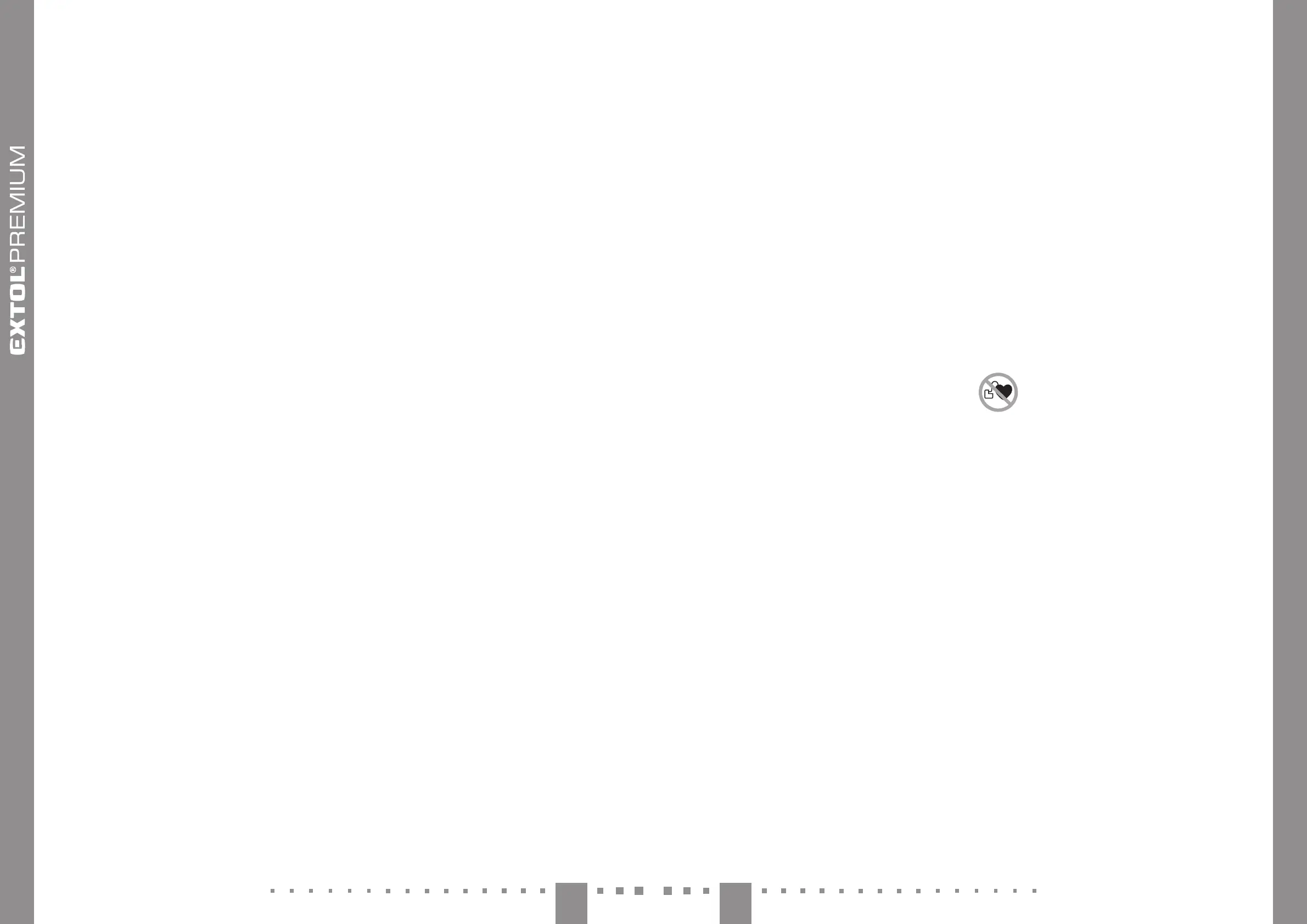
The operation of the generator generates an
electromagnetic eld during operation, which
may negatively aect the operation of active or
passive medical implants (pacemakers) and
threaten the life of the user. Prior to using this pressure
washer, ask adoctor or the manufacturer of the implant,
whether you may work with this compressor.
XIII. Safety instructions
for using the generator
Electrical generators may present risks that are not discer-
nible to amateurs and children in particular. Safe operation
is possible with asucient knowledge of the functions of
electrical generators.
a) Basic safety information
1) Protect children by ensuring that they remain at
asafe distance from electrical generator.
2) Fuel is flammable and ignites easily. Do not pour
fuel into the generator while the engine is running.
Do not pour fuel into the generator while smo-
king acigarette or in the vicinity of an open flame.
Prevent fuel from spilling.
3) Certain parts of combustion engines are hot and
may cause burns. Pay attention to warnings on
electrical generators.
4) Engine exhaust fumes are toxic. Do not use electri-
city generators in unventilated rooms. In the event
that electricity generators are located in unventi-
lated rooms, other fire and explosion prevention
requirements must be adhered to.
d) Electrical safety
1) Prior to using electricity generators and their
electrical equipment (including cables, power
sockets, etc.) they must be inspected to ensure that
they are not damaged.
2) This electricity generator must not be connected
to other power supply sources such as electrical
power grids. In special circumstances, where the
generator is intended to serve as astand-by backup
to existing electrical systems, such aconnection
must be performed only by aqualified electrician,
who must take into consideration the differences
between the operating equipment utilising the
public power grid and the operation of the electri-
city generator. In accordance with this part of norm
ISO8528 the differences must be specified in the
user's manual.
3) Protection against injury by electrical shock
depends on the circuit breakers that are specially
adapted to the electricity generator. In the event
that circuit breakers need to be replaced, then they
must be replaced with circuit breakers with identi-
cal parameters and performance characteristics.
4) Due to the significant mechanical strain placed on
them, only durable and flexible cables with rub-
ber insulation (meeting the requirements of norm
IEC60245-4) may be used.
5) If the electricity generator meets the requirements
of the protective function "protection by electri-
cal isolation" in accordance with annex B, B.5.2.1.1.
ENISO8528-13 grounding of generators is not neces-
sary (see paragraph grounding of the generator).
6) When using extension cords or mobile distribution
networks, the resistance value must not exceed
1.5Ω. The total length of cables with aconductor
cross-section of 1.5mm
2
must not exceed 60m.
With aconductor cross-section of 2.5mm
2
the len-
gth of the cable must not exceed 100m(with the
exception of cases, where the generator meets the
requirements of the protective function "protection
by electrical isolation" in accordance with annex B,
B.5.2.1.1. ENISO8528-13). Extension cords must be
unwound along their entire length for the purpose
of cooling by ambient air.
7) Selection of the protective arrangement, which
must be performed based on the characteristic of
the generator, operating conditions and the dia-
gram of grounded connections determined by the
user. These instructions and user's manual must
contain all the information necessary for the user
to be able to correctly perform these protective
measures (information about grounding, permitted
lengths of connecting cables, additional protection
devices, etc.).
• WARNING
y The user must adhere to the requirements of directives
related to electrical safety, which relate to the location
where the electricity generator is used.
y Never start the equipment in an enclosed or par-
tially closed area and under conditions of insuffi-
cient cooling and access to fresh air. Running the
generator in the vicinity of open windows or doors
is not permitted due to the inadequate extraction
of exhaust fumes. This also applies when using the
generator in trenches, shafts, outdoor holes, where
exhaust fumes fill up such areas because they are
denser than air and therefore are not well ventila-
ted out of such areas. This may result in poisoning
of persons working in these areas. Exhaust fumes
are poisonous and contain toxic carbon monoxide,
which is acolourless and odourless gas that may
result in loss of consciousness when inhaled and
possibly also death.
The safe operation of the generator in an enclosed
or apartially enclosed area must be assessed and
approved by respective government safety depart-
ments (re protection, extraction of fumes, noise
level, etc.), which are able to evaluate all the risks
set and evaluate all acceptable limit values of risk
factors, otherwise it is not permitted to operate the
engine in these areas.
y Petrol is flammable and poisonous, including its
vapours. Therefore, prevent fuel from coming into
contact with skin, breathing in vapours and ingesting
it. Handle petrol and refill the fuel tank in well venti-
lated areas to prevent inhaling petrol vapours. While
performing such tasks, use suitable protective aids to
prevent skin contact and potential spillage.
When handling petrol, do not smoke or handle an
open flame. Avoid contact with sources of radiant heat.
Do not refill petrol while the engine is running. Turn


 To Next Page
 Loading...