90 91
EN EN
889 5550
IX. Care and maintenance
1. Before commencing maintenance tasks, turn off
the engine and position it generator on arigid
horizontal surface.
2. Allow the generator to cool down before perfor-
ming maintenance (servicing) tasks.
• ATTENTION
y Only original spare parts of the manufacturer may
be used for repairs of the generator.
Regular inspections, maintenance, checks, audits and
adjustments in regular intervals are an essential prerequi-
site for ensuring safety and for achieving high performan-
ce of the generator. Table 2provides the plan of tasks that
must be performed in regular intervals by the operator
themselves and that may only be performed by an autho-
rised generator service centre for the HERON® brand.
To extend the lifetime of the generator, we recom-
mend that acomplete inspection is performed after
1200 hours of operation, including repairs, covering
the following tasks:
y the same tasks according to the maintenance plan
after every 200 hours and the following tasks that
may only be performed by an authorised generator
service centre for the Heron® brand:
y inspection of the crankshaft, piston rod and piston
y inspection of collector rings, carbon brushes of the
alternator or shaft bearings
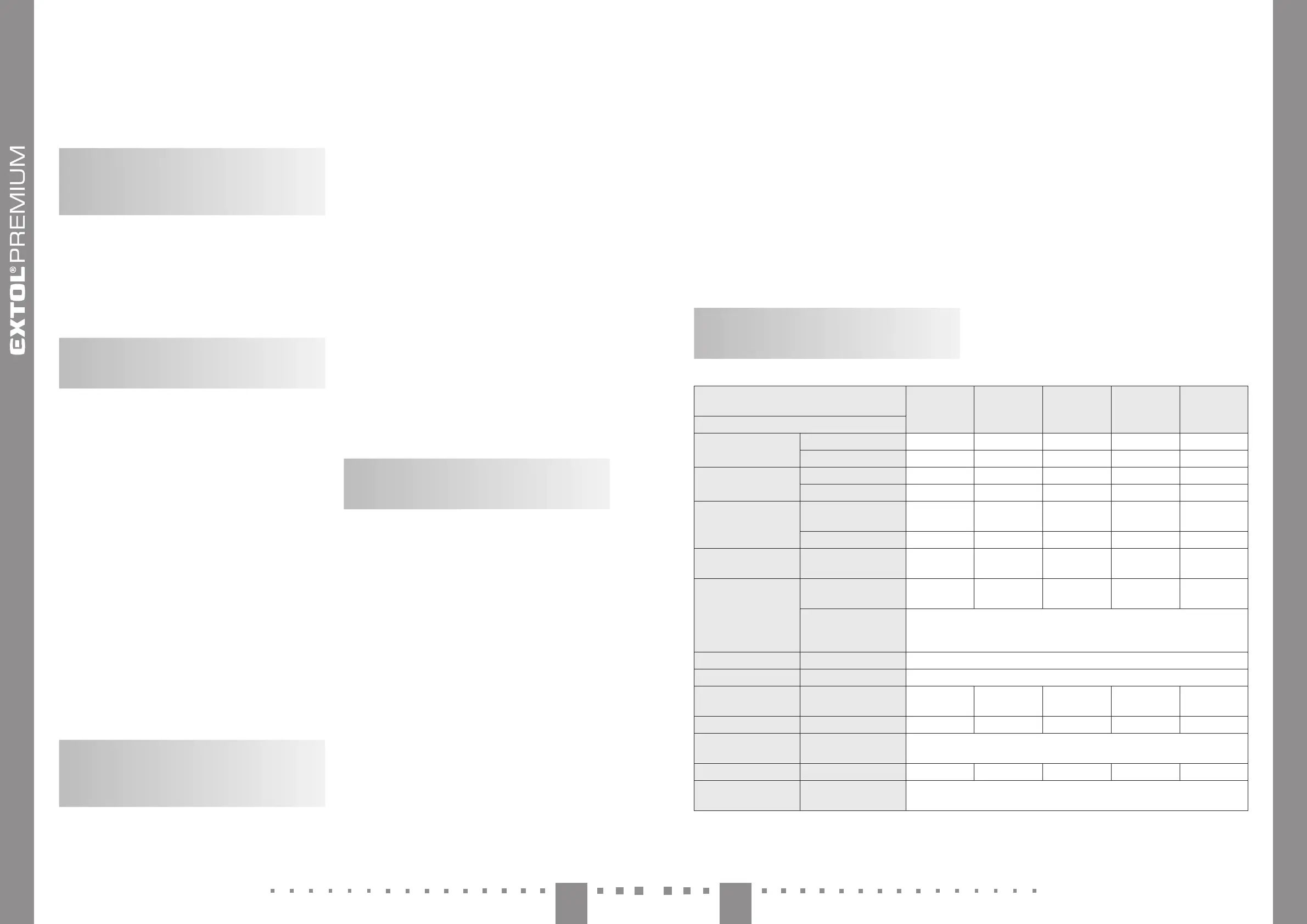
MAINTENANCE PLAN
• ATTENTION
y Not adhering to the servicing tasks in the main-
tenance intervals provided in table 2may lead to
amalfunction or damage of the generator, which is
not covered by the free warranty repair.
Always perform in the
here specied operating hour intervals
Before
every use
After rst
5hours of
operation
Every
50 oper.
hours
Every
100 oper.
hours
Every
300 oper.
hours
Maintenance task
Motor oil
Check condition X
Replacement X
(1)
X
Air lter
Check condition X
(2)
Cleaning X
(2)
Spark plug
Inspection,
adjustment
X
Replacement X
Valve movement
Inspection -
adjustment
X
(3)
Fuel line
Visual inspection
of tightness
X
(5)
Inspection
and replacement
if necessary
Every 2calendar years (replacement as necessary) X
(3)
Fuel tank sieve Cleaning After every 500 operating hours X
Fuel tank Cleaning After every 500 operating hours X
(3)
Carburettor -
setting tank
Draining via
setting tank screw
X
Carburettor Cleaning X
(3)
Combustion
chamber
Cleaning After every 500 operating hours X
(3)
Fuel valve Cleaning X
(3)
Electrical part
Inspection/
maintenance
Every 12 months from purchase X
(4)
Table 2
sensor will prevent the generator from starting up. The
presence of this sensor does not entitle the opera-
tor to omit regular checks of the amount of oil in
the engine's oil tank.
The oil sensor must not be removed from
the generator.
DIGITAL METER OF OUTPUT
VOLTAGE, FREQUENCY
AND OPERATION HOURS.
y The generator is equipped with adigital motor hours coun-
ter from the last start (the counter is automatically reset to
zero when the engine is turned off) as well as atotal motor
hours counter from the first start of the generator, the out-
put voltage and frequency, (see fig.1, position 2).
It is possible to use the button on the control panel to
switch between the individual measured values.
GROUNDING THE GENERATOR
y In terms of protection against dangerous contact voltage
on non-live parts, the generator meets the requirements
of the currently valid European Directive HD60364-4-4 for
protection by electrical isolation. The requirements of this
directive are entered into national electro-technical norms
of the given country (in the Czech Republic this is norm
ČSN33 2000- 4- 41 including valid annexes, if they exist).
y Norm ENISO8528-13, which species safety require-
ments for generators, requires that the user's manual of
the generator includes the information that the genera-
tor does not need to be grounded in the case where the
generator meets the aforementioned requirements for
protection by electrical isolation.
y The grounding terminal with which the generator is
equipped is used for unifying the protection between
the circuits of the generator and the connected electrical
device in the case where the connected electrical device
has Class I. protection or the electrical device is grounded,
where it is then also necessary to ground the generator
for the requirements of directive HD60364-4-4 (in the
Czech Republic it is norm ČSN332000-4-41) to be met.
Grounding must be performed using norm compliant
grounding devices and must be carried out by aperson
with the required professional qualications based on the
conditions where the generator is located and operated.
USING AN EXTENSION CORD
FOR CONNECTING ELECTRICAL
DEVICES TO THE GENERATOR
The load capacity of the cables depends on the
resistance of the conductor. The longer the cable used,
the greater must be the cross-section of the conductor
(wire/s). Due to electrical power losses, the greater the
length of acable, generally the lower is the operating
performance at its end.
According to norm ENISO8528-13, when using
extension cords or mobile distribution networks, the
resistance value must not exceed 1.5Ω. The total
length of cables with aconductor cross-section of
1.5mm
2
(for anominal current in the range >10A to
≤ 16A) must not exceed 60m. With aconductor cross-
-section of 2.5mm
2
(for anominal current in the range
> 16A to ≤25A) the length of the cable must not exce-
ed 100m(with the exception of cases, where the gene-
rator meets the requirements of protection by electri-
cal isolation in accordance with annex B(B.5.2.1.1.) of
norm ENISO8528-13.
According to the Czech norm ČSN 340350, the nominal
length of aflexible extension cable with awire cross-
-section of 1.0mm
2
Cu at anominal current of 10A
(2.3kW) must not be longer than 10m, an extensi-
on cable with acore cross-section of 1.5mm
2
Cu at
anominal current of 16A (3.68kW) must then be no
longer than 50m. According to this norm, the total
length of aflexible power cable including extension
cords should not exceed 50m(if, for example, this is an
extension cord with across-section of 2.5mm
2
Cu).
For reasons of cooling, the extension cord must not be
wound up or wound on to aspool, but must be fully
unwound along its entire length in order to be cooled
by the temperature of the ambient environment.
OPERATION AT HIGH ABOVE SEA
LEVEL ALTITUDES
y At ahigher above sea level altitude (above 1000m
a.s.l.) the fuel:air ratio changes in the carburettor
towards flooding with fuel (insufficient amount of
air). This results in reduced performance, increased
fuel consumption, carbonisation of the engine,
exhaust pipe, spark plug and more difficult starting.
Operation at high above sea level altitudes also
negatively affects exhaust fume emissions.
y In the event that you wish to operate the generator at
an altitude greater than 1,000 metres above sea level for
an extended period of time, have the carburettor read-
justed at an authorised generator service centre for the
HERON® brand.
Do not adjust the carburettor yourself!
• ATTENTION
y Even with the recommended readjustment of the
generator's carburettor, the performance nevertheless
declines by about 3.5 % per every 305m of above sea
level altitude. Without performing the above-described
readjustments, the loss in performance is even greater.
y When the generator is operated at an above sea level
altitude that is lower than for which the carburettor
is set, the carburettor has alower fuel mixture, which
again results in aloss in performance. Therefore, it is
necessary to readjust the carburettor.


 To Next Page